Panasonic LUMIX SHX1, Final Cut Pro 13 and AI Camera Mods: Studio Gear Roundup
The SHX1 pairs 6K capture with IBIS and external BRAW, while Final Cut Pro 13 adds MotionVFX tools and camera mods open new recording options.

Panasonic’s LUMIX SHX1 is a $4,698 full-frame box camera built around a tradeoff that shapes how it works on set: it has in-body image stabilization (IBIS), but no internal ND filter. In an interview, Panasonic’s Tsumura-san said the company had to choose between the two because they occupy the same area around the sensor; creators asked preferred IBIS. The camera also anchors a wider set of topics, from Final Cut Pro 13’s MotionVFX tools to community-developed firmware modifications for cameras from SIGMA, Sony and Nikon.

SHX1: a modular camera with external BRAW
The SHX1 may resemble a box version of Panasonic’s S1II, but its video workflow and body design give it a distinct role. It uses a partially stacked 6K full-frame sensor with an optical low-pass filter to reduce moiré. ProRes RAW records internally, while Blackmagic RAW (BRAW) currently records to an external SSD over USB-C. The camera also includes ARRI LogC3 at no added cost and supports 32-bit float audio recording in camera.

Johnnie, who tested the camera and spoke with Tsumura-san, sees the SHX1 as a significant return to the high-end cinema camera category for Panasonic, following the VariCam and EVA1. He also found less aggressive noise reduction in ProRes than on the S1II. The camera’s USB-C connections support accessories, and a V-mount battery plate suits production rigs. Tsumura-san said internal BRAW isn’t technically possible on this model yet, rather than a feature Panasonic deliberately withheld.

Choosing IBIS means crews need another way to manage exposure in bright conditions. The Tilta Mirage variable ND can be controlled through the camera menu, offering an external solution. Johnnie agrees with Panasonic’s choice of stabilization, while noting that the Sony BURANO combines IBIS and internal ND in a larger body.

The SHX1 can power an EVF or an external SSD over USB-C, but not both at once, and it has no built-in viewfinder. Its flexible monitor suits the camera’s modular form, though a viewfinder remains useful in direct sunlight. The system can expand with an XLR handle, a grip for Panasonic’s upcoming power zoom, and a live production unit that Johnnie likens to a highly capable PTZ setup. Vertical shooting is another part of the design, with anamorphic de-squeeze and stabilization intended to support that format.

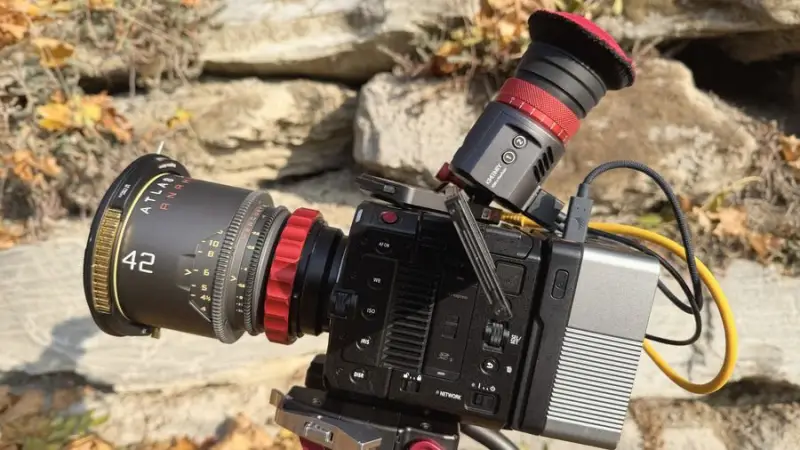
The body costs $4,698, or €4,403 excluding VAT at CVP. A kit with the handle and grip is $5,498, or €5,004 excluding VAT. For additional shooting in Japan, Johnnie recorded BRAW to an Angelbird card in a USB-C reader rather than an SSD. He shot his accompanying documentary on an Atlas Mercury 42mm 1.5x anamorphic lens, listed at $4,499 after a reduction from $7,499, and graded in fylm.ai after a pre-release DaVinci Resolve build would not install. The documentary follows Michelle, whose Korean family background and difficult early life are central to the film.

Lab results put rolling shutter in focus
Gunther tested a pre-production SHX1 after Panasonic said image processing was final. Rolling shutter is the main weakness in the measurements: at 5.8K ProRes RAW, it measured 26.2ms with Dynamic Range Boost (DRB) on and 12.2ms with DRB off. The S1II measured 27.5ms and 12.7ms in the same respective modes, while the Sony FX5 measured 13.3ms in dual gain.
Dynamic range was stronger. At ISO 1000 with DRB enabled, the SHX1 reached 13.2 stops at SNR 2 and 14.3 stops at SNR 1, close to the FX5’s 13.4 and 14.4 stops. In ProRes HQ, it measured 12.6 and 13.9 stops, with less aggressive noise reduction than the S1II. Exposure latitude remained usable to about 10 stops of push, with the image breaking at 11.
The results come from the same sensor used in the S1II, but processing affects the final image. One comparison raised in the discussion is the 1-inch LOFIC sensor in DJI’s Osmo Pocket 4P, which was described as outperforming these cameras in both dynamic range and rolling shutter. The next step many camera makers will be watching is whether LOFIC technology reaches full-frame sensors.
Final Cut Pro 13 adds a wider tool library
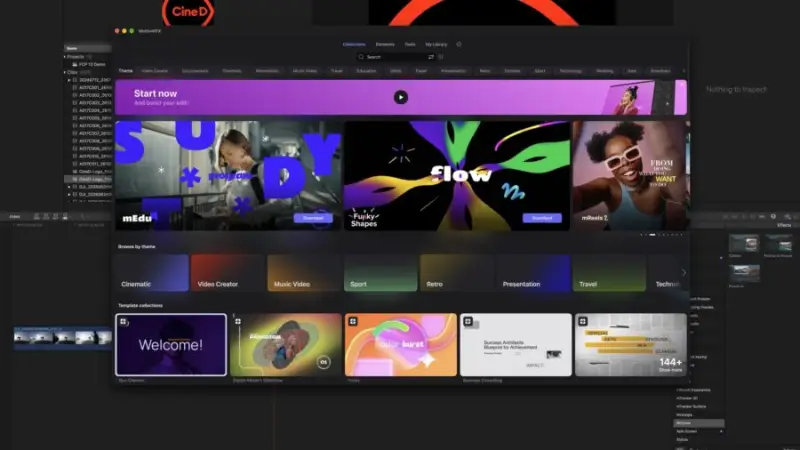
Final Cut Pro 13 is a free update for existing owners. Nino, who bought Final Cut Pro X more than a decade ago, is considering Apple Creator Studio for its integration of MotionVFX tools. The subscription costs $12.99 monthly or $129 annually and includes Pixelmator Pro, Motion and Compressor.
Subscribers get mRotoAI, mTracker Surface, mTracker 3D, mTracker 3D Area, mFlare 2, mFilmLook and mPuppet in the MotionVFX library; mUpscalerAI and mCaptionsAI are not included. MotionVFX’s CineStudio plan alone costs $29 per month or $348 per year. Apple’s Content Hub adds royalty-free stock video and still images, mostly in graded 4K rather than log formats.
Features available to all Final Cut Pro users include Natural Motion Blur, which analyzes footage to simulate the look of a slower shutter, plus a Disconnect Clips command for separating connected clips from the primary storyline. The update also brings horizontal and vertical split-screen presets, new keyframe easing and transcription support for 23 more languages, including German. Final Cut Pro and Motion also gain text-to-image generation. For editors already paying for motion graphics tools, the bundled library is the main reason to consider Creator Studio.
Camera mods add recording modes, with different levels of risk
AI tools have helped camera owners explore hidden settings and build modifications, recalling the Magic Lantern community around the Canon 5D Mark II. These projects vary in how deeply they alter a camera. Some load code from a memory card without writing to flash; others use service mode and can be reversed from a backup. Patching firmware carries the greatest risk and can leave a camera unusable. AI can speed up the search for settings, but it doesn’t confirm that a feature works reliably.
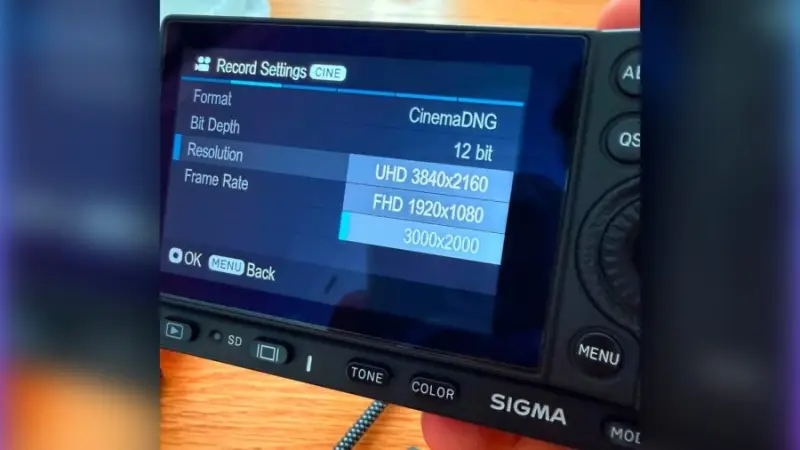
For the original SIGMA fp running firmware 5.02, fpSup loads from an AutoRun.txt file on an SD card and does not write to flash. It adds open-gate modes from OG2K through OG4K, including OG4K at 3840 × 2560. The two largest formats run at 23.98–29.97p, with recording in 12-bit. Data rates range from 98 MB/s for OG2K to 354 MB/s for OG4K, making an SSD necessary for the largest modes. The fpSup-Lossless option uses the camera’s hardware codec to reduce a 3K 12-bit frame from 9.1 MB to about 3.2 MB. Gyro data stored in each CinemaDNG frame can be used with Gyroflow. The mod supports the original fp, not the fp L.
A service-mode modification for the Sony a7 IV on firmware 6.02 enables shutter angle settings from 360° down to 5.6° through Sony’s USB service mode. It doesn’t replace firmware, though the camera’s dials can’t adjust the angle yet. Hidden Log Shooting code includes S-Log3, S709 and R709 LUTs, 16 user slots and .cube parsing. De-squeeze options at 1.3x and 2x are candidates but remain untested, and no open-gate mode has been found. With the a7 IV selling for about $2,000, these additions point to features Sony could consider supporting through its own menu system.
Nikon Z30 Wonder Lantern works by patching the owner’s C 1.20 firmware file on a computer. It raises 4K 24p, 25p and 30p bitrates from Nikon’s 144 Mbps to 168 Mbps in Balanced mode or 200 Mbps in High mode, the latter not yet confirmed on a camera. It also raises Full HD 60p bitrates, extends the slow-motion limit from 3 to 25 minutes, and adds photo zebras and a 5 GHz Wi-Fi option. Because it modifies firmware, it carries more risk than the card-loaded SIGMA or service-mode Sony approaches.
NikonFirmwarePatch 0.4.0 offers a much broader set of changes for the Z8 on firmware C 3.11. A camera already on C 3.12 may not be compatible. The patch adds 8.3K 3:2 open-gate N-RAW at 8256 × 5504 and 24, 25 or 30p, plus N-RAW Fine and Basic, ProRes 422, LT and Proxy, H.265 bitrate scaling, and S-Log3 and Log3G10 alongside N-Log. It also adds de-squeeze from 1.25x to 2x, RAW pre-release capture for stills and in-camera pixel shift up to 16512 × 11008.
Testing on real Z8 cameras remains limited, with unanswered questions about saturated blues and S-Log3 shadow behavior. That’s a reminder to treat feature lists as starting points: for production work, reliability and repeatable results matter as much as added formats. Panasonic’s next firmware capabilities and the camera-mod projects’ real-world behavior will be the details to watch.


