Sumi Jo Marks 40 Years on Stage with a Coloratura Recital in Singapore
At Esplanade Concert Hall, Sumi Jo paired dazzling coloratura with Korean art songs and chamber music in a recital marking 40 years since her European debut.

Sumi Jo’s Singapore recital turned a 40-year career milestone into a showcase of range: nimble coloratura, intimate art song and the theatrical instincts of a seasoned performer. At Esplanade Concert Hall on 15 November 2026, the South Korean soprano was joined by pianist Abigail Sin and guest instrumentalists for a programme that moved between opera, chamber music and Korean song.
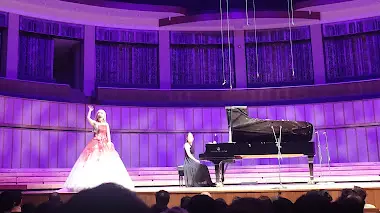

Presented by Altenburg Arts, the concert marked four decades since Jo’s professional debut in Europe. Its opening made the occasion’s focus plain: Julius Benedict’s The Gypsy and the Bird put her agility on display, with intricate runs and cadenzas delivered as part of a vivid stage performance rather than as vocal exercises in isolation. Sin’s piano provided the foundation for the recital’s shifts in scale and mood.
 |
| Photo: Ung Ruey Loon |
Opera arias, with chamber players in the mix
Two Italian arias brought contrasting kinds of dramatic weight. In Antonio Vivaldi’s Sposa, son disprezzata (“As a Bride, I Am Scorned”) from Bajazet, Jo shaped the music as a lament from a deserted wife. George Frideric Handel’s Lascia ch’io pianga (“Let Me Weep”) from Rinaldo expanded the texture, adding violinist Andrew Beer, violist Chan Yoong Han and cellist Cho Hang-oh to the vocal and piano partnership.
 |
| Photo: Ung Ruey Loon |
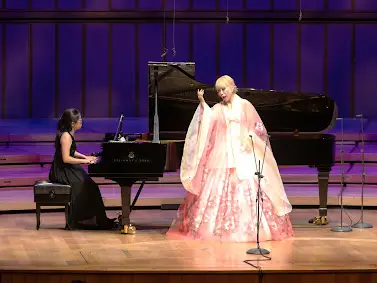
The instrumentalists had a more conspicuous role in Adolphe Adam’s Ah! Vous dirai-je, Maman from Le Toreador. Its familiar tune is widely known as “Twinkle, Twinkle, Little Star,” but the arrangement gave Beer a demanding solo line. He matched Jo’s variations closely, turning the number into a lively exchange between soprano and violin.
 |
| Photo: Ung Ruey Loon |
Costume changes gave the quartet room to make music on its own. The slow movement from Johannes Brahms’ Piano Quartet No. 3 in C minor, Op. 60, offered a quieter interlude. Cho’s cello solo was tenderly shaped, a reflective counterpoint to the opera’s heightened emotion and a reminder that the ensemble’s instrumental passages were central to the evening’s pacing.
Korean songs and a broader palette
After the interval, Jo appeared in a hanbok for three Korean art songs: Kim Dong-jin’s Azaleas, Lim Geung-su’s As Spring Comes Across the River and Lee Heung-ryeol’s Amidst Flower Clouds. Listeners who did not know the lyrics could still follow the expressive contours Jo gave each phrase. The change of repertoire and dress shifted the recital’s center of gravity from operatic display toward a more personal musical heritage.

 |
| Photo: LG Lim |
Wolfgang Korngold’s Lied from the Suite for two violins, cello and piano left hand, Op. 23, brought another chamber texture before Heitor Villa-Lobos’ Aria from Bachianas Brasileiras No. 5. The original scoring commonly uses eight cellos; here Cho and Sin took on the accompaniment together. Against that reduced arrangement, Jo moved between the piece’s familiar wordless vocalise and its Portuguese text, making the shift in vocal approach part of the performance’s appeal.
 |
| Photo: LG Lim |
A high point, then three encores
The final stretch returned to opera. Gaetano Donizetti’s Chacun le sait (“Everyone Knows It”) from La Fille du Régiment supplied a martial charge, while Vincenzo Bellini’s Casta Diva from Norma placed the spotlight on bel canto line and control. Jo was dissatisfied with the closing cadenza and asked for its final page to be repeated. The reprise landed with striking command in the upper register.
 |
| Photo: LG Lim |
Three encores made the ending generous and informal. Jo sang Michael Balfe’s I Dream I Dwelt in Marble Halls, then accompanied herself at the piano for the Korean air Arirang. For Giuseppe Verdi’s Brindisi (“Drinking Song”) from La Traviata, Singaporean tenor Jonathan Charles Tay joined her after being invited from the audience.

 |
| Photo: LG Lim |
Jo, now in her 60s, anchored the evening with the high notes that first made her name while giving the programme room for lyricism, Korean repertoire and chamber interplay. The recital’s strongest impression was that virtuosity still served the music’s character: a demanding cadenza could become theatre, and a familiar melody could open into a conversation between players. Four decades after her European debut, that balance remains her most persuasive calling card.
 |
| Photo: Ung Ruey Loon |
 |
| Photo: Pianomaniac |


