Dang Thai Son and Ewa Pobłocka Turn Piano Recital Into Dialogue; Julius Asal Plays “Last Words”
Dang Thai Son and Ewa Pobłocka move from solo Chopin to four-hand interplay, while Julius Asal traces final works by Schumann and Beethoven.

Two piano recitals in Singapore made different demands on the listener. At Esplanade Concert Hall on 7 November 2026, Dang Thai Son and Ewa Pobłocka built a programme around the shift from solo voice to shared performance. Four days later, at Victoria Concert Hall, Julius Asal shaped a more inward evening around music associated with endings. One recital opened its sound outward; the other asked how much a pianist can suggest through restraint.
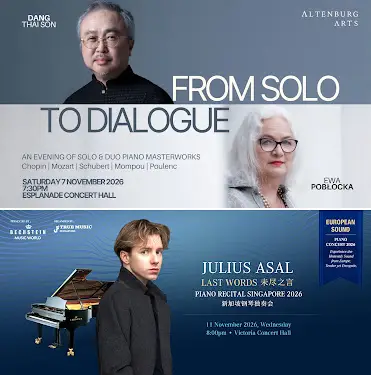
Dang Thai Son: colour before display
Dang’s standing in Chopin’s music carries particular weight: he became the first Asian pianist to win the Fryderyk Chopin International Piano Competition, in Warsaw in 1980. His opening set, though, began with Federico Mompou. In two contrasting preludes and “El Lago” (“The Lake”) from Paisajes (“Landscapes”), his measured pedalling and careful phrasing gave the short pieces room to resonate. Bell-like echoes in “El Lago” seemed to gather and fade, while “Cancion y Danza No. 8” let song and dance meet through shifts between major and minor. The effect rested on clarity rather than excess: the harmonies could speak plainly.

Photo: Ung Ruey Loon
Chopin brought a sharper edge. In the B-flat minor Nocturne (Op. 9 No. 1), Dang drew out the music’s melancholy; the C-sharp minor Polonaise (Op. 26 No. 1) answered with a more martial character. Across three Op. 50 Mazurkas, subtle changes of colour kept the dance pulse supple. He closed his solo portion with Scherzo No. 2 in B-flat minor (Op. 31), where abrupt dynamic contrasts gave the performance its most explosive moments. The sequence showed how force and delicacy can share a musical line without either being reduced to a mannerism.


Four hands, two pianos
When Pobłocka joined Dang, the recital’s centre of gravity changed. Mozart’s Sonata in D major (K. 381) and Schubert’s Rondo in D major (D. 608) put two players on one keyboard, where coordination has to be audible in every exchange. The Mozart brought buoyant energy; the Schubert offered a more gently humorous character. Their playing made give-and-take the point: each pianist could lead, answer or make space, and the music stayed conversational even when the parts grew busy.
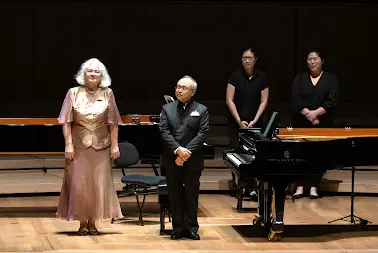


At two pianos, Chopin’s Rondo in C major (Op. 73) gave the players more room for filigree and lyrical exchange. The piece offered a glimpse of the composer’s early style, with virtuosity that remained tethered to melody. Poulenc shifted the mood again. His Elegie brought rich harmonies, while Capriccio après Le bal masqué leaned into the composer’s theatrical, cheeky side. The encore, L’embarquement pour Cythère, continued that playful spirit in waltz form. The change from one shared keyboard to two pianos expanded the space between the players, while the musical conversation remained intact.

Photo: Ung Ruey Loon
Julius Asal: a recital shaped by endings
Asal’s Last Words, presented by Bechstein Music World on 11 November, chose a quieter kind of intensity. The 29-year-old German pianist began with Robert Schumann’s Geistervariationen (“Ghost Variations”), the composer’s final completed work, written in 1854. Its theme and five variations received a restrained reading, marked by clarity and tenderness. Rather than treating the piece as a display of virtuosity, Asal let its subdued character set the terms for the evening.

Julius Asal explains the programme to the audience.
Without a pause, Schumann’s variations led into Beethoven’s final sonata, No. 32 in C minor (Op. 111). The first movement’s forceful declarations and sudden upheavals called for a pianist able to meet its challenges directly. Asal did so with assurance. In the second movement, the Arietta and its variations widened the scale of time: broad tempi and a composed touch carried the music towards its close. The contrast between the two works made their placement feel considered, allowing the listener to hear very different musical responses to finality.

Photo: Guan Ziwen
The evening’s Singapore premiere was Lera Auerbach’s Love Letters of Emma Hauck (2026), a 20-minute work inspired by letters written by Emma Hauck to her husband. Hauck, an artist, was committed to an asylum; the letters included the repeated words “Herzensschatzi, komm!” (“Darling, Come!”), set down in increasingly difficult-to-read script and never sent. Auerbach’s episodes follow a mind under strain, and Asal approached the piece with the seriousness its subject asks for. His performance drew the audience into its shifting emotional states without turning distress into spectacle.

Eight selections from Sergei Prokofiev’s Romeo and Juliet, transcribed by Asal and the composer, brought the programme back to pianistic force. Asal’s technique came to the foreground in “Romeo and Juliet at Parting” and “The Montagues and Capulets,” where the music’s dramatic contrasts could carry the weight of the ballet on a single instrument. Two encores softened the landing: Moritz Moszkowski’s Etude (Op. 72 No. 11), followed by Schumann’s “Of Foreign Lands and Peoples” from Scenes from Childhood.


Together, the recitals offered two useful models of pianistic communication. Dang and Pobłocka made listening between players part of the performance itself; Asal drew cohesion from a programme linked by music’s final statements. For listeners, the contrast is the takeaway: a piano recital can turn on the energy between two musicians, or on the patience one musician brings to a single line.


