Sony FX5 Netflix Approval Sets X-OCN LT, Dual Gain and Super 35 Limits
Netflix’s FX5 guide favors 16-bit X-OCN LT and Dual Gain, with clear frame rate, media and workflow limits—including a Super 35 resolution shortfall.
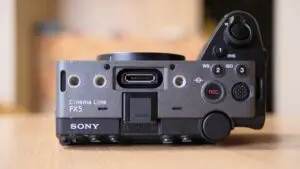
The Sony FX5 can now serve as a main camera on Netflix productions, provided crews follow the approved capture modes and settings. The accompanying six-page production guide puts 16-bit X-OCN LT at the center of the workflow, recommends Cine EI and Dual Gain at base ISO 800, and names XAVC S-I 4K as the internal video alternative. It also draws a firm line around the camera’s Super 35 mode: S35 3.2K is not recommended for primary capture.
The listing specifies 4992 x 3328 effective pixels and marks the FX5 for anamorphic capture. Sony announced the camera on July 22, 2026, and its European shipping date was later listed as November 16. Netflix requires at least 90% of a program’s final runtime to be captured on approved cameras following its requirements; it says that threshold may be more flexible for nonfiction work. For owner-operators and rental houses, the listing gives the FX5 a place on larger productions, while the guide’s mode-specific conditions determine how it can be used.
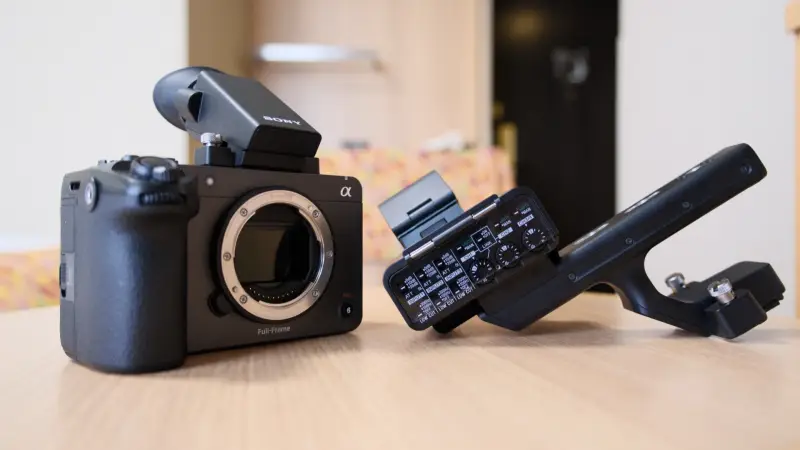
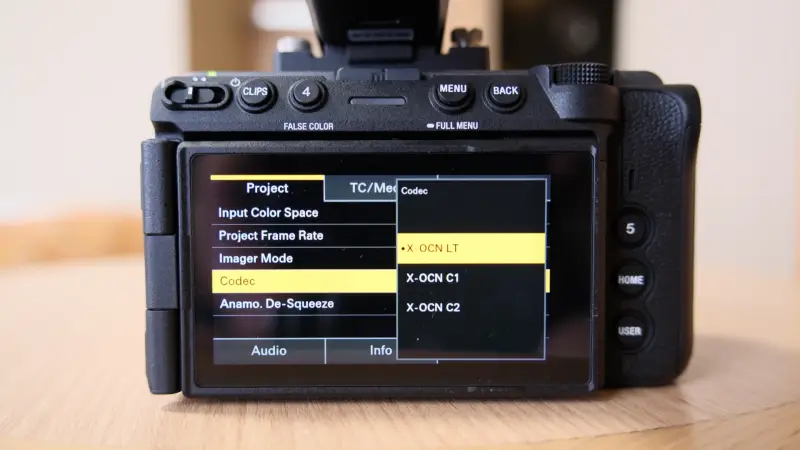
X-OCN LT is the preferred capture format
For RAW capture, Netflix specifies Cine EI with X-OCN LT. Its preferred imager setting is FF 5K 3:2 open gate at 4992 x 3328; FF 5K 17:9 and 16:9 are also listed when the production has agreed on those extractions. The guide sets 24 or 23.98 fps as the project rate to match the production, with 25, 29.97, 50 and 59.94 fps as alternatives.
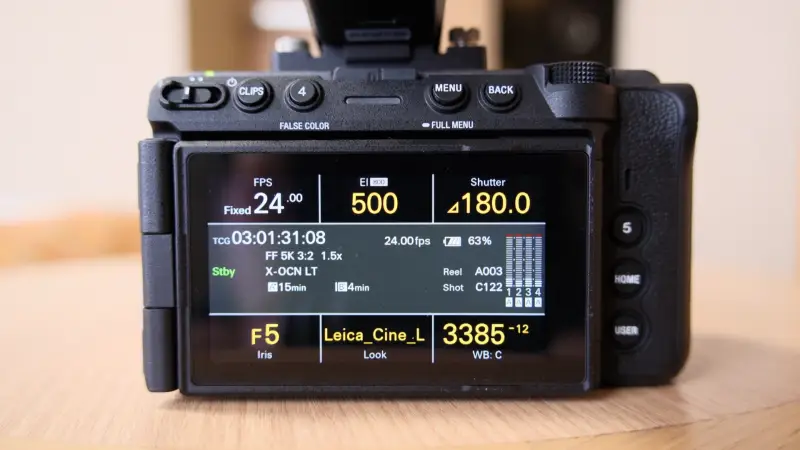
The recommended color settings are S-Gamut3.Cine/S-Log3, with S-Gamut3/S-Log3 as an alternative. Netflix favors base ISO 800 with Dual Gain enabled. The camera’s native ISO settings of 800, 4,000 and 12,800 without Dual Gain are alternatives. Because X-OCN is scene-linear RAW, crews need to validate their monitoring and post-production transforms; native FX5 X-OCN support arrived in DaVinci Resolve 21.0.4.
Sony’s X-OCN C1 is a fallback for situations where LT isn’t viable. The guide doesn’t list C2. At launch, C1 files were reported at about 80% of LT file size, while C2 files were about 75% of C1. Those smaller formats may help with storage, but LT remains the preferred choice in the production guide.
Dual Gain trades readout speed for dynamic range
Netflix strongly recommends Dual Gain whenever the chosen format and frame rate support it. The guide acknowledges a slower sensor readout, but says production testing found it within acceptable limits. The tradeoffs are practical: Dual Gain raises power consumption and caps recording at 30 fps in FF 5K 3:2, or 60 fps in FF 5K 17:9 and 16:9.
CineD’s lab measurements show the difference in 5K 17:9 X-OCN LT. Rolling shutter measured 13.3ms with Dual Gain on and 5.6ms with it off. Dynamic range rose from 10.6 / 12 stops to 13.4 / 14.4 stops at SNR = 2 / 1, a gain of about 2.5 stops. S-Log3 clipping code values stayed the same in both modes, so existing S-Log3 workflows don’t need a different clipping target.
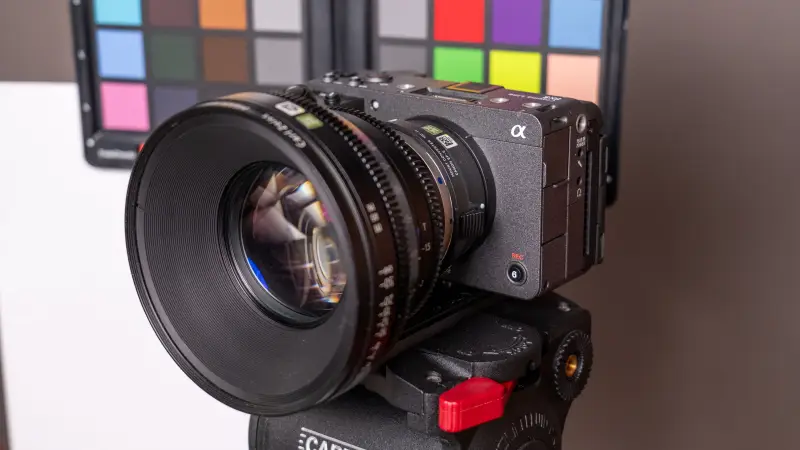
XAVC S-I, high speed and HDMI RAW
Crews avoiding RAW can use XAVC S-I: All-Intra, 10-bit 4:2:2, S-Log3, in Cine EI. FF 5K 17:9 records 4096 x 2160, while FF 5K 16:9 records 3840 x 2160. Bitrates are fixed by project rate: 240 Mb/s at 24 and 23.98 fps, 250 Mb/s at 25 fps, 300 Mb/s at 29.97 fps, 500 Mb/s at 50 fps, and 600 Mb/s at 59.94 fps. Choosing “High” doesn’t raise the 24p rate above 240 Mb/s.
UHD XAVC S-I isn’t available at a true 24.00 fps project rate. Netflix points crews to DCI 4K or an X-OCN mode for that rate. Long-GOP and 4:2:0 recording aren’t recommended, and in-camera noise suppression should remain off unless testing shows “Low” is needed.
For high-speed work, XAVC S-I in FF 5K 17:9 or 16:9 and FFc 4.5K reaches 120 fps through Variable FPS; Dual Gain limits that to 60 fps. X-OCN LT in FF 5K 17:9 or 16:9 supports fixed-rate recording up to a 59.94 fps project rate. Variable FPS records no audio, and starting variable-speed shooting cancels external timecode lock.
HDMI RAW uses FFc 4.5K at 4552 x 2400 or 4552 x 2560, rather than 5K open gate. Netflix asks productions to validate the recorder format, debayering and timecode with post-production. The guide doesn’t count the announced 5K 3:2 X-OCN at 120 fps or 4K at 240 fps as available modes. Sony has said firmware version 2, which is planned to add them, is expected in August 2027 or later.
Super 35 and anamorphic considerations
The FX5’s S35 3.2K mode reads 3264 x 1836 photosites and records 1920 x 1080. Netflix says that falls below its 3840-photosite spherical minimum, so it doesn’t recommend the mode for primary capture. The camera has no full 4K Super 35 crop. FFc 4.5K modes record 4096 x 2160 or 3840 x 2160 in XAVC S-I, but crop the full-frame sensor only slightly. Productions planning to use Super 35 lenses should account for the fact that the FX5 has no internal Super 35 image area meeting Netflix’s resolution floor; full-frame lenses are the safer choice for main capture.
Anamorphic approval depends on the complete setup. Productions need to select the scan mode, lens squeeze and extraction together, then check retained photosites with Netflix’s framing calculator. Open gate capture and a de-squeezed display alone don’t establish that a particular setup meets the requirements.
Stabilization, sync and media
For gentle handheld shots, the guide recommends SteadyShot “Standard”; for tripod work, it recommends “Off.” Active and Dynamic Active stabilization aren’t available in X-OCN, and stabilization is unavailable when Anamorphic De-Squeeze is set above 1.0x. For vehicles, drones and other high-vibration setups, Netflix points to a Sony hardware service that locks the sensor board. Availability in late 2026 was anticipated but unconfirmed.
For timecode, the specified connection is Sony’s VMC-BNCU1 adapter on USB PORT 2, with “USB Timecode” set to “On(PORT2),” Preset mode and Free Run. Keep the connection in place for about 10 seconds after lock. Sony notes that an offset of one frame and drift can occur without a reference, so the guide calls for checking sync against sound and slate, then re-jamming after a project-rate change or variable-speed recording.
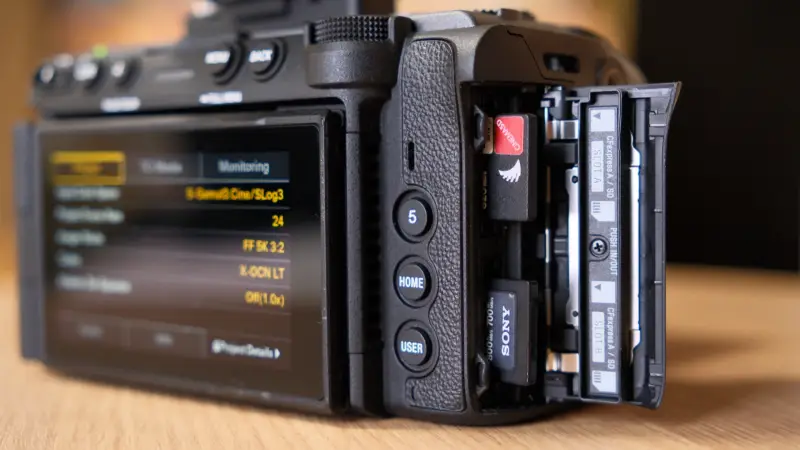
X-OCN requires VPG400-certified CFexpress Type A cards; SDXC and VPG200 cards don’t qualify. At normal frame rates, XAVC S-I can use SDXC V90 or qualified CFexpress Type A cards, while high-speed recording requires VPG400 cards. The guide also calls for a unique camera ID and reel number in clip names, and verified backups before cards are formatted.
Capacity, power and heat
Sony estimates that a 960GB CFexpress Type A VPG400 card holds about 174 minutes of X-OCN LT in FF 5K 3:2 at 24 or 23.98 fps, 139 minutes at 29.97 fps, and 69 minutes at 59.94 fps. In XAVC S-I 4K, the estimate is about 508 minutes at 24 fps DCI or 23.98 fps, and 205 minutes at 59.94 fps.
Sony’s battery estimates—about 170 minutes of continuous recording or 105 minutes in normal use—were measured in XAVC S-L, so they don’t establish runtime for X-OCN or Dual Gain. The operating range is 0 to 40°C (32 to 104°F), and Fan Control “Auto” is the recommended starting point. Since Dual Gain draws more power, crews should test a longest-take scenario with the actual camera rig and ambient conditions. The guide also notes that the FX5 menu layout closely follows Sony VENICE.
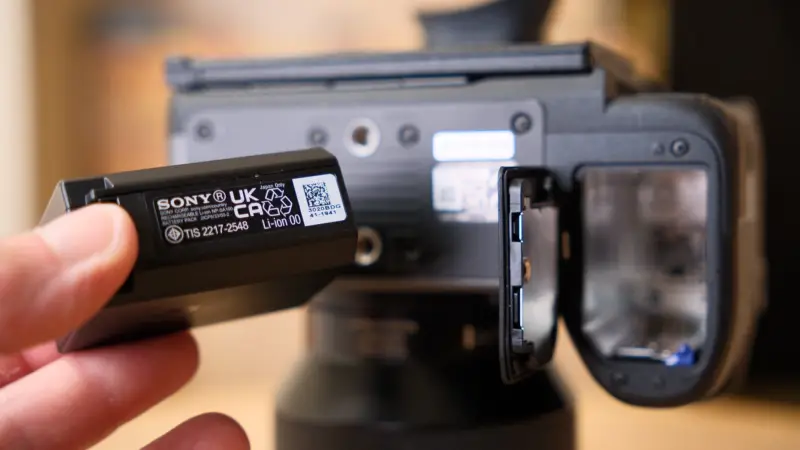
The FX5 body is listed at $4,898 at B&H, with the XLR handle unit kit at $5,498. CVP lists the body at €5,399 (€4,461.98 excluding VAT). For productions building around the camera, the settings guide makes the format choice and lens coverage part of the same planning decision: X-OCN LT with Dual Gain is the preferred path, while Super 35 coverage requires particular care.


