CISAC Reports €15.5 Billion in Creator Royalties as Audiovisual Streaming Collections Rise 32%
CISAC’s 2026 report puts global royalties at €15.5 billion, with audiovisual digital collections up 32% and total screenwriter and director collections at €762 million.

Screenwriters and directors collected €762 million in 2025, while digital royalties for audiovisual works climbed 32% to €142 million. Those figures sit within a record €15.5 billion in collections across creative fields, reported by CISAC’s Global Collections Report 2026. The headline growth is strong, but changes in reporting membership explain part of it; for film and television authors, the digital figures offer the clearest sign of where collection work is expanding.
CISAC represents 228 authors’ societies in 111 countries and territories. These collective management organizations license uses of creative works and distribute royalties to authors. France’s SACD, for example, represents screenwriters and directors. The report, released on November 4 in CISAC’s centenary year, covers 2025 collections across music, audiovisual, visual arts, literature and drama. Its figures are based on members’ gross domestic collections.
Record growth needs context
Collections rose 11.3% overall, but that comparison includes a new contributor: The Mechanical Licensing Collective, which collects mechanical royalties for songwriters in the United States from streaming and download services. The MLC accounts for about 52% of the annual increase. Excluding it, global collections grew 5.3%, following 6.4% growth in 2024. That remains a gain, though it gives a more measured picture than the headline rate.
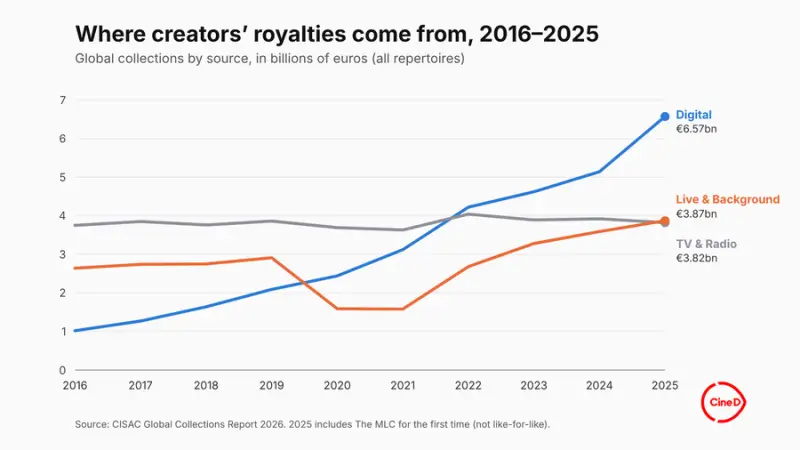
Digital collections reached €6.57 billion, up 27.9%, and represented 42.4% of the total. In 2016, the category stood at €1 billion. Live & Background, which includes concerts and festivals as well as music played in venues such as shops, restaurants, hotels and gyms, grew to €3.87 billion. It edged past TV & Radio, which declined 2.6% to €3.82 billion. TV and radio were still the largest source of creator income as recently as 2021.
The report cites Nielsen’s finding that streaming represented 48.6% of US television viewing in May 2026; YouTube alone reached 13.8%. The royalty rankings reflect a wider change in where audiences spend time. For creators, though, a shift in viewing habits only translates into income when licensing arrangements capture the uses and rights involved.
Audiovisual totals cross €750 million
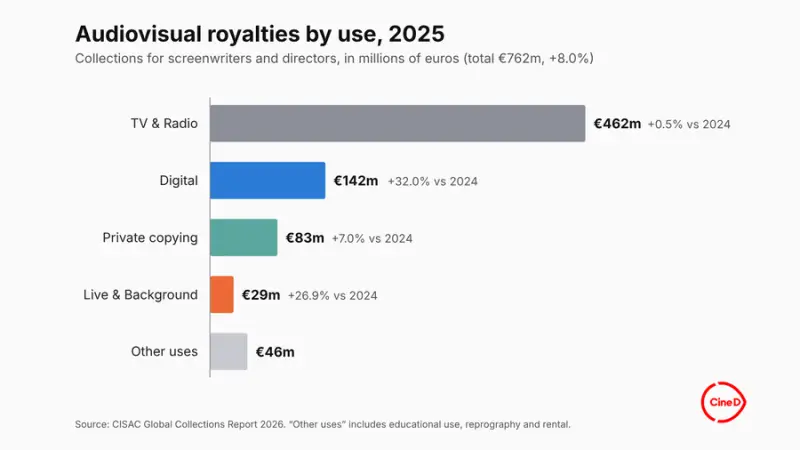
Collections for audiovisual works rose 8.0% to €762 million, marking a fourth consecutive annual increase. The total was 42.3% higher than in 2016. Europe accounted for 86.2% of collections worldwide, and France alone reported €273 million, more than one-third of the global figure.
Two societies contributed to CISAC’s audiovisual data for the first time: the Writers Guild of Japan and the Korea Television and Radio Writers Association. Their reported €64 million changes the year-on-year comparison. A calculation based on the report’s figures suggests that, without these additions, audiovisual collections would have been about 1% below 2024. CISAC does not publish a like-for-like comparison for this category, so that estimate points to a flat or declining year in established markets rather than proving a precise underlying rate.
TV & Radio remained the largest income source for audiovisual authors, at €462 million, or 60.7% of the total. That was a 0.5% increase. In France, however, TV & Radio collections fell 9.7%. CISAC attributes the decline to unusually high payments in 2024 and renegotiation of a joint licensing agreement with television distribution platforms.
Streaming royalties keep climbing
Digital collections for audiovisual works grew for a seventh straight year, rising 32.0% to €142 million. Japan supplied the largest single increase, with €30.2 million in new revenue. France represented 44.9% of digital audiovisual collections as SACD continued to sign and renegotiate distributor contracts. These included retroactive agreements with HBO Max covering 2024 to 2027 and with Paramount+ dating from 2022.
Uruguay recorded a first payment from Netflix to the society AGADU, the country’s first such collection for screenwriters and directors. SACD’s negotiations with TikTok, by contrast, had not produced terms it considered acceptable by November 2025; the society also said works it had asked to have removed remained available. The range of outcomes shows how uneven the licensing process remains across platforms and territories.
Futuresource estimates that consumers spent around $142 billion on subscription video services in 2025. That figure cannot be directly compared with the €142 million collected for audiovisual digital uses: the amounts cover different currencies, rights and territories. Still, the difference helps explain why authors’ societies are pressing to secure streaming agreements. A platform’s subscription revenue is not itself a measure of what creators are owed, but licensing terms determine whether their work generates a share.
Cinema recovers from its low point
Across all repertoires, cinema collections rose 5.3% in 2025, their highest level since 2019. They remained 10.2% below 2016. Gower Street Analytics puts the global box office at $33.6 billion for 2025, up 12%, and forecasts another rise in 2026.
Futuresource says original productions, familiar intellectual property and theatrical releases continue to attract streaming audiences. It points to Netflix and Apple TV+ as services that give selected films cinema runs before streaming. The report’s figures make the next comparison worth watching: a stronger box office does not automatically restore collections to their 2016 level, but sustained theatrical activity could support future growth.
Better music data could improve payments
Film and television composers have a practical stake in another development. In June 2026, CISAC introduced AVR+, a machine-readable cue-sheet format based on Global Cue Sheet Standard 2.0. Cue sheets identify the music used in a film or program. When those records are incomplete, societies can struggle to match a use to a work and distribute the associated royalties. AVR+ is intended to automate parts of that process and connect use data more directly to payments. It also identifies sound recordings, which can help performers and labels receive their share.
The report illustrates the scale of music use with Netflix’s KPop Demon Hunters: its soundtrack song “Golden” generated 2.43 billion on-demand audio streams worldwide in 2025. That example also shows why accurate identification matters across both publishing and recorded music.

Subscription growth is expected to slow
Futuresource expects global subscription video-on-demand spending to rise from around $142 billion in 2025 to $189 billion in 2030. Paid subscriptions are projected to increase from 2.2 billion to 2.6 billion. Yet annual spending growth is expected to ease from 14% in 2025 to low single digits by the end of the decade. In North America, 85% of households already subscribe to at least one service.
Platforms are also seeking more revenue from each subscriber. Across the 21 markets tracked by Futuresource, video revenue per user was 16% higher in 2025 than in 2022. Between 2025 and 2026, at least one global service raised the price of its ad-supported tier in 17 markets. Futuresource Principal Analyst Dave Watkins said: “The next phase of growth will be won not by acquiring new audiences, but by deepening the value of the ones platforms already have.”
Bundles with telecom companies and pay-TV operators can expand reach and reduce cancellations, while lowering revenue per user. If royalty payments depend on platform revenue, that trade-off may matter in future licensing talks. It’s a concern for authors’ societies as subscription growth matures and services look for other ways to increase income.
AI remains hard to measure in royalty data
AI features prominently in the report’s forewords, but the figures offer little direct evidence of its financial effect on audiovisual authors. CISAC President and ABBA co-founder Björn Ulvaeus wrote: “Human creativity is not the enemy of artificial intelligence. It is the reason artificial intelligence exists.” Director General Gadi Oron said the priority should be ensuring technology strengthens rather than erodes creators’ livelihoods. In June, CISAC’s General Assembly in Paris adopted the Paris Commitment, calling for human creativity to be recognized, protected and fairly paid.
The report’s clearest number concerns music uploads. Deezer reported that fully AI-generated tracks made up 34% of new tracks delivered to its service each day in November 2025, and more than half on peak days in June 2026. Those are upload counts, not listening or royalty figures. Oron said the first licenses between authors’ societies and AI developers had begun to appear.
No figure is provided for AI licensing income. Futuresource says the scale and direction of AI’s effect on collections remain difficult to assess. For film and television creators, the immediate question is how rights and payment systems will account for AI use as licensing develops. The next report may have more measurable data, but the 2026 figures leave that question open.
The CISAC Global Collections Report 2026 is available in English, French and Spanish from the CISAC report page. Its clearest takeaway for screenwriters and directors is that streaming collections are growing quickly, while the overall audiovisual increase depends in part on new reporting societies. Future comparisons will show whether digital gains spread across established markets and translate into broader growth.


