Nikon Raises Profit Forecast 50% as Camera Sales Plan Falls for Holiday Season
Nikon’s group profit outlook improves on stronger services and cost cuts, while lower camera and lens sales expectations weigh on the second half.

Nikon expects higher profit for its fiscal year, but the revised forecast points to a tougher holiday season for its camera business. The group’s operating profit estimate rose by 50%, while revenue fell by ¥10 billion from the plan issued in August. Nikon attributes the revenue reduction mainly to a lower second-half sales plan for cameras and lenses.
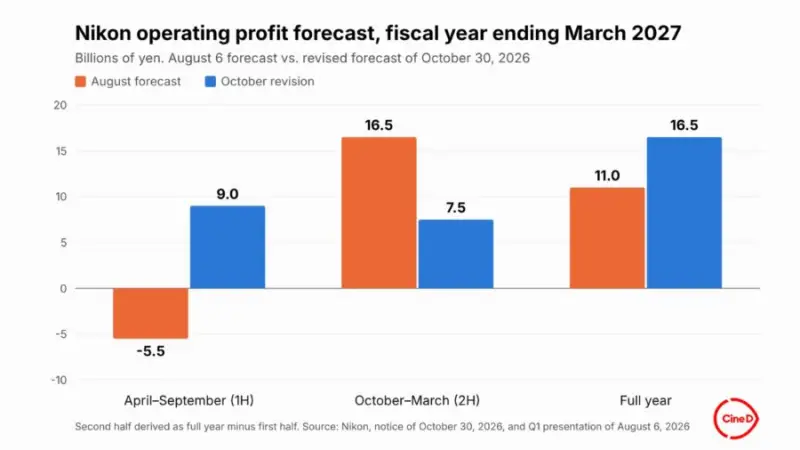
The company published its revised outlook on October 30, 2026, ahead of its full first-half results. Its fiscal year runs from April through March, so the forecast covers April 2026 to March 2027. Nikon now projects revenue of ¥722 billion and operating profit of ¥16.5 billion, up from ¥11.0 billion. Profit attributable to owners of the parent is forecast at ¥16.0 billion, a 60% increase. The company’s planning exchange rates are ¥155 to the dollar and ¥180 to the euro.
The rise in expected profit comes largely from the six months already completed. Nikon had previously expected an operating loss of ¥5.5 billion for April through September; it now anticipates operating profit of ¥9.0 billion. The company points to stronger service revenue in its semiconductor lithography business, refunds of US import tariffs, and lower costs after spending cuts and postponed expenses. Those factors help explain the group’s improved outlook, but they don’t signal a recovery in camera demand.
The second half carries the camera concern
Subtracting Nikon’s first-half expectations from its full-year forecast shows how much the second-half outlook has weakened. The company now expects October through March revenue of ¥387.5 billion, down from the ¥396.0 billion implied by its August plan. The second-half operating profit outlook falls from ¥16.5 billion to ¥7.5 billion.
That period includes the holiday selling season, typically an important stretch for camera makers. Nikon identifies its Imaging Products Business as the main source of the lower revenue forecast. Its revised outlook names Precision Equipment, Healthcare and Industry as divisions with improved profit expectations; Imaging Products is absent from that list. The forecast doesn’t include updated segment figures, so the scale of the imaging revision remains unclear until Nikon reports its results.
In August, Nikon had projected ¥290.0 billion in imaging revenue and ¥13.0 billion in operating profit for the full fiscal year. The profit estimate was already below the ¥17.2 billion recorded a year earlier. The company planned to sell 850,000 interchangeable lens cameras and 1.25 million lenses, while cutting its estimate for the total interchangeable lens camera market by 300,000 units, to 6.7 million. At the time, Nikon cited weak demand in China and rising memory costs. Those pressures remain relevant to the reduced second-half plan.

Group recovery and camera targets tell different stories
The broader company is recovering from a steep loss last fiscal year. Nikon recorded an operating loss of ¥112.4 billion, with ¥106.2 billion of that loss coming from its Digital Manufacturing Business, which includes metal 3D printing. Against that baseline, a return to operating profit would mark a significant improvement for the group. But the improvement is being driven by factors outside the camera business, so it offers little evidence on its own about the health of Nikon’s imaging sales.
The company’s May medium-term plan targets ¥360 billion in imaging revenue and ¥34 billion in imaging operating profit for the fiscal year ending in March 2028. Nikon has also identified a Z CINEMA series as part of its growth plans. A lower forecast for the current holiday half makes those targets harder to reach, though the revised group forecast doesn’t reveal how Nikon’s individual camera lines are performing.
That gap matters for filmmakers following Nikon’s cinema push. Nikon doesn’t report RED or its cinema cameras separately, leaving the ZR, KOMODO and V-RAPTOR folded into the wider imaging figures. The group numbers therefore can’t show whether cinema products are gaining traction or offsetting softer sales elsewhere. For camera buyers, the next useful details will be the segment results and any updated unit targets in Nikon’s full first-half reporting.
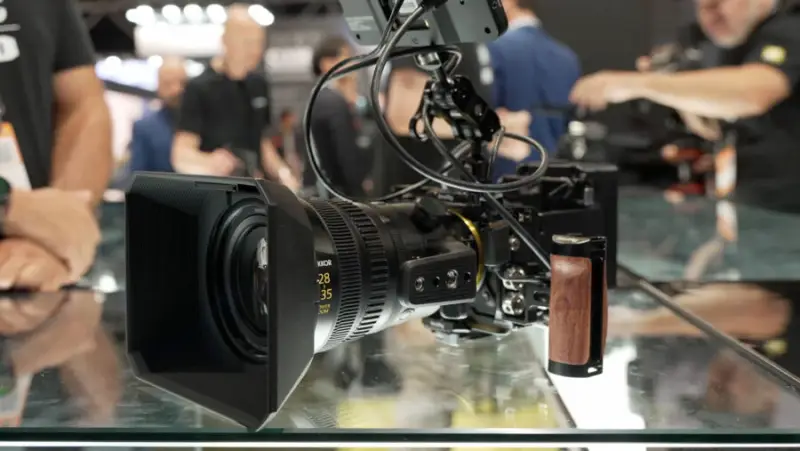
Products and ongoing support can shape camera sales alongside demand and component costs. Nikon ZR owners are still waiting for a major firmware update, and improvements to existing cameras could strengthen the system for users already invested in it. Nikon’s stated plans also put video at the center of its camera ambitions, with the Z CINEMA series still to come.
For now, the revised forecast sets up a clear split: stronger group profit on the back of services and cost reductions, alongside a lower sales plan for cameras and lenses during the fiscal year’s second half. Nikon’s upcoming imaging figures should show whether the August unit targets have changed and how far the current slowdown has shifted its path toward the 2028 goals.


