Jeff Mills and Tomorrow Comes The Harvest Make Room for Improvisation on The Forbidden Planet
Across improvised sessions and changing lineups, Mills and his collaborators bring electronic percussion into conversation with acoustic instruments.

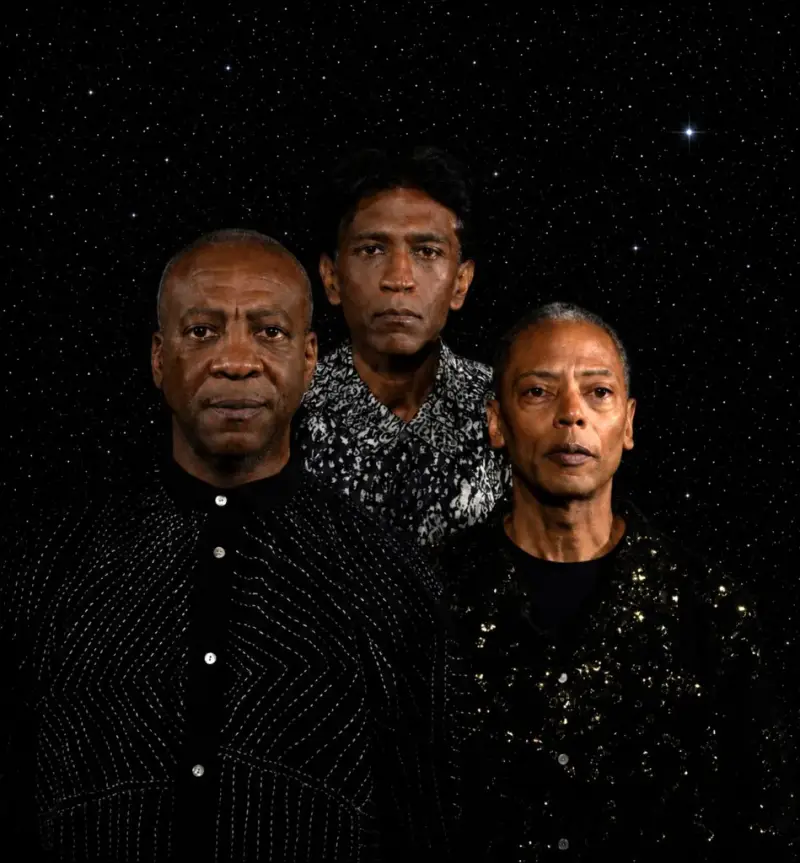
The Forbidden Planet treats electronic percussion as one voice in an ensemble. On the second album from Tomorrow Comes The Harvest, Jeff Mills, keyboardist Jean-Phi Dary and percussionist Prabhu Edouard work with flutist Rasheeda Ali to shape music through interaction, leaving space for ideas to develop instead of locking every part to a fixed electronic grid.
That approach gives Mills’ machines a different role from the one they often play in techno. His Roland TR-909 and electronic percussion supply rhythmic character, while tabla, keyboards and flute bring their own phrasing and textures. The result moves between electronic pulse and live improvisation without needing a firm border between the two.

Machines in the conversation
On the record, Mills’ electronic rhythms can point toward the club music that defined much of his career, but they don’t dictate every move. The musicians respond to one another, and the machines become part of that exchange. A beat can establish a direction, then yield to a keyboard phrase, a tabla pattern or a more open passage.
That balance is the album’s central idea. It doesn’t sound like acoustic music placed over a programmed track, or electronic production decorated with live instruments. Its character comes from the players shaping the same musical space together. Listening for the individual parts has its rewards, but the stronger impression is how the pieces interact.
The record asks for attention. Its changing rhythms and open arrangements don’t always follow familiar song structures, and the music’s momentum depends on details that can be easy to miss in the background. For listeners who want a fixed beat and clear verse-to-chorus turns, this may be a less direct experience. For anyone interested in how a group can hold a groove while letting it shift, the arrangements offer plenty to follow.
Improvisation, then editing
The music took shape over nearly two years, through sessions at Criteria Studios in Miami, Soda Sound and Studio Ferber in Paris. The accompanying notes describe recordings that began with improvisation, sometimes capturing performances with an almost single-take spontaneity. Mills and the other musicians later refined that material into the album’s finished compositions.
Improvisation here is a working method, not a claim that the record was simply captured without decisions afterward. A musical idea might begin with one player, draw a response from another and change direction before the group settles on a form. Mills says he looks for a point where the musicians have said all they want to say musically. If the sounds connect comfortably on playback, he considers whether the moment has the shape of a finished piece.
He also describes the editing process as guided by feel. The initial aim is to alter the recordings as little as possible, but he listens repeatedly to make sure the result doesn’t become uncomfortable. That review can take weeks or months. The production choice, then, is not simply to preserve every spontaneous moment; it’s to retain the character of the performance while deciding what belongs in the final version.
Studio Ferber has a familiar, warm setting for Mills, who has worked there on other projects. He recalls Criteria for its history as a successful recording studio and says the room’s past was palpable during the sessions. Even so, he credits the musicians as the main force behind the album’s direction.
Different lineups, shifting arrangements
The album’s personnel change from track to track. “The Shadow Knows,” “Superstar” and “Five Shades of Gray” feature Mills, Dary, Edouard and Ali. “The Key of Life” and “New Harmony” use a lineup of Mills, Dary and Ali, while bassist Laurent Vernerey joins “Say No More.” Those combinations give the music different options for building rhythm and atmosphere.
Across the record, the arrangements move between rhythmic intensity and more spacious passages. The shifts help keep the album from settling into one texture for too long. Rather than relying on a conventional song format to mark each turn, the group uses changes in instrumentation, density and interplay to keep the music in motion.
The different configurations also make the album’s group identity feel flexible. The core project has a defined membership, but a piece can take shape around a smaller combination of players or add another instrumental voice. That makes the record a series of related encounters, with each arrangement testing a slightly different balance between pulse and open space.
Listening formats and the live set
The Forbidden Planet is available as a double vinyl set, a CD/DVD edition and a digital release. The extended CD includes “Natural High,” “Stellar Landscape,” alternate versions of “Say No More” and “The Happening.” For listeners who want to hear more versions of the group’s ideas, that edition adds material beyond the main album and includes a filmed performance.
The double LP offers a focused way to hear the record as its sides unfold. A turntable makes the listener choose when to turn the record and gives each side a natural stopping point; that suits music built around sustained interplay. The CD/DVD edition has a different practical appeal: the additional tracks broaden the listening, while the video offers a view of how the players work together.
The DVD captures Tomorrow Comes The Harvest at London’s Jazz Café on September 27, 2025. It includes performances of “Transcendence” and “Event Horizon,” with Mills, Dary, Edouard and Ali, plus a special appearance by Vernerey. The footage makes the group’s cues and timing visible in a way that the studio recording alone can’t fully convey.
A performance the reviewer attended at Amsterdam Dance Event in 2025 also made the project’s live character clearer. The group can extend a passage or take the music in a different direction from one night to another. In Mills’ view, those discoveries belong to the moment: the band doesn’t aim to bring ideas from the stage back into the studio. He describes them as shared memories among the musicians, part of how the group builds trust and connection.
Jeff Mills on rhythm, control and listening
Mills traces one key lesson in the project to his work with drummer Tony Allen, the collaborator whose distinctive approach helped shape Tomorrow Comes The Harvest’s origins. Mills says Allen taught him to explore rhythm through feeling rather than rely only on what a musician has studied. Letting go, he explains, made it possible to accept musical directions that might once have seemed unlikely, and to trust where they lead.
That lesson also changed how Mills relates to timing. After decades of working chiefly with machines, he says it took time to loosen his “perfect synchro minded” approach when he began playing with musicians. Once he recovered a sense of natural human timing, electronic parts could move with a more human feel. The group doesn’t use MIDI or other synchronization devices to bind players together, which leaves Mills free to shape his part without requiring the ensemble to follow one shared clock.
His account of the TR-909’s role gets specific about how that feel is created. Mills focuses on the silent spaces between notes and sounds, adjusting the transitions so a rhythm lands differently than a straightforward pattern might suggest. He compares the effect to speaking English with a Scottish accent: the basic material remains recognizable, but its delivery changes. For him, that’s a way to make the drum machine behave more like an expressive player.
Listening is just as important as playing. Mills says that working with other musicians means hearing the whole composition and considering what the music is trying to make someone feel. He also values conversation outside the performance. Learning how fellow players think and communicate gives him a better sense of how to respond to them musically.
That emphasis on communication applies beyond jazz. Mills sees attentive listening as relevant to electronic music too, where a producer’s choices establish a feeling that a DJ can carry to an audience. With Tomorrow Comes The Harvest, the exchange happens both in words and through sound.
Genre, space and the next direction
Mills regards the project as a glimpse of how musicians might work in the future, drawing on different styles to express a shared idea. He says the group isn’t aiming to write traditional compositions in every case; at times, the goal is to capture a moment without imposing a conventional beginning or ending. That gives the music room to move outside expectations attached to either jazz or electronic music.
At the same time, Mills doesn’t see playing with acoustic musicians as a reason to rethink how techno should be presented. He says machines can communicate certain obscure ideas in ways that acoustic instruments can’t reproduce, and that quality remains specific to electronic music and techno. The project’s blend expands his working vocabulary without erasing what he sees as distinct in his electronic practice.
That perspective connects to his earlier work, including Blue Potential, his 2005 performance with the Montpellier Philharmonic Orchestra. Mills says both projects extend techno by finding ways to communicate with musical traditions outside electronic music. For him, collaboration takes research: he had to understand how acoustic instruments generate sound before he could know how to play alongside them. It wasn’t simply a matter of gathering musicians and seeing what happened.
Nor does Mills tie Tomorrow Comes The Harvest chiefly to Detroit or Paris, despite their importance in his life and musical history. When he plays with the group, he says, the experience feels connected to places beyond Earth, and can make the room and audience seem to disappear. The album’s spacious passages and shifting arrangements suit that sense of music detached from a single place or genre.
With a second album released, Mills is considering what instruments and sounds could take the project further. He hasn’t settled on a direction yet. For now, The Forbidden Planet makes its strongest case through the group’s process: players listening closely, shaping a shared pulse and leaving some musical discoveries where they happen.
Album details
Artist: Tomorrow Comes The Harvest
Album: The Forbidden Planet
Label: Axis Records
Catalog: AX127
Release date: November 20, 2026
Formats: Double vinyl, CD/DVD and digital
Personnel: Jeff Mills, Jean-Phi Dary and Prabhu Edouard, featuring Rasheeda Ali and Laurent Vernerey


