Vimeo’s Storage Changes Leave Longtime Users Locked Out of Their Videos
Vimeo’s storage limits can lock older videos from playback and download. Check your account and keep independent copies of work that matters.
Vimeo’s new “unlimited storage” message comes with a sharp distinction: the unlimited allowance applies only to public videos with embedding turned off. For a filmmaker whose portfolio lives on a personal website, or whose client work is shared privately, those files still count toward a storage cap. Older accounts face a different constraint: their existing videos can remain subject to a 5GB total limit, with some files locked against playback and download.

That leaves longtime users with a practical problem. Videos uploaded when Vimeo’s free account was described in weekly upload terms may now sit behind a payment prompt, without an easy way to change their visibility or retrieve the files. A storage service can set limits; holding the only accessible copy of a creator’s work behind a monthly fee is a more troubling arrangement.
From filmmaker community to storage limit
A filmmaker who joined Vimeo in July 2008 describes choosing it for its HD playback, uncluttered player and active community. YouTube, by comparison, was then associated with lower-resolution video. As the Canon EOS 5D Mark II helped popularize DSLR filmmaking, Vimeo became a home for early short films and other work made with the camera.
Over the years, the account accumulated personal projects, travel footage and skateboarding videos, followed by music videos, short films and wedding films. Some were early professional work made on little money with friends and artists. The files are more than old uploads: they document a filmmaker’s development and include work made with the trust of clients and collaborators.
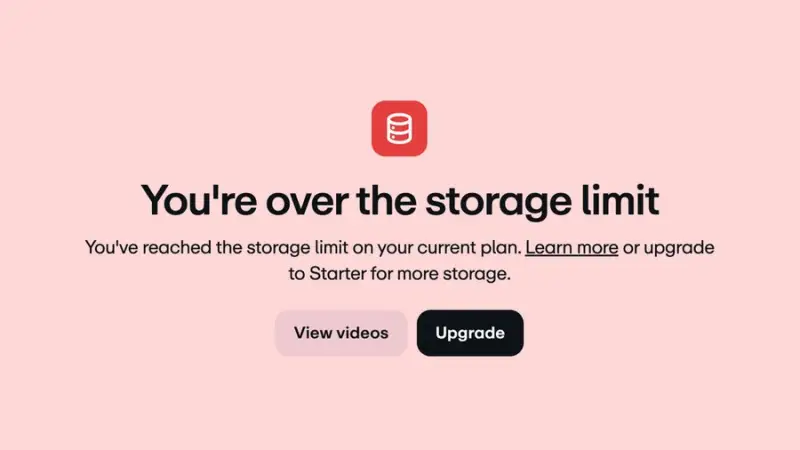
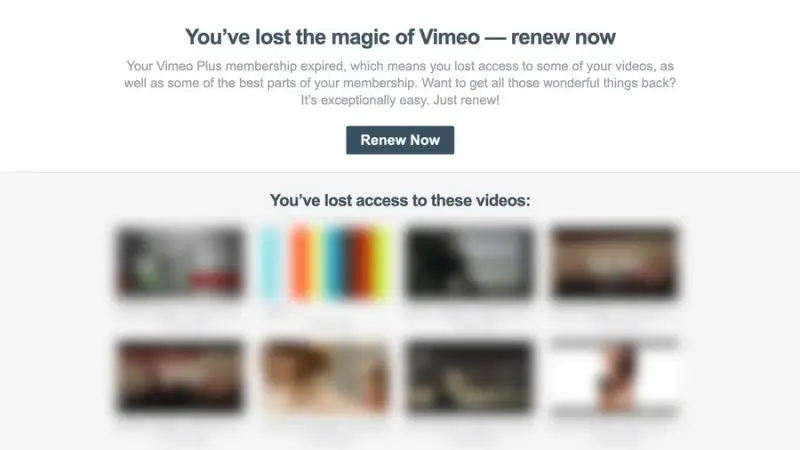
The issue surfaced when the filmmaker tried to share a video made a couple of years earlier. Only six videos appeared online, and the requested clip wasn’t among them. A login message said a Vimeo Plus membership had expired and suggested renewing to restore access. The account holder says they had never purchased Plus, Pro or another paid Vimeo plan.
A separate prompt reported that the account had reached a 5GB limit and offered Vimeo Starter. The minimum cost to regain access was around €8 per month. The exact plan and cost required to unlock a particular archive may vary, but the immediate effect is clear: a person trying to retrieve older work is being directed toward a paid account.
How the free allowance changed
Vimeo Basic was once presented chiefly in terms of how much a user could upload each week. A company FAQ comparison from around 2014 listed 500MB per week for Basic and 5GB per week for Plus. As late as 2020, the free plan was described as allowing 500MB weekly, or up to 25GB a year.
Those figures describe an upload pace, rather than a lifetime ceiling on the total amount already stored. The filmmaker says there was no clear notice that old videos would later count toward a fixed account limit, or that crossing it could make the files inaccessible. For creators who treated Vimeo as a place to host finished work, that difference matters: the expectation was that uploads would remain watchable even after new uploads stopped.
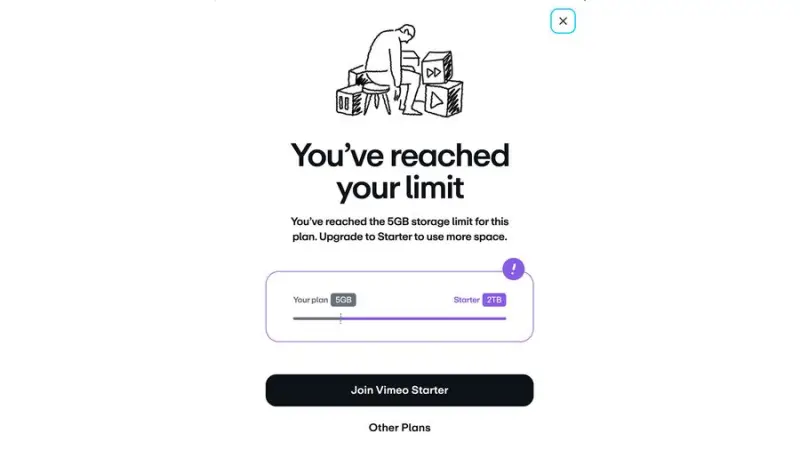
By 2019 at the latest, Basic accounts had a 5GB total storage cap, and accounts over that amount could no longer add new videos. Vimeo pointed to the continuing cost of storage and delivery. The filmmaker moved new work to YouTube, while older private and password-protected Vimeo videos remained viewable.

Restricting future uploads gives users a choice about where to host new material. Applying a later limit to existing uploads, then blocking access to them, creates a different problem. The creator’s complaint isn’t that hosting should cost nothing forever; it’s that the change affects work uploaded under a different understanding of how the free allowance operated.
What “unlimited” covers
Vimeo introduced managed storage on individual plans in 2026, describing unlimited storage as available on every new plan, including Free. The company’s help information narrows that claim: only videos set to Public with embedding turned off qualify for the unlimited allowance.
Videos that can be embedded elsewhere count toward managed storage. So do Unlisted, password-protected, Embed only and Private videos. Vimeo describes managed storage as covering videos for which the account holder controls who can watch. That captures many routine professional uses: a portfolio embedded on a filmmaker’s site, a password-protected client cut or an unlisted link sent to a producer.
For those workflows, the central question isn’t simply how many gigabytes a plan allows. Visibility and distribution settings determine whether a video counts against the allowance. Making a file public while disabling embedding may remove it from managed storage, but that setting can’t suit work that needs to stay private or appear on an external portfolio site.
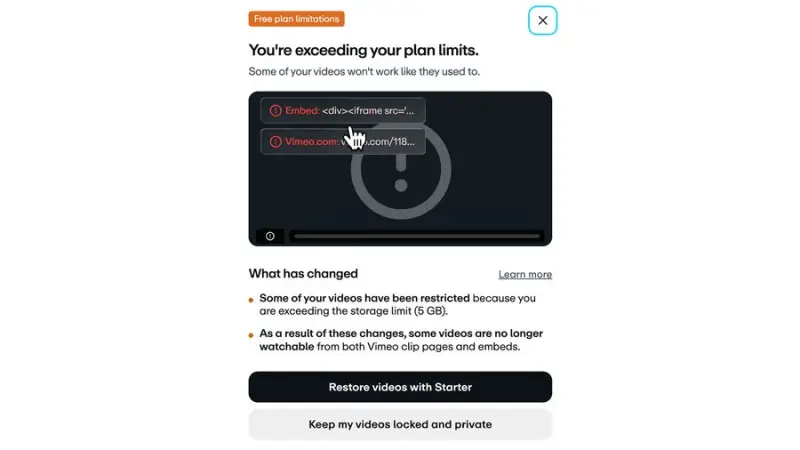
There’s another divide between new and legacy accounts. Vimeo says older plans continue to count total storage, including public videos. The new managed storage figure appears when an account moves to a current plan. That means an existing user may not receive the same allowance as someone signing up today; the filmmaker’s account remains under the older 5GB limit.
The change makes the word “unlimited” less useful as a guide for working creators. A filmmaker has to check the plan type, the age of the account and each video’s visibility and embedding settings. Public video that can’t be embedded is a narrow fit for portfolios, client reviews and projects that need controlled access.
Locked files and the available choices
Vimeo calls affected videos “locked.” They aren’t deleted, but they can’t be played through direct links or embeds. Users also can’t edit or download them. The help information says a locked video can’t be switched from Public to Private, or have embedding disabled, as a way to bring it back within the allowance.
The filmmaker outlines three ways to unlock videos: upgrade to a plan with enough capacity, make eligible videos public with embedding turned off, or delete videos until the account falls under its limit. Each has a cost. A paid plan means a recurring fee for access to older files. Public visibility may be unacceptable for client work, unreleased edits or personal material, and the locked status can prevent changing settings anyway. Deleting a locked file, Vimeo says, is permanent and doesn’t send it to “Recently deleted.”
That last detail turns account cleanup into a serious decision. If the only copy of a video is on Vimeo, deletion could erase it; leaving it locked means the owner still can’t retrieve it. Before changing account settings or removing files, creators should establish what copies they have elsewhere. The account holder describes the fee as paying for access to the videos, rather than for storage they intend to keep using.

The case for charging, and the case for access
Video storage and delivery carry real costs, and Vimeo is a business. No creator can assume that a free hosting plan will last indefinitely. The filmmaker also acknowledges that Vimeo’s terms have included clauses allowing the company to disable access to or remove content when an account exceeds its plan limits. A 2016 version of the terms included such language for expired subscriptions.
That context supports limits on new uploads and paid options for continued hosting. It doesn’t settle the question of what happens to files already on an account. There’s a practical difference between stopping new uploads, ending public playback after a warning, and preventing an owner from downloading the material. A clear export period would give creators a route to preserve work before access ends.
The filmmaker also recognizes that Vimeo was never intended to serve as a sole backup. Creators who relied on it as their only copy, including the writer, took a risk. But video platforms have often been used as informal archives: a completed project gets uploaded, local copies go missing over time, and the hosted version becomes the one remaining copy people can reach.
That reliance can turn stored work into leverage when a platform changes its terms or account structure. The filmmaker points to changes at WeTransfer and Evernote as examples of free services becoming less useful to established users. In this account, the concern is broader than Vimeo: a familiar tool can become a toll point when years of work and workflow depend on it.

Protect the masters outside the hosting account
Anyone with an older Vimeo account should review the library now, including any locked-video filter available to them. Download files that remain accessible at the highest quality offered. Then make sure important work exists in multiple places. The filmmaker recommends keeping at least three copies, across two types of media, with one copy stored off-site. Local drives paired with a separate cloud backup can provide a workable arrangement.
For new projects, it helps to treat video hosting as a way to show or share work, not as the archive itself. Client review services such as Frame.io or RevCut.io may suit review workflows. Creators looking for another Vimeo-style home can also assess rushes, which launched in 2026 as a European alternative. Whatever service handles playback, keep the camera masters and final exports on storage you control.
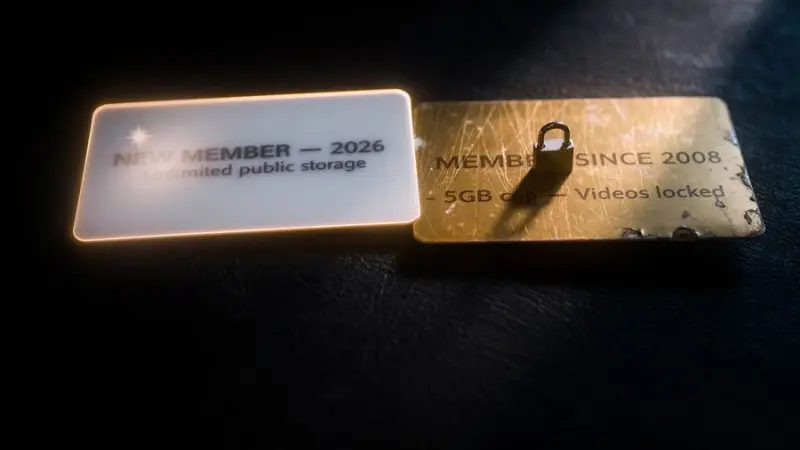
The filmmaker’s account began as a record of early work and grew into a professional archive. Vimeo’s prompts now frame access as a matter of renewing a membership, though the account holder says they never had one. Whatever decision they make about retrieving the files, the platform’s role has changed: it’s no longer a place they trust to hold the only copy.
Check the account, recover what’s still available, and keep independent copies of anything that matters. Hosting can make a film easy to share; only a separate archive gives its owner a reliable path back to the work.


