11h11 Audio’s Golden Reverb Pairs 11 Algorithms With Golden Ratio Timing
Stéphane Vachon’s debut plugin combines 11 reverb algorithms, three voicings each, modulation and spatial tools, and a 14-day trial.

Golden Reverb gives producers 11 distinct reverb structures and a set of practical tools for shaping them, from sidechain ducking to three-axis spatial control. It’s the first commercial release from 11h11 Audio, the independent company founded by Canadian musician and DSP developer Stéphane Vachon. The plugin launched November 23, 2026, at an introductory price of $29; its regular price is $59, and a free 14-day trial is available.
Vachon built the reverb around timing relationships drawn from the golden ratio and Fibonacci sequences. He applies those proportions to delay taps, reflection clusters and modulation patterns, aiming to give the decay a particular character. The company says this approach can reduce unwanted ringing and produce smoother tails, though that remains a design claim rather than an independently verified comparison.
Eleven structures, with a notable exception
Each of the 11 algorithms uses a different DSP topology: the delay lines, allpass diffusers and feedback matrices are connected and modulated in different ways. Within most algorithms, three voicings reshape the perceived size, acoustic treatment and harmonic energy while retaining the core structure.
Algorithm 10, Golden Studio Classics, works differently. Its three positions select three separate topologies: Phi Non-Linear Gate, Rounded Golden Plate and Golden Random Hall. That gives users gated, plate-style and hall options within one algorithm slot.
Vachon came to reverb through a musician’s interest in how spaces affect sound. He describes it as the space a performance lives in, and says he has long been curious about why some environments feel uplifting while others can be uncomfortable. Exploring how golden ratio and Fibonacci relationships might shape delay taps, reflection clusters and modulation spirals became the starting point for Golden Reverb.
Tools for controlling the wet signal
The plugin adds five analog-inspired preamp models, a sidechain ducker and an effects section with modulation, filtering and other processing. The ducker responds to the incoming dry signal, lowering the reverb while that signal is present and letting the wet sound return according to the release setting. For vocals, synths and percussion, that can help keep a reverb tail from crowding the source without setting up a separate sidechain processor.
A three-axis binaural spatializer adjusts perceived position across left and right, front and back, and vertical placement. The modulation section offers 20 LFO waveforms with tempo synchronization. FX ONLY mode runs the additional effects without the main reverb, so modulation and spatial processing can be used on their own.
Golden Reverb includes 94 factory presets, grouped around shorter, medium and longer spaces as well as experimental effects. That gives users a set of starting points across conventional room and tail lengths, alongside more unusual textures.
Formats, compatibility and pricing
11h11 Audio lists Golden Reverb as a VST3 plugin for Windows and macOS, with Audio Units support on macOS. The developer names Ableton Live, Logic Pro, Studio One, Reaper and Cubase as compatible hosts, and lists support for common sample rates up to 192 kHz.
The $29 introductory price and $59 regular price reflect Vachon’s position as an independent musician entering a crowded plugin market. He says he wants producers to try the software, and is comfortable with users exploring the free 14-day trial even if they don’t purchase it. For buyers, the trial offers a direct way to assess how the algorithm set and workflow fit their sessions.
A musician’s route into DSP
Before writing C++, Vachon played guitar and sang, and spent time trying to identify how unfamiliar sounds in records had been made. Pedals and studio gear became tools for chasing textures; teaching himself DSP programming was, in his words, a continuation of experimenting to discover new sounds. He still values sound mangling as part of making music, even when it distracts from finishing a song.
He says the visual design and GUI polish took more effort than he expected outside the DSP work. Friends suggested features during development, and each addition could mean another round of interface changes. The experience gave him a clearer sense of how much product work sits around the audio engine.
Dream Degrade is already in development
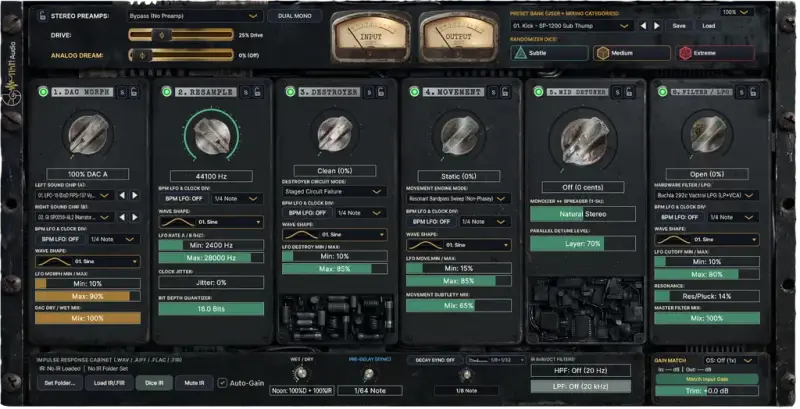
Vachon started work on 11h11 Audio’s next plugin before Golden Reverb. Dream Degrade is aimed at a different group of producers and draws on the character of older digital-to-analog converter chips associated with vintage gaming hardware. His interest grew after hearing Plogue’s Chipcrusher, which prompted him to imagine sounds he couldn’t make with the tools he had.
Vachon says Dream Degrade won’t copy Chipcrusher; the project follows the same curiosity that led him to learn DSP in the first place. Golden Reverb shows that curiosity applied to space and decay. The next release will take it toward deliberately degraded digital textures, giving producers another way to reshape a sound at its source.