REL Carbon Special Black Label Review: Deeper Bass, More Musical Detail
The £4,799 Carbon Special pairs a 900W amp with a 12in all-carbon driver, adding bass control and detail across a full range of speakers.
A subwoofer aimed at the whole system
The REL Carbon Special Black Label makes its case for a subwoofer in systems that already have capable speakers: bass extension is only part of the benefit. In my listening, adding it to Fyne Audio Vintage 10 floorstanders tightened bass lines and brought more definition to vocals, guitars, drums and other instruments. That makes this Serie S model a substantial upgrade over the S/850, though at £4,799 it sits close to the top of the range.
REL was founded in Wales in 1990 by Richard Edmund Lord, who wanted to address the performance of subwoofers available at the time. John Hunter, formerly the US distributor for Sumiko, bought the company in 2005. Design is now carried out in the USA, while manufacturing takes place in China. Serie S sits below REL’s Reference range and is intended for higher-level systems in medium to large rooms.
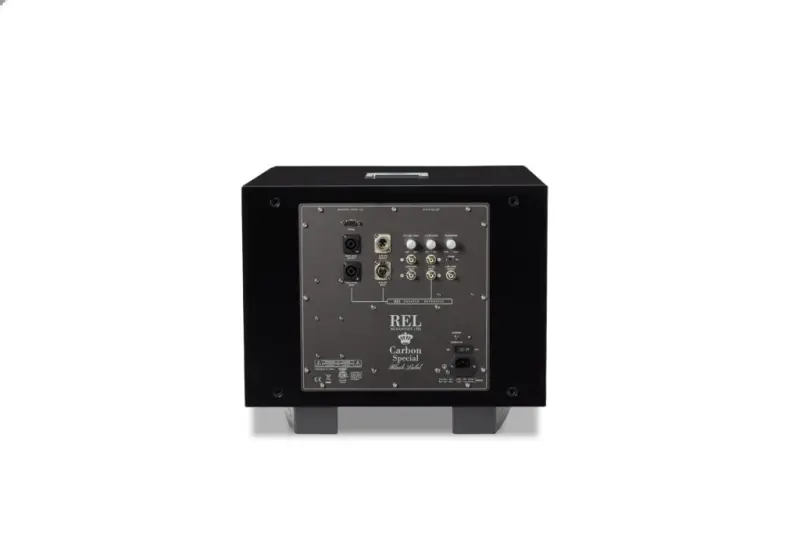
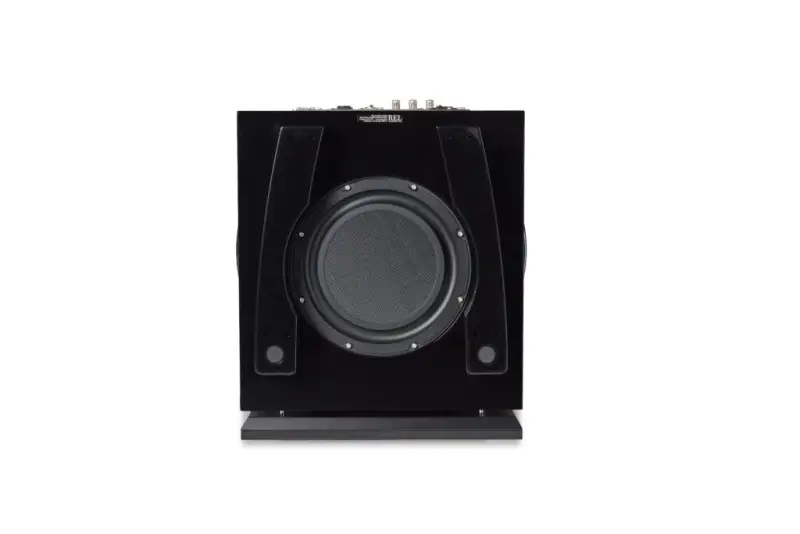
The Carbon Special costs £4,799, compared with £3,599 for the S/850 and £5,499 for the 212 Black Label. It shares the S/850’s height and width but its cabinet is 25mm deeper. Inside, the design moves beyond the S/850’s 12in carbon alloy active driver and downward-firing passive radiator. The Carbon Special uses the all-carbon 12in forward-facing driver found in the No31 Reference model, paired with a long-throw, all-carbon passive ABR similar to the one used in the 212 Black Label.
Driver, amplifier and connections
A 900W linear Class D amplifier powers the active driver. That is a modest increase over the S/850’s 850W rating; REL says the amplifier can deliver 1,200W to 1,400W on peaks. The company uses analogue filtering across its subwoofers, citing response speed as a key design priority and its view that digital signal processing is too slow.
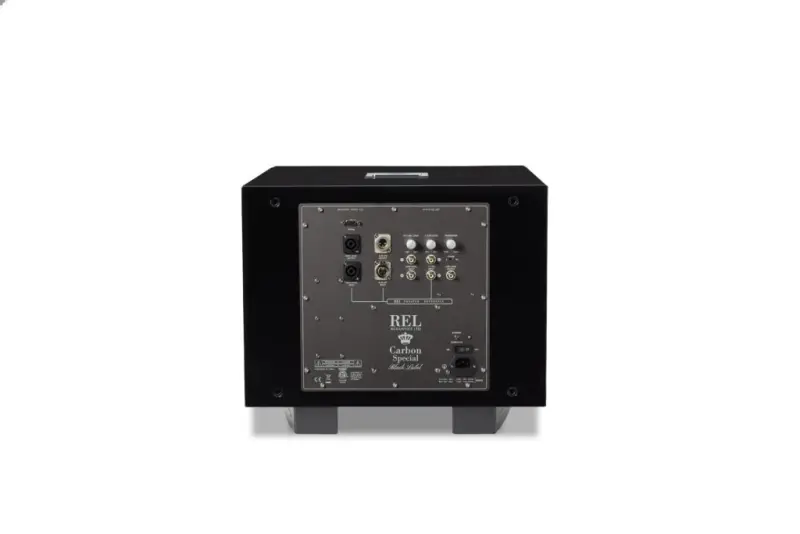
REL’s High Level connection is a defining part of its approach. The supplied 10-metre cable runs from an amplifier’s speaker terminals to the subwoofer’s Neutrik Speakon input, carrying the same signal sent to the main speakers. REL’s rationale is that this lets the sub integrate with the character of the existing system. The company says the sub’s high impedance leaves the amplifier unaffected, with no drain.
The Carbon Special also accepts low-level RCA and LFE RCA inputs. Its outputs include High Level Neutrik Speakon, low-level RCA and LFE XLR. There’s a 0 or 180 degree phase switch, an 80dB gain control range and optional Airship Direct wireless capability, sold separately. One connection caution from REL: on Class D amplifiers, don’t connect the cable’s black ground wire to the amplifier’s black speaker terminal. I’ve used the High Level connection with valve and transistor amplifiers and preferred its sound to the low-level input.
Setup in a real listening room
My system included an Audio Note TT3/PSU3 turntable with Arm Two and a Hana Umami Black cartridge, a Music First Audio LP103 LCR phono stage, a Viva Solista tube integrated amplifier, and Fyne Audio Vintage 10 speakers with SuperTrax super-tweeters. Digital playback came from an Audio Note CDT Five transport and DAC Five Special. MusicWorks supplied the mains blocks and cables.
REL UK sales director Rob Hunt handled setup, using a setup CD to adjust phase, crossover frequency and gain. REL recommends a corner for a single subwoofer, but that placement wasn’t practical in my room. We settled on a position just in front of the left speaker, close to the wall and angled slightly inward. Placement and adjustment depend on the room and the main speakers; a retailer can often help find a workable position.
The sub’s specifications include an in-room lower frequency response of -6dB at 19Hz. Its cabinet measures 41 x 48.8 x 56.5cm (HxWxD), and it weighs 44.5kg. The finish is piano black lacquer, with a detachable wooden grille.
What changed with the music
The first difference was control. On Chris Walker’s “We’re In This Love Together,” from his Al Jarreau tribute album, the bass line became deeper, tighter and more agile. Without the REL, I’d found it somewhat overblown; with the sub, the lowest notes were easier to follow. Vocals opened up, and Gerald Albright’s saxophone sounded more articulate and expressive.
Julian Lage’s “Omission,” from Speak To Me, showed that the improvement wasn’t confined to low frequencies. Acoustic guitar notes had clearer shape and attack, while the electric guitar sounded cleaner. The bass line moved with greater fluency; drums gained definition and punch, giving the track’s clipped rhythm more impact.
On Larry Carlton’s “Minute by Minute,” from Discovery, the bass guitar had more weight and movement. When kick drum joined it, the impact was both forceful and controlled. Carlton’s guitar and the percussion also came through with finer detail. Fergus McCreadie’s “Sun Pillars,” from Stream, gave the double bass from David Bowden more solidity and speed, while McCreadie’s piano retained delicacy and definition across its registers. Stephen Henderson’s drumming, and the rhythmic interplay between him and Bowden, were easier to appreciate.
Jon Allen’s “Night & Day,” from Deep River, brought a similar lift in presence: the vocal sounded clearer and more powerful, with tighter drums and bass supporting the track’s rhythmic character. Across these selections, the sub seemed to make the soundstage more spacious and let individual performances breathe.
A step up for more than bass extension
REL UK sales director Rob Hunt describes the Carbon Special as going “deeper, louder, faster.” My experience supports the appeal of deeper, better-controlled bass, but the value here is broader: the sub made the system’s musical detail easier to hear, even with speakers that already extend well into the bass. REL’s John Hunter has argued that low-frequency information contributes to musical fundamentals and their harmonics; in practice, the Carbon Special’s effect was audible in instrumental definition and rhythmic coherence as well as low notes.
For listeners moving up from the S/850, the Carbon Special brings a more powerful amplifier and the No31-derived active driver, with a matching all-carbon passive radiator. It’s a meaningful step for the Fyne Audio Vintage 10 system I used, and a candidate for larger speakers as well as compact ones. At £4,799, €5,599 or $4,999, it’s a significant purchase. The payoff, in my room, was a more controlled foundation and a clearer view of the performances above it.


