Panasonic LUMIX SHX1 Lab Test: Rolling Shutter, Dynamic Range and Latitude
The SHX1 pairs strong dynamic range and deep ProRes RAW latitude with 26.2ms rolling shutter when Dynamic Range Boost is on.

The LUMIX SHX1’s lab results split along a clear line: Panasonic’s full-frame camera delivers strong dynamic range and substantial exposure latitude, while its slow readout in Dynamic Range Boost mode limits fast-moving work. A change to ProRes HQ 4:2:2 also stands out: its noise reduction appears less aggressive than on the closely related LUMIX S1II, preserving more image detail without lowering the measured dynamic range.
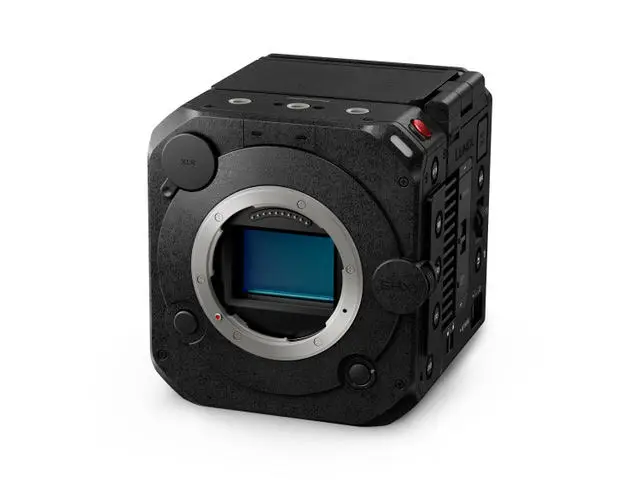
These tests used a pre-production SHX1 supplied by Panasonic in August 2026. Panasonic said the camera’s imaging pipeline was final, making the sample suitable for evaluation. The SHX1 shares imaging technology with the S1II and adds features aimed at professional video workflows. The key question was whether its results would improve on its sibling’s. They do in some areas, but the rolling shutter figures remain a concern.
Dynamic Range Boost slows readout
The SHX1 offers two readout modes: Dynamic Range Boost (DRB), a dual gain mode with a native ISO of 1000, and a standard mode without DRB, with a native ISO of 640. Dual gain combines low and high ISO gain in one exposure to expand shadow detail, but it can increase rolling shutter. The size of that tradeoff depends on the camera and mode.
In full-frame 5.8K ProRes RAW with DRB enabled, the SHX1 recorded 26.2ms of rolling shutter. That’s slightly quicker than the S1II’s 27.5ms, but well behind the Sony a7R VI’s 15.6ms in dual gain mode. The a7R VI figure was measured at 4K, rather than the SHX1’s 5.8K. The Sony FX5 measured 13.3ms in 5K 17:9 X-OCN LT with dual gain on, and 5.6ms with it off.
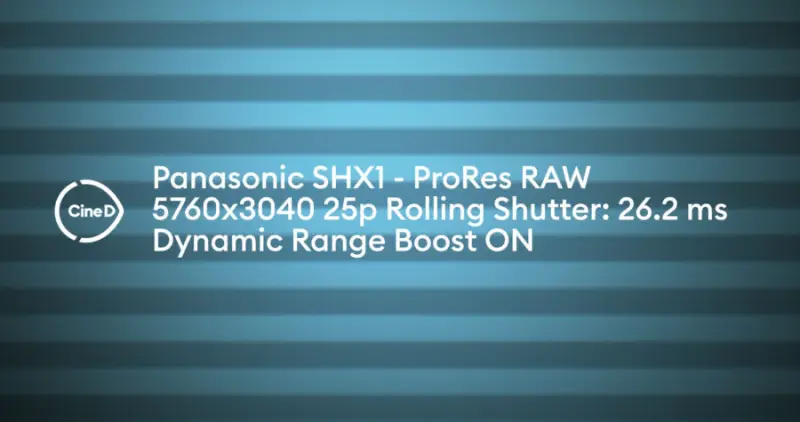
Switching DRB off brings the SHX1’s rolling shutter down to 12.2ms, compared with 12.7ms for the S1II. That’s a much more usable result for movement in the frame. With DRB active, though, 26.2ms can make fast pans and subject motion more visibly skewed. The larger camera body raised the possibility of faster sensor readout with additional cooling capacity, but these tests show no such improvement over the S1II.
RAW dynamic range edges past the S1II
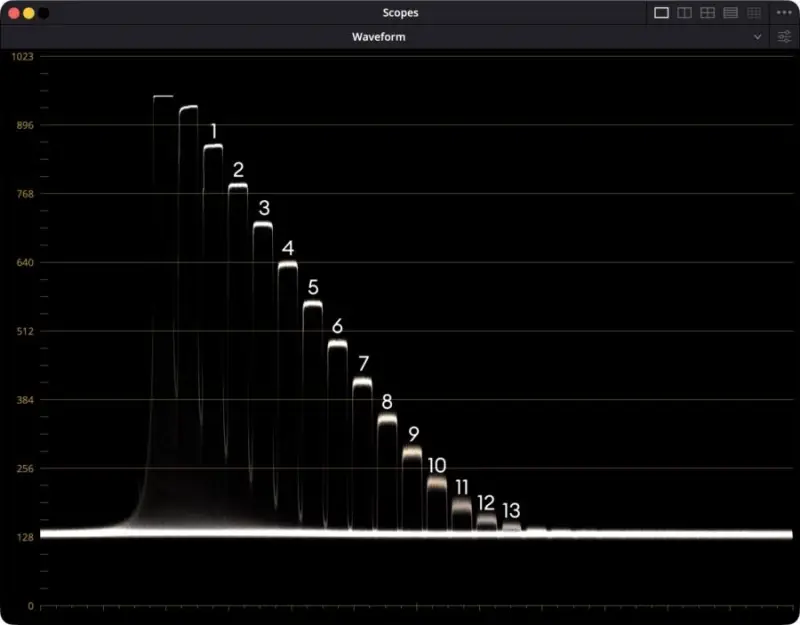
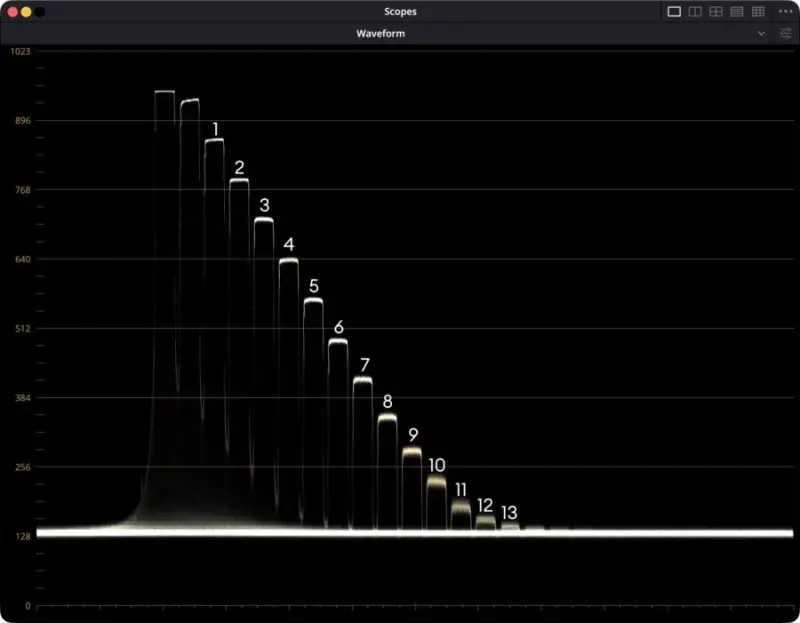
In 5.8K ProRes RAW at ISO 1000 with DRB on, the waveform shows 13 stops above the noise floor, with traces of two more stops inside it. IMATEST measured 13.2 stops at a signal-to-noise ratio (SNR) of 2 and 14.3 stops at SNR 1. The S1II reached 12.9 and 14.2 stops at those respective thresholds, so the SHX1 holds a small advantage.
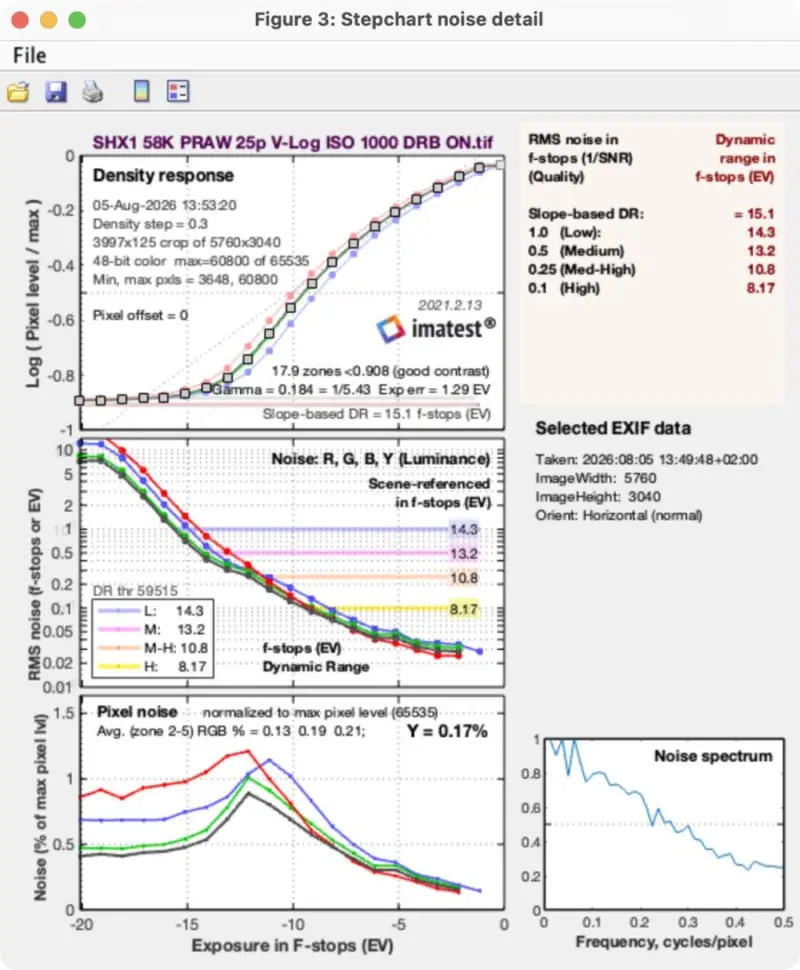
The noise spectrum also points to strong high-frequency detail and relatively little internal noise reduction. In standard mode, with DRB off at ISO 640, the result was 11.6 stops at SNR 2 and 12.9 stops at SNR 1. The FX5 measured 13.4 and 14.4 stops in 5K 17:9 X-OCN LT, a modest lead over the SHX1’s DRB-enabled RAW result.
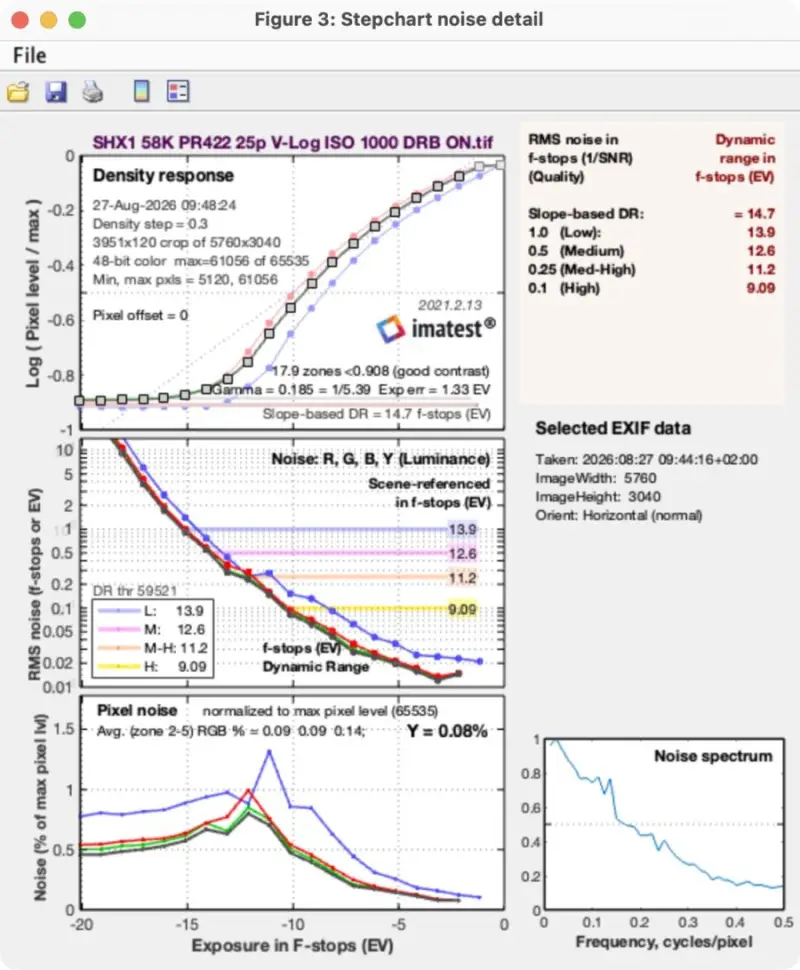
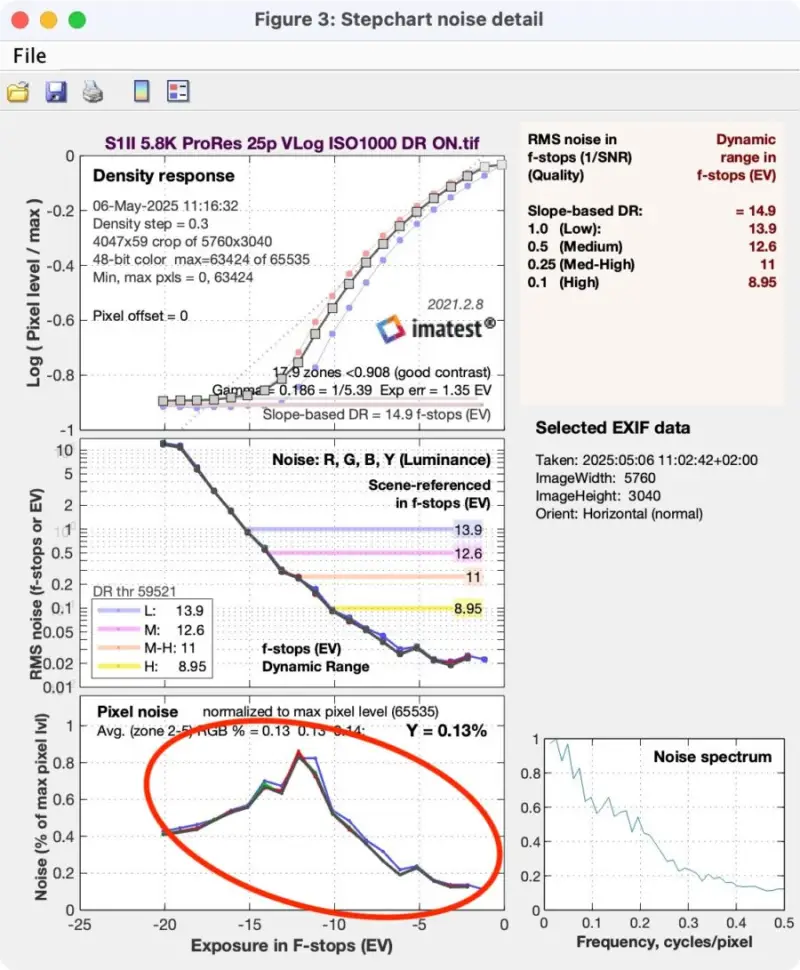
The SHX1’s 5.8K ProRes HQ 4:2:2 mode measured 12.6 stops at SNR 2 and 13.9 stops at SNR 1. Those figures match the S1II, but the noise pattern differs. In the S1II test, noise reduction blurred the distinction between the red, green and blue channels and reduced high-frequency information. The SHX1’s graph retains clearer channel separation and stronger high-frequency amplitudes. That suggests less aggressive internal noise reduction, with more fine detail preserved at the same measured dynamic range.
ProRes RAW latitude in practice
Exposure latitude tests how far footage can be pushed back to a base exposure after overexposure or underexposure, while retaining detail and color. The SHX1 test used ProRes RAW files in DaVinci Resolve. The starting exposure placed the subject’s forehead at about 60% luma on the waveform monitor. From there, the image could be raised by five stops before the red channel approached clipping.


For the underexposure test, the lens aperture was stopped down in one-stop steps to T8, then shutter time was doubled. Each file was returned to the starting exposure with ISO and exposure offset in Resolve’s RAW controls. The V-Log footage was converted through DaVinci Intermediate to Rec. 709 with a color space transform. This process stresses the whole image pipeline, especially the shadows, rather than measuring highlight recovery alone.
At three stops underexposed, the lifted image showed the first trace of fine noise, for eight stops of total latitude. Four stops under produced clearly visible noise, but it remained straightforward to reduce. At five stops under, the total reached ten stops. Noise reduction could still clean up the footage, though it required balancing temporal and spatial processing carefully to avoid damaging the image.

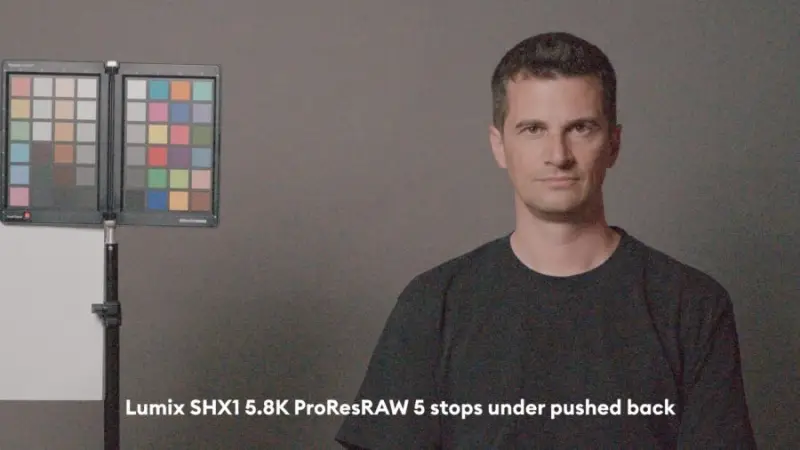

At that five-stop push, the result looked marginal, but the test found no horizontal lines, vertical stripes or major color shifts. The reviewer judged it comparable to the ARRI Alexa Mini LF at this point, and slightly preferable to the S1II image. The RAW footage’s fine-grained noise also remained visually pleasing through the less extreme pushes.
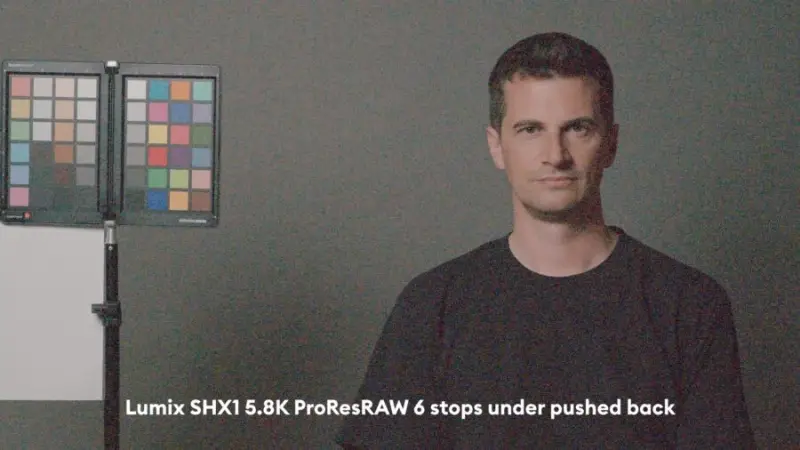
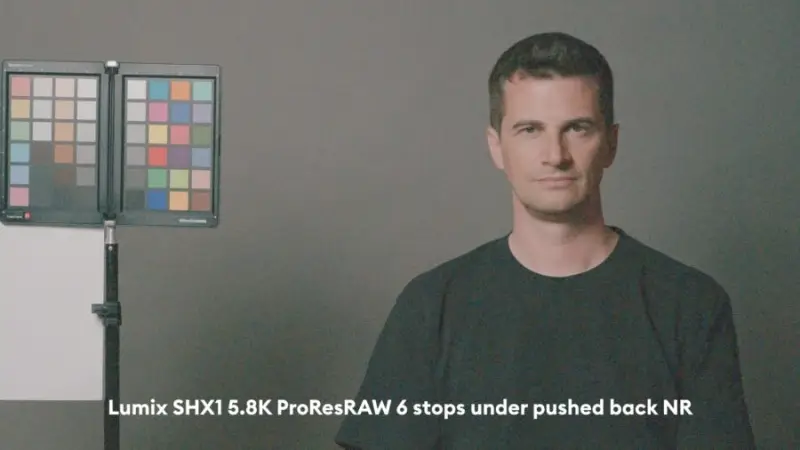
At six stops under, for eleven stops of latitude, the image fell apart. A pronounced green cast and large, shifting patches of chroma noise appeared. Even DaVinci Resolve’s AI UltraNR couldn’t restore a clean image. The FX5 performed better in this part of the comparison, retaining a usable result at eleven stops.
A strong image pipeline with a readout limit
The SHX1’s dynamic range is competitive, and its ProRes RAW latitude puts it among the stronger full-frame options tested here. ProRes HQ 4:2:2 also earns attention for retaining more high-frequency detail than the S1II’s implementation. Those results give camera teams useful flexibility for shadow recovery and detailed footage.
DRB’s 26.2ms rolling shutter is the main compromise. Shooters who need dual gain for difficult lighting may have to account for skew during fast camera movement, while DRB off produces a much quicker 12.2ms result. The small-sensor DJI Osmo Pocket 4P, which uses LOFIC technology, outperformed the SHX1 across the lab comparisons. For full-frame buyers, the SHX1’s balance is clear: strong tonal recovery and detail, with readout speed the deciding constraint for action-heavy work.


