Valerie June’s Blues Guitar Journey Comes Into Focus on Brighter Blue
Valerie June traces her guitar growth through blues and gospel, drawing on Southern players and the history carried by the standards on Brighter Blue.


Valerie June’s Brighter Blue brings her guitar playing to the foreground. The three-track EP pairs gospel and blues standards with a new solo on Howlin’ Wolf’s “Smokestack Lightnin’,” a song she’s spent years using to practice the very techniques she now puts on record. For June, that progress reaches beyond the fretboard: these songs connect her musical development to a personal way of learning Southern history.
The release follows her 2025 album Owls, Omens, and Oracles and includes two other interpretations: the gospel hymn “I’ll Fly Away” and “Trouble in Mind,” a blues standard recorded by artists including Nina Simone and Janis Joplin. June’s versions come from a repertoire with a long history of reinterpretation, but she approaches it as a player still curious about what her hands can do.
That curiosity has been a long time coming. June remembers being a child who struggled to keep time during playground hand-clapping games. On her cheerleading squad, she says, classmates teased her about having no rhythm. The memory makes her present-day confidence at the guitar feel especially hard-won. “Sometimes I just cry when it hits me,” she says. “I couldn’t even clap my hands to a beat, and now I can play guitar!”
Learning through the blues
Growing up in Tennessee, June found that music offered a way into histories that felt difficult to approach through school lessons. The blues gave her a way to hear both the pain and the possibility within Black American history. She points to Charlie Patton, Sister Rosetta Tharpe and Robert Johnson as artists whose music helped her understand hardship, hope and the desire for a better future.
The connection remains vivid in the place where she lives. Cotton fields still surround her in Tennessee, and June thinks about the people who once labored in them and the lives their descendants lead now. “Their energy is so grateful that I’m not picking that,” she says. “What I’m doing is shredding my guitar.” Her words place the act of playing inside a much longer story, while keeping the focus on the freedom to make music in the present.
At first, guitar was a practical choice. June had begun performing with a band; after it broke up, she wanted to continue as a solo artist and didn’t want singing to be the only way she could make music. “I never want to be in a place where I can’t play music because all I do is sing,” she says. Guitar gave her another way to carry a performance on her own.
Finding a steady pulse took time. June built rhythm through daily dancing, then worked to transfer what she felt in her body to her hands. From there, she learned to find notes and chords that sat well with her voice. She didn’t expect herself to reach a particular level by a particular age. “Music doesn’t come easy for me,” she says, describing a slower, more patient approach to learning. Even modest progress mattered: if she could add a little improvisation between chords by the time she was 80, she’d be satisfied.
Finding a path into the solo
June’s guitar vocabulary grew through listening to Southern players, among them Tharpe, Beverly Guitar Watkins, Cordell Jackson, Memphis Minnie and Jessie Mae. Their example mattered not only because of what they played, but because of the confidence they showed in a music business that was more male-dominated in their time. June recalls seeing Watkins perform about 20 years ago, playing behind her head and with her teeth. That display helped June believe her own ambitions on guitar were possible.
Tharpe’s playing also offered a lesson in how to approach a solo. June watched videos of her hands and noticed that she often seemed to walk into a lead passage rather than begin it at its destination. Some of the notes on the way could sound unexpected or out of place, but they carried the line toward its target.
June doesn’t frame that idea in formal theory terms. She hears it as a practical lesson: a note that initially seems wrong can work as a bridge if the player knows where the phrase needs to go. “Sound can forgive,” she says. “You just got to know how to use that note to get you to where you’re going.” It’s a flexible approach to improvisation, grounded in listening and direction rather than a requirement to make every note conform at once.

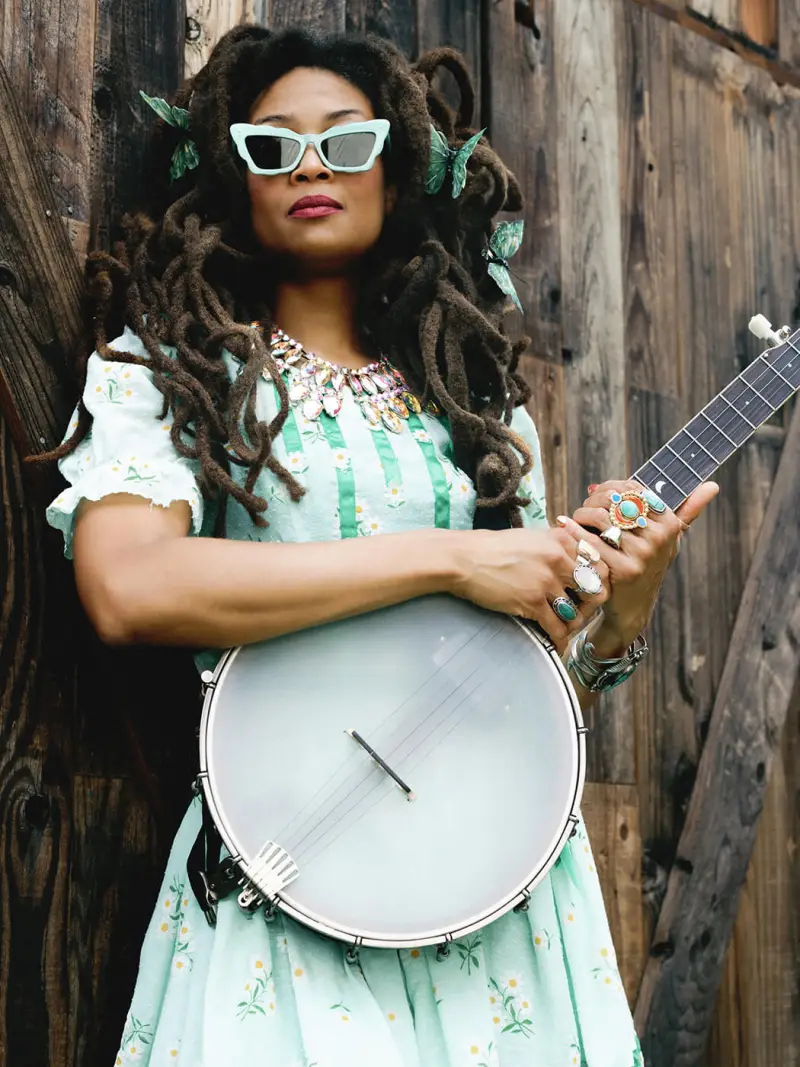
“Smokestack Lightnin’” became one of the songs June used to work on those ideas. For Brighter Blue, she recorded a rocking solo on her Guild Aristocrat. The song has been interpreted by acts including Soundgarden, the Yardbirds, the Grateful Dead and the Animals, giving June a familiar standard through which to make her own mark.
The EP’s songs come from difficult periods, yet June hears their performance in the present as a meeting between the conditions that shaped them and the possibilities available now. Her guitar solo makes that passage tangible: years of patient practice turn a song she once used as a study piece into a vehicle for her own voice. June’s wish is that the work continues to point ahead. “Keep the engine rolling toward that brightness,” she says, toward what earlier generations would have wanted for those who followed.


