Martin’s Painted Guitars: From Orange Tops to the Colourful 16 Series
Martin’s painted tops span orange shellac, sunburst finishes, artist editions and the new 16 Series, where colour still lets the wood show through.


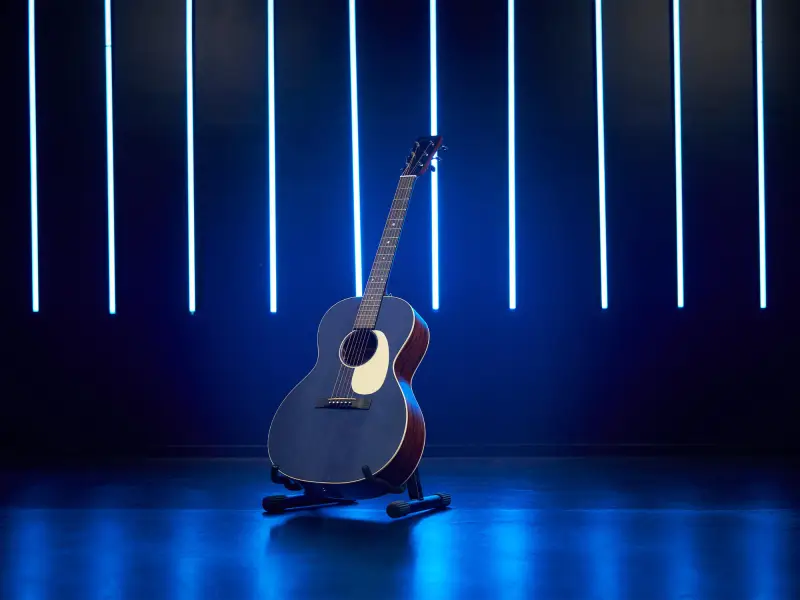
Martin has generally let the wood set the look of its acoustic guitars. That makes the new 16 Series, with tops in colours including Cherry Cola, Blue Denim, Black Smoke and Cream, a noticeable change in emphasis. The history behind those finishes, though, reaches back well before digital printing: Martin has offered coloured or shaded tops in different forms for more than a century.
That history also shows how varied “painted” can mean on an acoustic guitar. Martin’s early orange tops came from a change to the finish process; later shade tops used a sunburst look. More recent instruments have carried printed graphics or hand-painted artwork, while a small number of models received opaque colour across the body. The 16 Series takes another route, applying colour to the top while leaving the body finish distinct.
Early colour came through the finish
Martin’s first documented alternative to a natural-looking top dates to the 1890s. Jason Ahner, the company’s Archives & Museum Manager, says Martin offered an orange-top finish made with unbleached shellac in the French polish process. The option remained available until the company began spraying shade-top, or sunburst, finishes in 1931.
That distinction matters: the early orange appearance came from the finishing materials and technique, rather than a painted graphic laid over the top. It gave buyers a way to choose a warmer look while keeping the instrument’s traditional construction and ornament. Even the oldest surviving Martin, dating from 1834, paired a plain overall appearance with a carefully inlaid soundhole rosette designed by C.F. Martin.
Sunburst finishes became a more familiar alternative to natural tops, first appearing on Martin’s C Series archtops. Yet shade-top instruments were never ordered in large numbers, according to Ahner. Their relative scarcity has helped make pre-war examples collectible. The source reports that a pre-war shade-top Martin can cost around 50 per cent more than a comparable natural-top guitar. Country musician Vince Gill is among the collectors of these instruments.
Printing expands the design palette
Martin’s more recent move into striking top artwork grew out of experiments with its X Series. Those guitars use high-pressure laminate (HPL) for some tops, a surface that can carry a broad range of printed designs. The Cowboy X was an early example, featuring a cowboy scene on its HPL top.
Martin later adopted digital printing technology from Japanese company Mimaki, which allows graphics to be printed directly onto a guitar top. Ahner says the process gives the company a similar degree of design freedom while also making it possible to print on a solid-wood top. That opens up more options than the occasional sunburst or all-black finish, without requiring the whole instrument to be coated in one colour.
For players, the practical distinction is visible in the instrument itself: a printed image can make a guitar a more individual object, while the choice of top material remains part of the design. The source doesn’t specify how the printed finish affects maintenance or long-term wear, so those details are worth checking for a particular model before buying.

One-off artwork and signature colours
Hand-painted Martin guitars follow a separate thread. Ahner traces the series to 2008, when artist Robert Goetzel painted a D-28 Marquis for Martin’s 175th anniversary. That guitar is now displayed in the company museum. Its artwork was also used on the DX-175 and LX-175 editions.
Goetzel’s later works have generally been one-off instruments, with a select number made each year and commonly offered at the NAMM Show. Their designs have marked occasions including Earth Day and the Semiquincentennial. These pieces sit closer to individual artworks than to a standard finish option; the visual character of each guitar comes from the artist’s work.

Solid-colour Martins have been less common. The best-known early example is an all-black D-42 made as a rare custom order for Johnny Cash in 1972. Later signature models carried forward the look associated with Cash, though they too have remained scarce.
Other special editions used colour over the whole body. Martin made the white-lacquer Belleza Bianca for Eric Clapton and Hiroshi Fujiwara in 2006, followed by their OM Navy Blues in 2014. In 2010, the company built a red 000C-MR for Steve Miller. Ahner draws a clear line between those instruments and the 16 Series: the earlier models were finished in one colour across the body, while the newer series paints only the top.
A coloured top with the wood still in view
That separation is the defining visual choice in the 16 Series. The colour changes the first impression, but its transparent quality leaves the wood beneath visible. It gives players a more expressive finish option while retaining a connection to the material that has long been central to Martin’s acoustic designs.
Martin’s path from orange shellac to Mimaki printing isn’t a straight march toward louder decoration. It’s a series of different ways to balance personal expression with the appearance of the instrument’s materials. For anyone drawn to the new 16 Series, the useful detail is simple: the tops bring colour to the foreground, while the visible wood remains part of the look.


