Matt Bellamy on Manson Guitars’ Next Chapter: New Artists, AI Guitar Ideas and More
Matt Bellamy outlines Manson’s expansion, new artist models and a possible AI prompted guitar, while keeping live players and distinctive design in focus.


Manson Guitar Works is entering a bigger phase of its life, with a new showroom and expanded factory space in Devon. For owner Matt Bellamy, that growth creates room to widen the brand’s artist roster and product range while returning to the kind of instrument design that first drew him to the company: guitars built around a player’s own way of making music.
Bellamy’s confidence in Manson’s craft was tested in an unusually direct way. The company set his original Manson 007 beside last year’s limited Black Edition replica and asked him to identify the original. He picked the replica. Even after years of playing the 007 onstage and in the studio, he couldn’t distinguish the two by their small details, including the finish cracks.
That close match reflects how far Manson has developed since Bellamy became its owner in 2019. The company has built custom guitars for him since his early days as a young player visiting Hugh Manson’s shop in Exeter. Now the showroom sits above an expansion of the Ashburton factory, intended to increase UK production capacity as demand continues to challenge the small builder.

A showroom built around Manson’s history
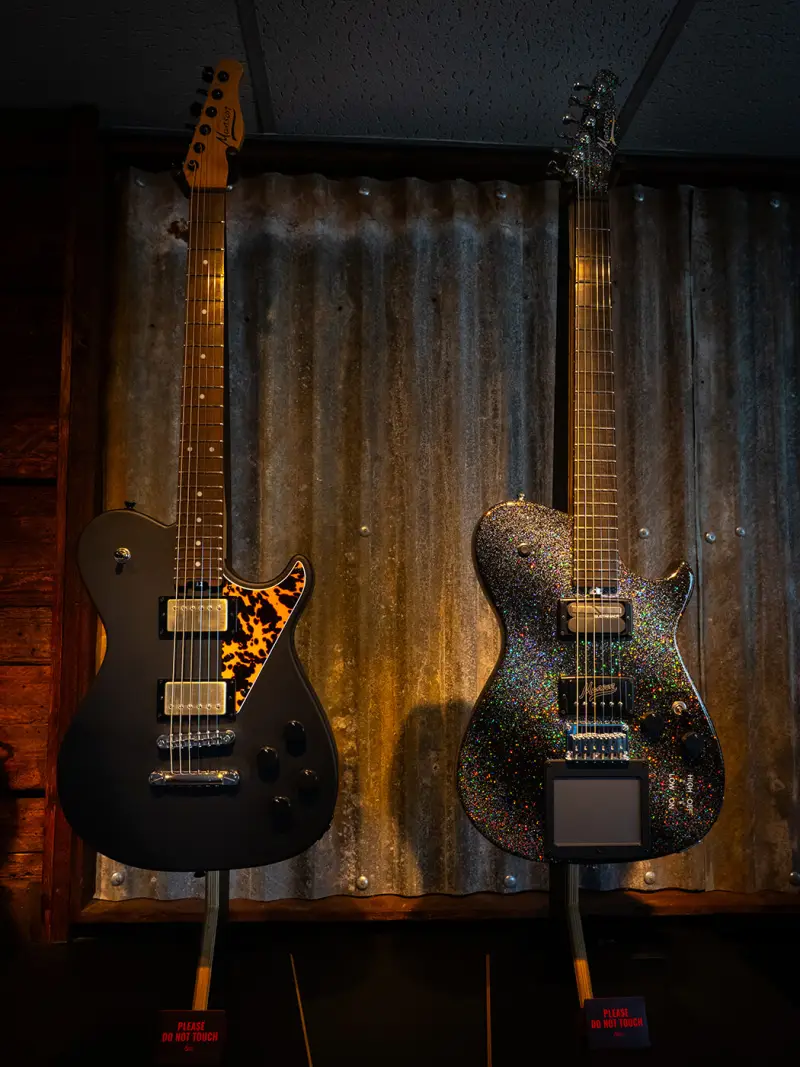
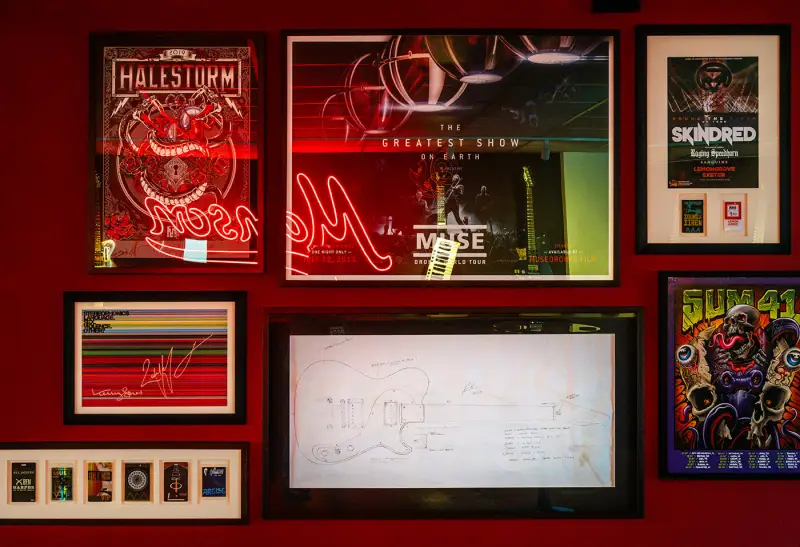
The new artist showroom gathers instruments from across Bellamy’s history with the company, including prototypes and unusual archive pieces. One is his “GEO” mask guitar; another is an early acoustic prototype. Bellamy says he had not seen the collection arranged together before the showroom opened, and describes the room as a museum of his own past. He may bring in the original DeLorean guitar, though Manson managing director Adrian Ashton has been wary of keeping such a valuable instrument on site.
Bellamy also wants the room to tell a broader story over time. Manson’s identity has long been closely tied to him and to Led Zeppelin bassist John Paul Jones, whom Hugh Manson worked with as a longtime technician. Bellamy would like to see more artists represented on the walls and more players associated with the brand.
That shift is already underway. Manson has made signature guitars for Mikey Demus of Skindred and worked with Adam “Nolly” Getgood on the Oryx. The company is developing a signature model with Graham Coxon of Blur and a guitar with Emi Grace, a 22-year-old player Bellamy discovered through Instagram. He says he contacted her after her playing repeatedly appeared in his feed.
For Bellamy, Grace points to a change in how guitarists can build careers. Social platforms give instrumental players a route to an audience and a livelihood without requiring them to front a band or write songs in the conventional format. He sees that as a useful new path for guitarists, and wants younger artists to help carry Manson beyond its close association with him.
Designing a guitar as a blank canvas
Bellamy’s relationship with unusual guitar design began as a practical response to life in Muse, a three-piece band. In the group’s early years, he sang and played guitar without a technician handling effects for him. He wanted to change sounds while moving around the stage, so he and Manson began looking for ways to put controls and effects directly into the instrument.
That approach eventually became a defining feature of his guitars. Manson instruments have incorporated onboard effects and MIDI controls, with the best-known example being a Korg Kaoss Pad fitted into the guitar body. The electronics were only one part of the design, though. Bellamy also wanted a shape that didn’t carry the musical associations of a Telecaster, Stratocaster or Les Paul.
His reasoning is personal but has a clear design consequence: familiar instruments can invite familiar ways of playing. Bellamy wanted something that felt like a blank canvas, giving him room to find his own musical language. The Manson silhouette began as that fresh starting point, and he says the same impulse still informs how the company approaches new instruments.
Exploring prompt controlled guitar sounds
Bellamy wants Manson to revisit embedded technology with current tools. One idea he is interested in is a guitar that can be prompted to produce a particular kind of sound. Similar concepts already exist in the effects pedal market, he says, but he would like to explore bringing that interaction into the instrument itself, so a player could describe a desired sound directly to the guitar.
He doesn’t claim the technology is ready. Bellamy says the necessary systems may not yet be developed enough for a guitar, and he sees the idea as a long-term possibility. His interest comes partly from working with a large collection of synthesizers: finding a sound can take hours, while prompt based interfaces can make sound selection quicker, even if their audio quality is currently lower.
The part that appeals to him is combining an easy digital interface with an analog result. That suggests a guitar built to shorten the route from an idea to a usable tone, while retaining a physical response or signal path. Bellamy has not described a design, signal chain or release plan, so the prompt guitar remains a concept to explore rather than a product announcement.
He also sees live performance gaining value as audiences become less certain about what they encounter on screens. Bellamy says his children are gravitating toward real experiences amid the growing presence of generated material in their feeds. His expectation is that audiences will want more live music played by musicians in the room, where the performance itself provides a direct human connection.
More guitars, effects and possible new categories
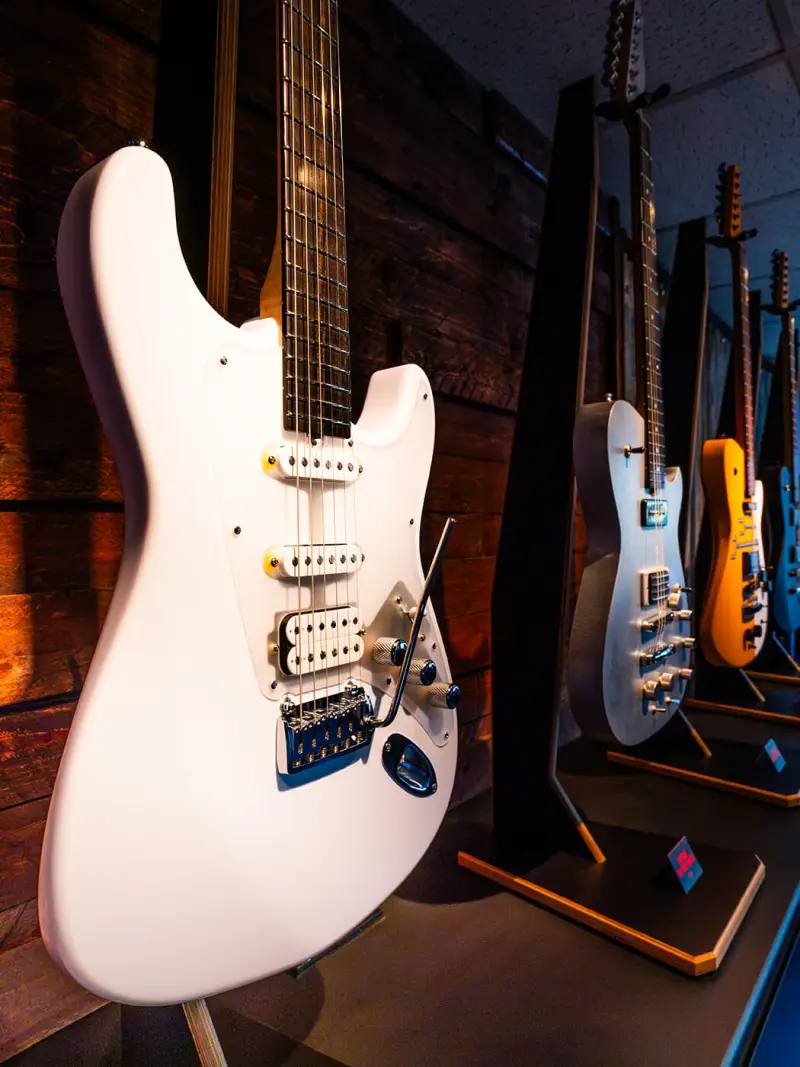
Manson has expanded in several directions during Bellamy’s ownership. The company worked with Cort on the more affordable Meta series, released the high-end Black Edition instruments, and collaborated with ThorpyFX on its first pedal, the Supermassive. Bellamy expects the brand to keep revisiting early designs in limited runs while developing new models alongside them.
Among the current projects are the Oryx eight-string and the red MB “Wow!” guitar, connected with Muse’s recent album The Wow! Signal. Bellamy says Manson plans to begin selling the Wow! guitar soon. The company is also considering a second run of the Supermassive with minor changes, as well as a possible experimental pedal developed with Coxon.
Amplifiers could be another category, but Bellamy says Manson would need a distinct reason to enter it. He can imagine either a hand-wired tube design or something more future-facing, such as an amp controlled through prompts. The practical manufacturing questions have not been worked through, and a project might require a partner.
He is also interested in bringing more bass players into Manson’s orbit and exploring acoustic instruments. The acoustic prototype in the showroom was made for Bellamy while he was looking for a way to incorporate acoustic sounds into live sets. Manson never sold it, but he describes it as a lightweight electro-acoustic and sees the category as an area the company could explore further.
For Bellamy, the challenge is to grow Manson without losing the individual design choices that earned it a loyal following. The showroom makes the company’s past visible; its expanded factory and developing artist roster point toward a broader future. The next useful sign will be how those ideas turn into instruments players can take onto a stage or into a studio.


