A Metronome Practice Plan for Building Clean Guitar Speed
Build guitar speed with small metronome increases, relaxed technique and short fast bursts in a focused 15-minute routine.
Clean playing sets the ceiling for guitar speed. When a passage falls apart, pushing harder usually rehearses the errors: the useful tempo is the one where your notes stay even and your hands remain loose. A metronome makes it easier to build from that point in measured steps, while brief fast bursts let your hands experience a higher pace without turning the whole practice session into a struggle.
Set a tempo you can control
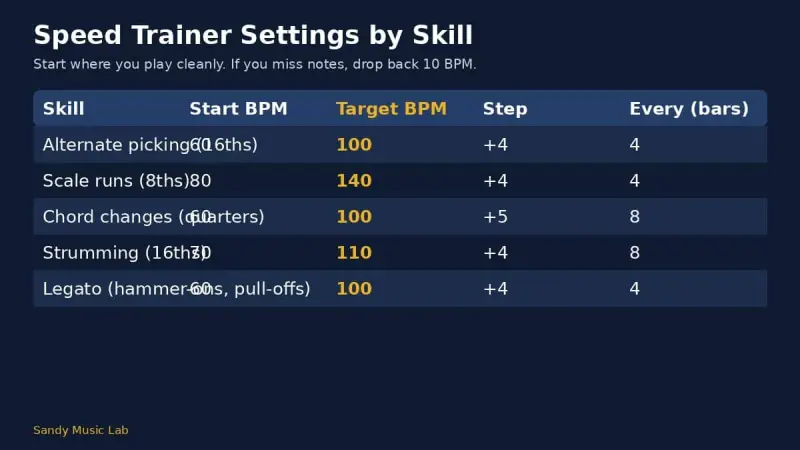
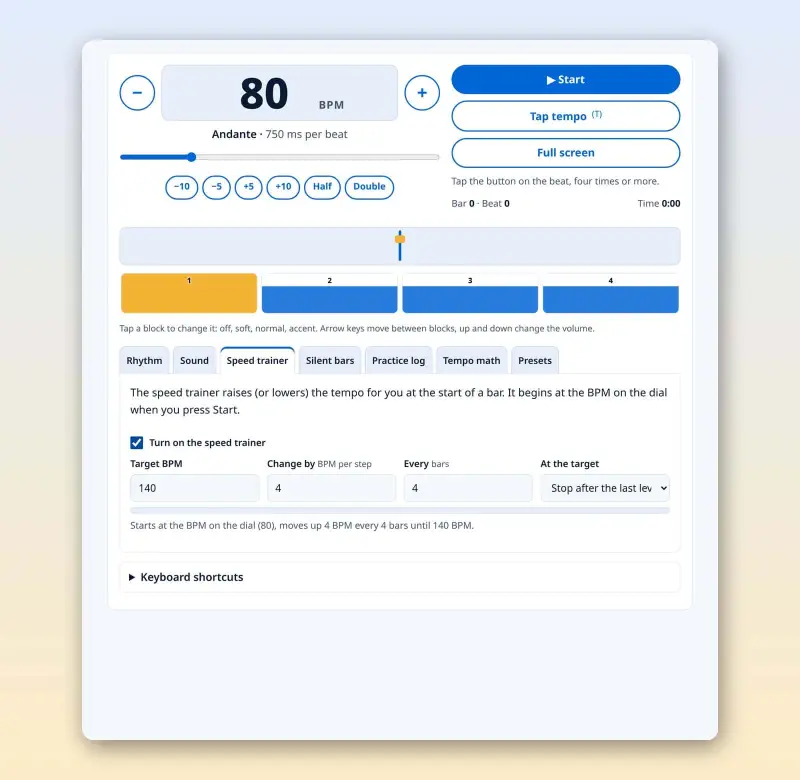
Find the point where an exercise starts to go wrong, then set your working tempo about 10 BPM below it. Start the speed trainer at that clean tempo, choose a target 30 to 40 BPM higher, and raise the setting by 4 BPM every 4 bars. The online metronome’s Speed trainer can handle those increases automatically.
Continue only while the notes remain clear. When timing or accuracy slips, stop and make a note of the tempo you reached. Drop back 10 BPM, play several clean repetitions, and finish there. Record the session so you can track the broader trend; day-to-day results vary, and a single slower practice isn't a verdict on your progress. Many players gain a few BPM a week with consistent work.
Small increases matter. Steps of 2 to 5 BPM keep the challenge close enough to your current ability that you can adjust without a sudden jump in difficulty. A common starting range is 60 to 80 BPM for sixteenth-note practice, but your own clean tempo should guide the setting.
Choose exercises that match the task
Pick two or three exercises per session rather than trying to run through all seven. Each targets a different part of the playing system, from finger coordination to chord transitions:
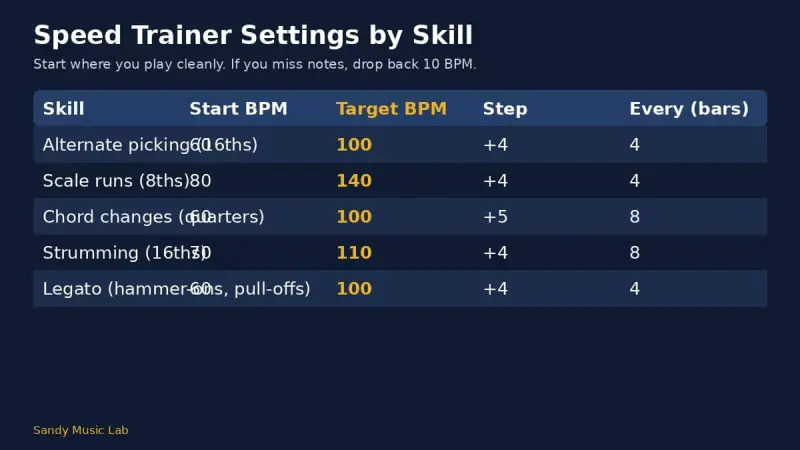
- 1-2-3-4 chromatic pattern: finger independence and picking synchronization. Start at 60 BPM in eighth notes.
- Single-string alternate picking: picking-hand speed and compact motion. Start at 60 BPM in sixteenth notes.
- Three-notes-per-string scale: longer runs and string changes. Start at 70 BPM in eighth notes; the guitar major scale shapes are suitable material.
- String-skipping pattern: accurate movement across non-adjacent strings. Start at 60 BPM in eighth notes.
- Legato trills: fretting-hand strength and stamina. Start at 60 BPM in sixteenth notes.
- One-minute chord changes: count clean switches between two chords in a minute. Use 30 changes as a starting target.
- Sixteenth-note strumming: an even, relaxed strumming hand. Start at 70 BPM.
For more exercise ideas, see the guitar exercise guide. The aim is to work on a specific limitation, then carry that control into music.
Use bursts to visit faster tempos
A short burst introduces speed without asking you to sustain it before your hands are ready. Take a four-note figure, play it quickly, then stop on the first note of the next group. Rest for a beat and repeat. When four notes stay clean, connect two bursts for eight notes, then four for a 16-note run.
Pair this with the metronome work: play the complete exercise at your clean tempo, then set the bursts 15 to 20 BPM above it. Keep the faster section short enough that accuracy survives. If the notes blur or your hands tighten, shorten the burst or reduce the tempo.
Keep movement small and tension low
Technique changes can remove wasted effort. Hold the pick firmly enough that it won't slip, but avoid squeezing; expose only a small amount of its tip. Move from the wrist rather than swinging the elbow, and keep the pick close to the strings. On the fretting hand, let the fingers hover near the fretboard and use only enough pressure to produce a clean note.
Watch for the picking hand and fretting finger landing together. Slower repetitions give you room to correct that timing before increasing the pace. Relax your shoulders, position the guitar comfortably, and shake out your hands every few minutes. Tension tires the muscles and limits how quickly they can move.

A focused 15-minute session
| Time | Work | Setting |
|---|---|---|
| 0–2 minutes | Relaxed 1-2-3-4 chromatic warm-up | 60 BPM, trainer off |
| 2–7 minutes | Main exercise with gradual increases | Clean tempo toward target, +4 BPM every 4 bars |
| 7–10 minutes | Fast bursts | 15 BPM above your top clean tempo |
| 10–13 minutes | Apply the work to a riff, solo or song section | Song tempo or slightly slower |
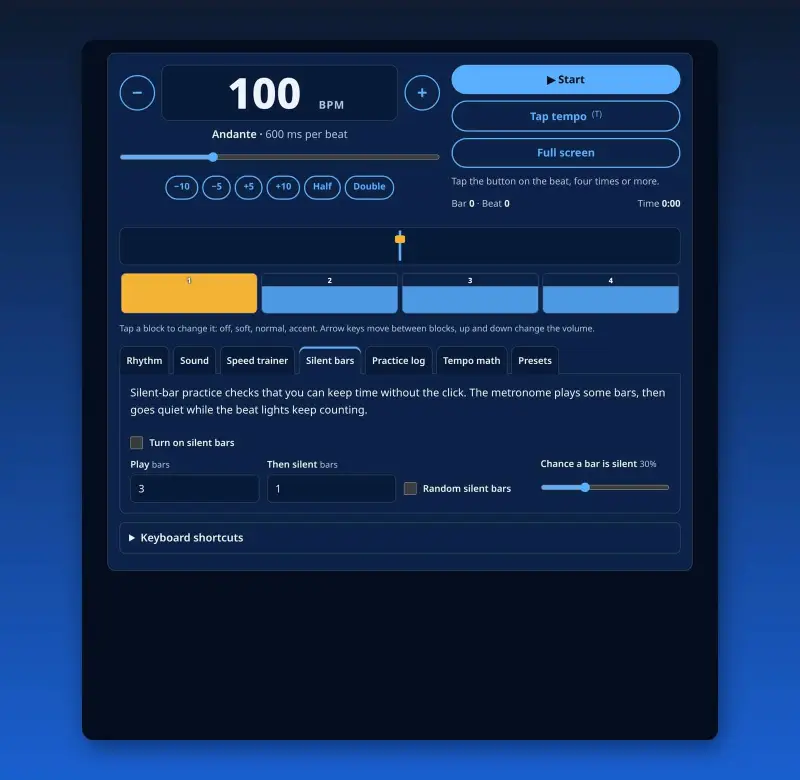
| 13–15 minutes | Silent-bars timing check and cool-down | 2 bars on, 1 bar silent |
Silent bars briefly remove the click, testing whether your internal pulse holds through the gap. The online metronome includes a silent-bars mode. This short routine can sit inside a broader guitar practice plan.
Build speed in rhythm parts, too
For chord changes, choose two shapes and count clean switches for one minute. Then put them in time with a slow metronome, playing one strum per beat, and increase the tempo as the changes become reliable. The CAGED system guide covers movable chord shapes that can help with transitions.
For strumming, keep your hand moving in steady down-and-up sixteenth notes, including when a stroke doesn't hit the strings. The strumming patterns tool lets you practice patterns at different tempos. Consistent motion gives the rhythm hand a dependable framework as the pace rises.
Keep the practice sustainable
Ten to fifteen focused minutes a day can be more useful than a longer session of tense, inaccurate repetition. Alternate picking is a practical starting point because it gives the picking hand a steady pattern; alternate and economy picking can both reach high speeds. Whatever approach you use, keep the notes clean at your working tempo and use bursts to test the next level. The gain comes from returning regularly and letting the recorded tempo show the longer-term progress.


