Capo on the 4th Fret: Chord Chart, Keys and Guitar Tips
Capo 4 turns familiar C, G and Am shapes into E, B and C# minor, with practical guidance on voicings, tuning and song use.
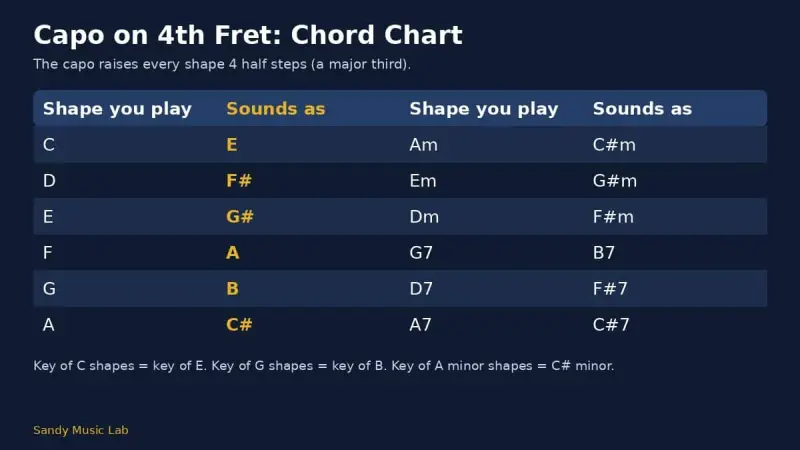
Capo 4 gives guitarists a quick route to keys such as E, B and C# minor while keeping familiar open chord shapes under the fingers. Every shape sounds four semitones higher: C becomes E, G becomes B, D becomes F#, and Am becomes C#m. The higher position also produces a brighter, more ringing character that can suit fingerpicking or add a distinct layer alongside another guitar.
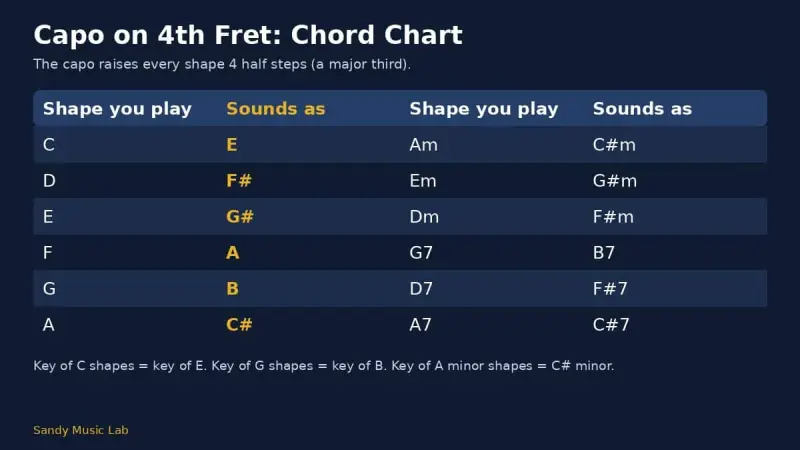
Capo 4 chord chart
Each fret raises the pitch by one semitone, so placing a capo at the fourth fret transposes every chord up a major third. Keep the fingering shown on the chord sheet and use the chart to identify the sounding chord.
| Shape played | Chord heard | Shape played | Chord heard |
|---|---|---|---|
| C | E | Am | C#m |
| D | F# | Em | G#m |
| E | G# (Ab) | Dm | F#m |
| F | A | A7 | C#7 |
| G | B | E7 | G#7 |
| A | C# (Db) | D7 | F#7 |
| Cadd9 | Eadd9 | Fmaj7 | Amaj7 |
One practical benefit is that several difficult open-position chords become familiar shapes. C#m, F#, G#m and B can involve barre chords without a capo; at capo 4, those sounds can be played with Am, D, Em and G shapes. That can make a part easier to finger and let open strings ring in a different way.
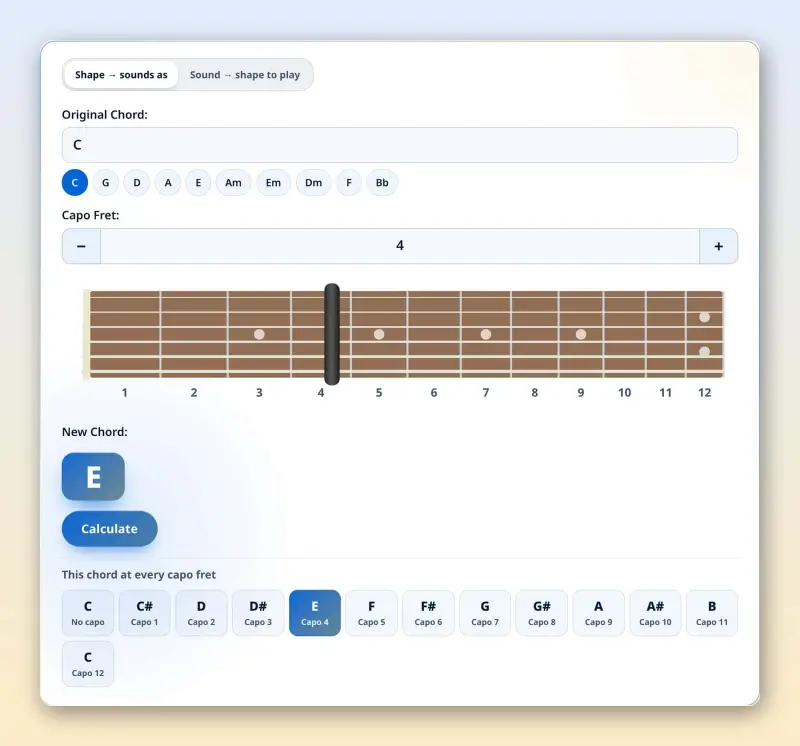
Which key do the shapes produce?
Transpose the key of the shapes up four semitones. The common C-shape progression C, F, G and Am, for example, sounds in E major. G shapes land in B, while Am shapes place the harmony in C# minor.
| Shape key | Typical shapes | Sounding key at capo 4 |
|---|---|---|
| C major | C, F, G, Am | E major |
| G major | G, C, D, Em | B major |
| D major | D, G, A, Bm | F# major |
| A major | A, D, E, F#m | C# major |
| A minor | Am, F, C, G | C# minor |
| E minor | Em, C, G, D | G# minor |
For a song that needs to sound in E, the reverse calculation is just as useful: move down four semitones from the target key to find the shapes to play. At capo 4, C shapes give E; G shapes give B; D shapes give F#; Am shapes give C#m; and Em shapes give G#m.

Those options can reduce the amount of barre work in a progression. Without a capo, the listed keys can call for chords such as E, A, B and C#m in E, or B, E, F# and G#m in B. Capo 4 lets a guitarist approach those harmonies through more familiar open shapes.
Capo 4 or capo 2 for E?
Both capo 4 with C shapes and capo 2 with D shapes put the guitar in E, but they offer different voicings. The capo 4 arrangement is brighter and more jangling, with C, F, G and Am shapes. Capo 2 uses D, G, A and Bm shapes and tends to sound fuller and a little deeper.

The awkward chord changes differ too. F can be simplified to Fmaj7 or a partial shape with capo 4; Bm can be played as a partial shape with capo 2. The higher capo can work well for fingerpicking or a second guitar part, while the lower position may suit a main strummed rhythm. With two guitars, using both positions in E gives the same key different voicings, widening the arrangement without changing its harmony.
Song example and setup tips
Dolly Parton’s “Jolene” is a familiar capo 4 example. Lessons commonly use Am, C, G and Em shapes; with the capo, those shapes sound in C# minor, matching the recording. Fingerpicked folk and pop songs in E or B can also use capo 4 to retain open-position shapes.
If the guitar doesn’t line up with a recording, check its tuning first, then try capo 3 or 5 if the song sits in a different key. A singer can use the same capo options to find a comfortable range while keeping the arrangement’s shape manageable.
- Tune before attaching the capo, then check again. The strings can read slightly sharp after clamping.
- Place it just behind the fret wire. Accurate placement helps avoid pushing the strings unnecessarily sharp.
- Use light fretting pressure. At the fourth fret, the string length is shorter, so a firm grip may be more than the chord needs.
- Give your fingers room. Shapes are more compact here; arch your fingers so nearby open strings continue to ring.
- Simplify F when needed. Fmaj7 or a three-string F can make the change easier while keeping a suitable voicing.
Capo 4 is most useful when the target key is convenient but its open-position chords are not, or when a brighter voicing helps the arrangement. The chart makes the transposition predictable; the final choice comes down to which shape, register and string sound best for the part.


