Guitar String Frequencies: Standard, Alternate Tunings and Bass Charts
See the exact frequencies for standard guitar, alternate tunings and bass, plus the equal temperament formula and a practical method for tuning by ear.
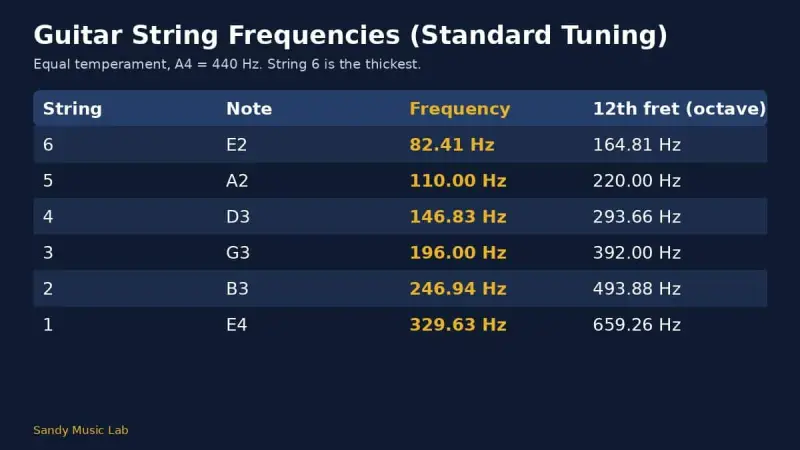
Knowing a string’s target frequency makes alternate tunings easier to set up and gives you a reliable reference when tuning by ear. At A4 = 440 Hz, a guitar in standard tuning runs from E2 at 82.41 Hz to E4 at 329.63 Hz. Those figures also make the relationships between strings clear: the open high E is four times the frequency of the low E, or two octaves higher.
The chart values below are rounded to two decimal places. They describe the open strings; fretted notes rise in pitch according to equal temperament, where each semitone multiplies frequency by about 1.0595.
Standard tuning reference
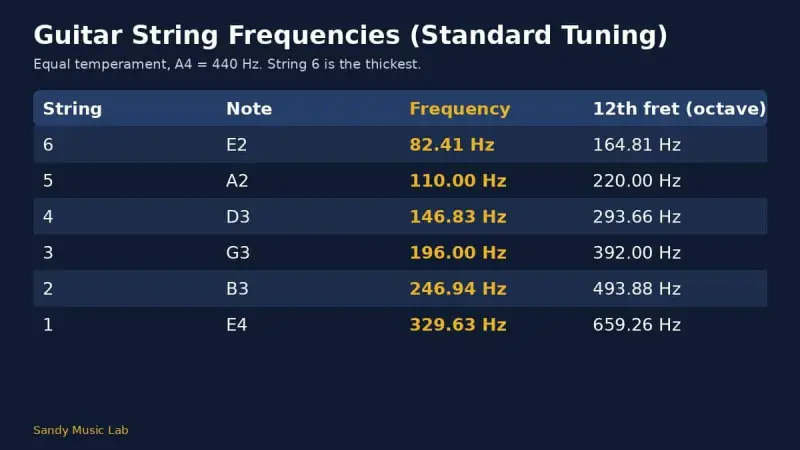
Standard tuning, E A D G B E, places the A string at 110 Hz. That’s two octaves below A4, the 440 Hz reference pitch used for the figures in this guide. The remaining open-string targets are:
| String | Name | Scientific pitch | Frequency (Hz) |
|---|---|---|---|
| 6 (thickest) | Low E | E2 | 82.41 |
| 5 | A | A2 | 110.00 |
| 4 | D | D3 | 146.83 |
| 3 | G | G3 | 196.00 |
| 2 | B | B3 | 246.94 |
| 1 (thinnest) | High E | E4 | 329.63 |
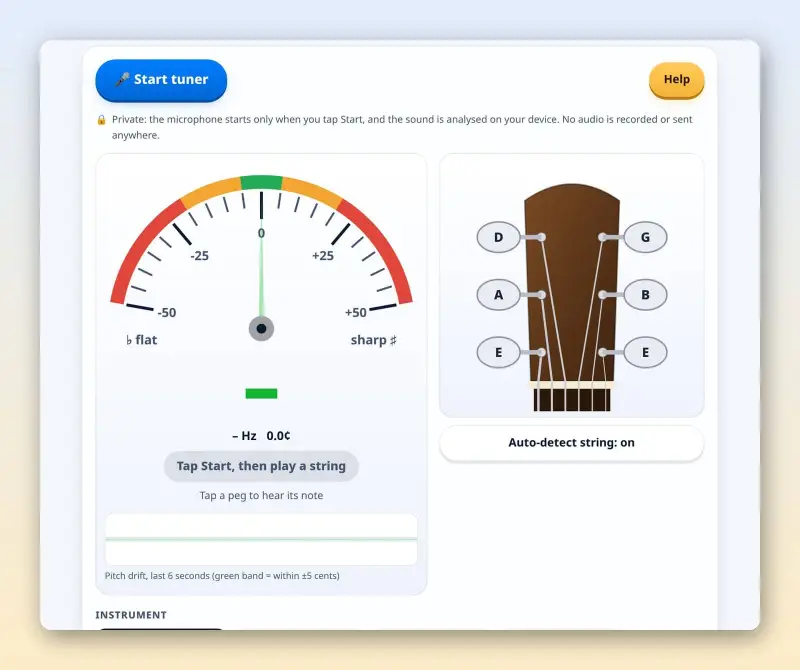
For a tuner workflow, the note name and frequency are two ways to identify the same target. A reference tone can help when you want to check a tuner by ear, set up an instrument without using its microphone, or compare pitches across instruments. The standard string names and their order are covered in this guide to guitar string names and notes.
Alternate tuning targets
Drop tunings lower the sixth string while leaving the other strings in place; down tunings shift every string. The difference matters when using a frequency generator, because one incorrect reference tone can put the whole setup off. These targets all use A4 = 440 Hz.
| Tuning | 6 | 5 | 4 | 3 | 2 | 1 |
|---|---|---|---|---|---|---|
| Standard (E A D G B E) | 82.41 | 110.00 | 146.83 | 196.00 | 246.94 | 329.63 |
| Drop D (D A D G B E) | 73.42 | 110.00 | 146.83 | 196.00 | 246.94 | 329.63 |
| Half step down (Eb Ab Db Gb Bb Eb) | 77.78 | 103.83 | 138.59 | 185.00 | 233.08 | 311.13 |
| D standard (D G C F A D) | 73.42 | 98.00 | 130.81 | 174.61 | 220.00 | 293.66 |
| Drop C (C G C F A D) | 65.41 | 98.00 | 130.81 | 174.61 | 220.00 | 293.66 |
| Open G (D G D G B D) | 73.42 | 98.00 | 146.83 | 196.00 | 246.94 | 293.66 |
Drop D keeps five strings at standard pitch and lowers the low E to D2, or 73.42 Hz. Drop C combines that lowered sixth string with D standard tuning on the other five strings, bringing the low note to C2 at 65.41 Hz. A built-in guitar tuner can select these tunings directly; the half-step-down guide covers the Eb setup.
Bass string frequencies
A four-string bass uses E1, A1, D2 and G2: the same pitch classes as the guitar’s lowest four strings, one octave lower. A five-string bass adds B0 below them. The lower register can be harder to judge on small speakers, so a reference tone may be easier to compare through headphones or a suitable playback system.
| String | Note | Frequency (Hz) |
|---|---|---|
| Low B (5-string) | B0 | 30.87 |
| E | E1 | 41.20 |
| A | A1 | 55.00 |
| D | D2 | 73.42 |
| G | G2 | 98.00 |
Equal temperament and fret positions
In equal temperament, an octave is divided into 12 equal semitone steps. Each step raises frequency by the twelfth root of 2, approximately 1.0595. That gives a simple way to calculate a note from a known reference:
- One fret higher: multiply the frequency by 1.0595.
- Twelve frets higher: double the frequency for a one-octave rise.
- Any note relative to A4: f = 440 × 2^(n / 12), where n is the number of semitones above or below A4.
The low E, E2, sits 29 semitones below A4. Applying the formula gives 440 × 2^(-29 / 12), or 82.41 Hz. On a 24-fret guitar, the 24th fret of the high E string reaches E6 at about 1,318.51 Hz; a 22-fret instrument reaches D6 at about 1,174.66 Hz on that string.

Why string pitch changes
Three physical properties set the pitch of a vibrating string: its vibrating length, tension and mass. Fretting shortens the active length, raising the note. Tightening the string increases tension and raises pitch, while a heavier string vibrates more slowly than a lighter one at otherwise similar conditions.
Those relationships also explain why a tuning change can affect feel. Lower tunings reduce pitch by reducing string tension, while string gauge and scale length shape the tension needed to reach a given note. A string tension calculator can compare tension across tunings and scale lengths; the string gauge finder helps identify gauges for lower tunings.
Fundamental, overtones and tuning by ear
The listed frequency is a string’s fundamental. A plucked string also produces overtones at integer multiples of that frequency, including 2×, 3× and 4×. Their relative levels contribute to the instrument’s tone, so a guitar doesn’t sound like a single pure tone even when its fundamental is 82.41 Hz. For the same reason, guitar EQ decisions often involve frequencies well above the fundamental; the EQ frequency chart provides a broader reference.
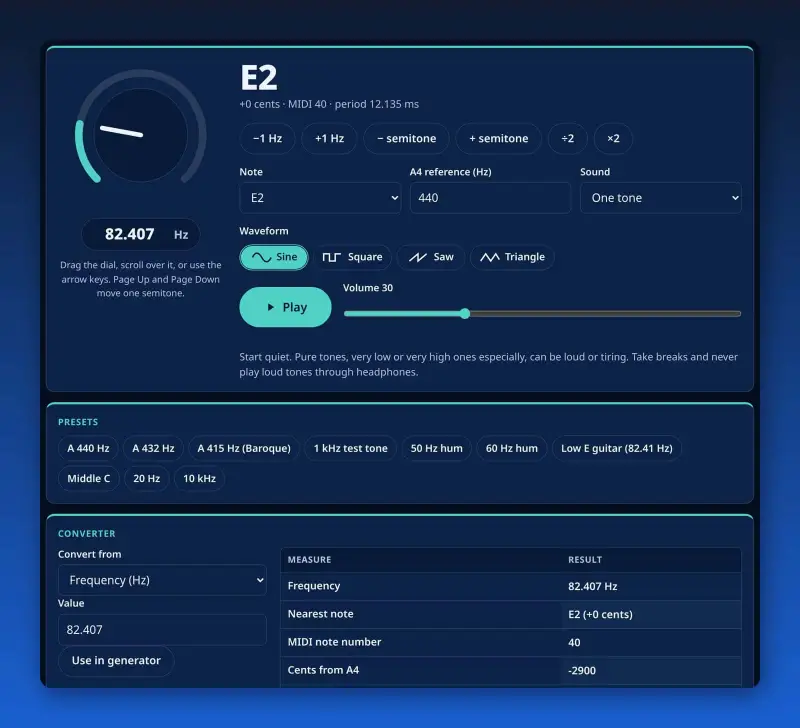
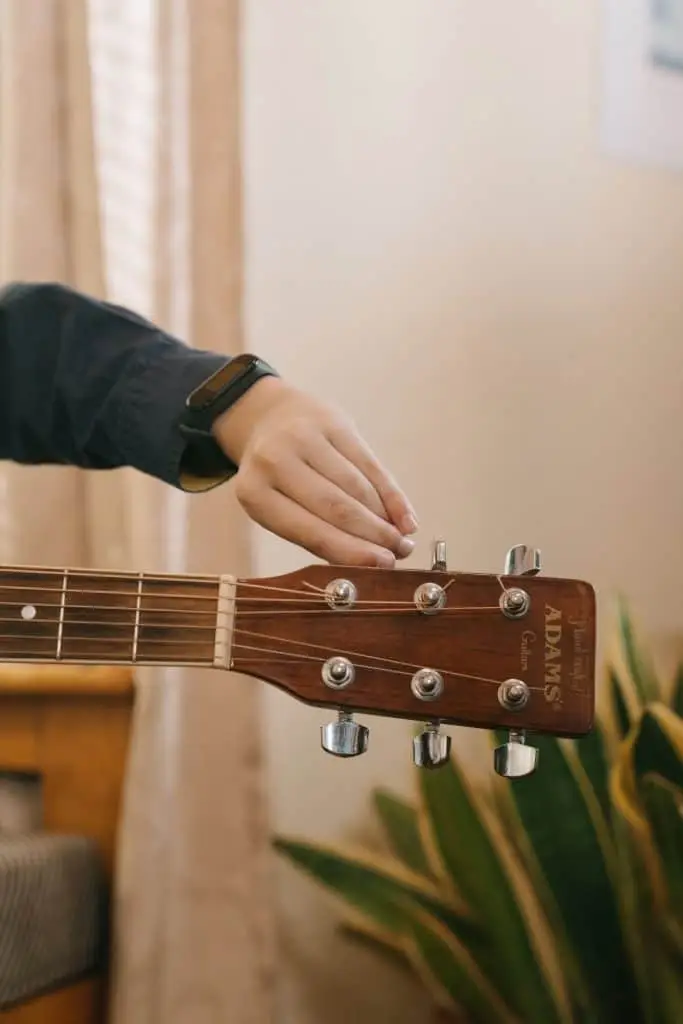
To tune against a reference tone, play the target frequency for the open string, then pluck the string and listen for beats: a slow fluctuation in loudness as the two pitches interact. Adjust the tuning peg until that pulsing slows and disappears. Repeat for each string, or use one tuned string as a reference for the others with the fifth-fret method described in this guide to tuning by ear.
- Choose the correct tuning and string target, such as 82.41 Hz for low E in standard tuning.
- Play that frequency with a tone generator.
- Pluck the open string and adjust its tuning peg while listening to the beats.
- Check the other strings against their own reference tones or against a string that’s already in tune.
Small speakers can struggle to reproduce low E clearly. In that case, play E3 at 164.81 Hz and compare it with the low E string’s 12th-fret harmonic, which is one octave above the open string. This keeps the comparison in a range that may be easier to hear while preserving the same pitch relationship.
All values here were calculated using equal temperament at A4 = 440 Hz and rounded to two decimal places. The practical takeaway is to match both the note and tuning before adjusting: a frequency chart is most useful when it reflects the instrument’s actual setup.


