Memorize the Guitar Fretboard with Five Methods and a Four-Week Routine
Learn the natural notes on two strings, map the rest with octave shapes and build recall through short daily quizzes.
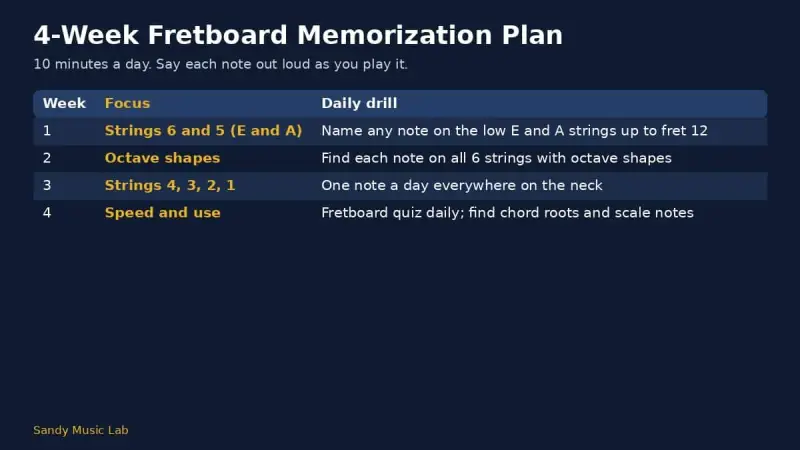
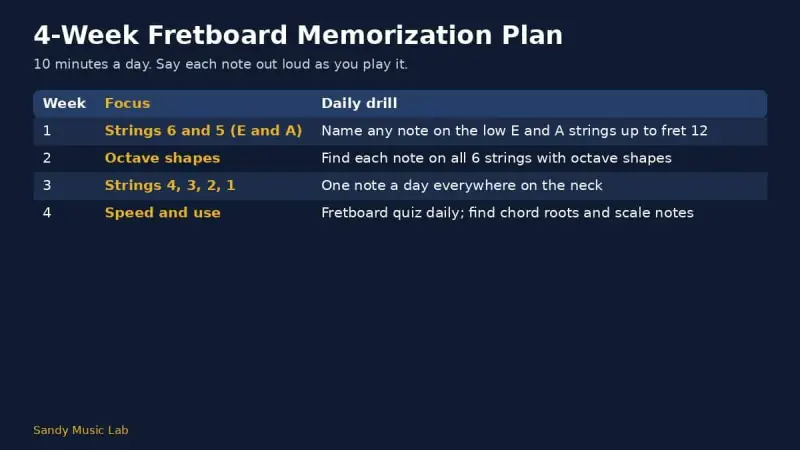
Knowing the notes across the guitar neck makes chord placement, scale work, transposing and communication with other musicians more direct. The task is smaller than it looks: there are 12 notes before the pattern repeats at the 12th fret. With a few reliable reference points and 10 minutes of focused practice each day, many players can learn the low E and A strings in a week and get familiar with the full neck within a few weeks.

Three facts make the neck easier to map
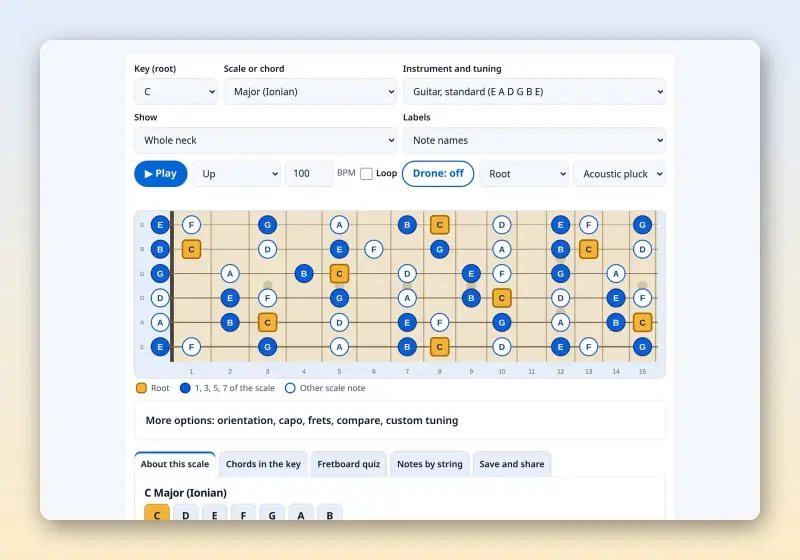
Each fret raises a note by one half step. The 12-note sequence is A, A#/Bb, B, C, C#/Db, D, D#/Eb, E, F, F#/Gb, G and G#/Ab, then A again. Two neighboring natural-note pairs, B–C and E–F, sit one fret apart; all the other natural-note pairs have a fret between them.
The 12th fret repeats the open-string note an octave higher. That means learning frets 0 through 11 gives you the map for the rest of the neck. Once you have memorized a few positions, the remaining notes can be worked out by counting half steps.
Start with the low E and A strings
The sixth and fifth strings are practical starting points because guitarists often use them for bass notes and chord roots. Say each note aloud while playing up and down the strings; the combination of sound, movement and naming gives you more to work with than reading a chart alone.
| String | Fret 0 | Fret 1 | Fret 3 | Fret 5 | Fret 7 | Fret 8 | Fret 10 | Fret 12 |
|---|---|---|---|---|---|---|---|---|
| Low E | E | F | G | A | B | C | D | E |
| A | A | A#/Bb | C | D | E | F | G | A |
Once these positions feel familiar, barre chords rooted on either string are easier to place. One especially useful reference is the fifth fret of the low E: it is A, matching the open A string, a relationship that also helps when tuning by ear.
Carry known notes across the other strings
Octave shapes let you transfer a note you know to a different string. From the low E to the D string, move up two strings and two frets; for example, F at the first fret of the low E appears at the third fret of the D string. The same two-string, two-fret shape works from A to G.
The B string changes the spacing. From D to B, and from G to high E, move up two strings and three frets. Low E and high E are tuned two octaves apart at the same fret. These shapes extend what you learn on the low E and A strings across all six strings.
Use fret markers as reference points
The dot inlays at frets 3, 5, 7, 9 and 12 give you fixed landmarks. Learn the notes at those positions, then use them to find nearby frets by moving one or two half steps.
| String | Fret 3 | Fret 5 | Fret 7 | Fret 9 | Fret 12 |
|---|---|---|---|---|---|
| E (6th) | G | A | B | C#/Db | E |
| A (5th) | C | D | E | F#/Gb | A |
| D (4th) | F | G | A | B | D |
| G (3rd) | A#/Bb | C | D | E | G |
| B (2nd) | D | E | F#/Gb | G#/Ab | B |
| E (1st) | G | A | B | C#/Db | E |
Build recall one note at a time
Choose one note, such as C, and find every instance from the open strings through the 12th fret. Play the positions from low E to high E and back, naming the note each time. Then work through G, D, A, E, B and F, following the circle of fifths.
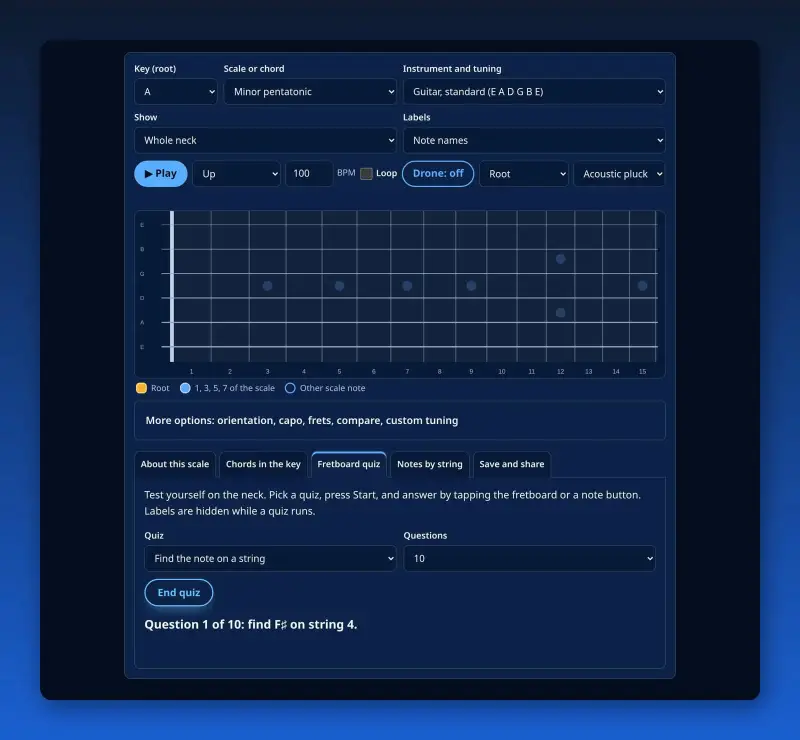
A fretboard tool can show note names while you check your work; switch to dots only when you’re ready to test recall. This progression keeps the task focused while helping connect note locations with chord and scale patterns.

Quiz yourself, then use the notes in music
Recognition from a chart is a start, but recall is what helps the notes stick. Begin with a 10-question quiz that asks you to find a note on a specified string. Then switch to a naming mode, where a fret is highlighted and you identify the note. Aim for 10 correct answers without hesitation before moving to 20 questions.
Keep track of your results. Repeated misses on the same strings point to the positions that need another pass. Make the practice useful at the same time: name the root of each chord you play and identify the notes in riffs you learn. The circle of fifths and CAGED chord shapes can help connect fretboard positions to harmony and scale patterns.
Keep the practice focused
Trying to learn every string at once can make the neck feel like a pile of unrelated positions. Add strings in stages, play and speak the notes rather than relying on charts, and watch the two one-fret natural-note pairs: B–C and E–F. Those are common places to lose your count.
Memorization helps with barre chords, scales, soloing and transposing, but it doesn’t need to be a separate exercise from playing. Ten minutes a day spent finding notes, naming chord roots and checking recall gives the knowledge a place in your actual playing. Beyond the 12th fret, the same note pattern returns an octave higher.


