AudioLab 3000CD and 3000A Pair CD Playback with a 35W Integrated Amp
AudioLab’s 3000CD adds an onboard ESS DAC and broad digital connections, while the 3000A supplies 35W per channel into 8 ohms and includes a phono input.
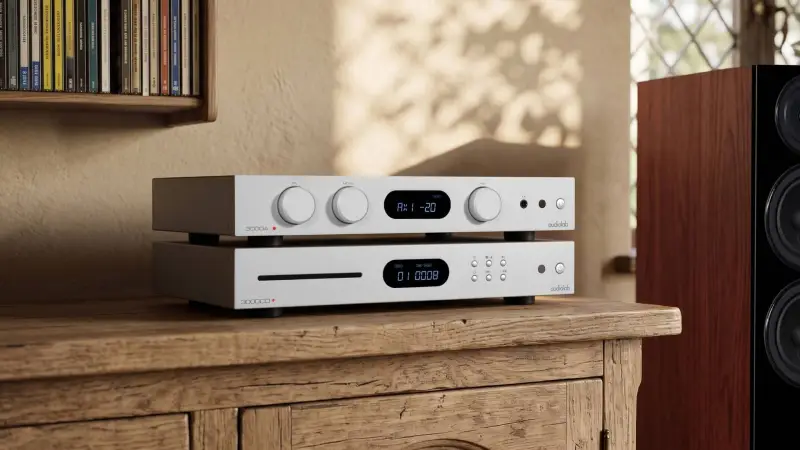
AudioLab’s new 3000CD and 3000A bring CD playback, digital conversion and speaker amplification together as a home hi-fi pairing priced at £449 (about $600, AU$900) per component. Both are due to go on sale in November. The price puts the system within reach of listeners building a separates setup on a budget, while its mix of digital and analogue connections gives it room to work with more than just a CD collection.
The 3000CD is a complete CD player rather than a transport that relies on a separate digital-to-analogue converter. Its built-in DAC comes from ESS Technology, so the player can send an analogue signal directly to an amplifier. It can also act as a digital source for other equipment, giving buyers options for how they assemble the rest of the chain.
CD playback with a built-in DAC
AudioLab describes the 3000CD’s disc-reading system as designed for stable playback. A servo controls the spindle speed, keeps the laser focused and tracks the disc’s rotation. Those jobs help the player read the data on a CD consistently; the servo does not change the recording, but it supports the process of retrieving it from the disc.
The player supports standard CDs as well as CD-R and CD-RW. That matters for listeners with discs they have recorded themselves: the 3000CD is specified to play FLAC, WAV and WMA files from those formats. The available information doesn’t list further file limits or playback settings, so buyers with particular disc-authoring habits may want to check those details before choosing it.
Its connections cover several common hi-fi arrangements. Analogue outputs include RCA and XLR, while digital connections comprise two optical and two coaxial outputs. A USB-C port lets a computer connect to the player’s ESS DAC, offering a way to route computer audio through the same conversion stage used for discs. The exact supported computer formats and operating systems haven’t been specified.
That range of connections makes the 3000CD more flexible than a CD transport, which sends a digital signal onward for conversion elsewhere. AudioLab’s 6000CDT MKII is an example of a dedicated transport; the 3000CD instead has its own DAC and analogue outputs. A listener can connect it straight to an amplifier, or use its digital outputs with a separate DAC if the rest of the system calls for that approach.
An amplifier with room for other sources
The 3000A is intended to pair with the CD player, but it can also amplify signals from other sources. Its rated output is 35W into 8 ohms or 55W into 4 ohms. Those figures describe power at the two stated speaker impedances; they don’t, on their own, establish how loud the amplifier will play in a particular room. Speaker sensitivity, listening distance and room size all affect the result.
AudioLab says the amplifier is designed to preserve signal integrity as it raises the source signal to drive speakers. In a conventional system, a source such as the 3000CD supplies an audio signal, and the amplifier provides the power needed at the speaker outputs. Pairing the two gives buyers a straightforward route from disc to loudspeaker, with each component handling a distinct part of the signal chain.
For analogue sources, the 3000A has one phono input and three RCA inputs. The phono connection is intended for a turntable, making the amplifier a possible starting point for a system that combines vinyl and CD playback. The source information doesn’t specify the phono input’s cartridge compatibility, so anyone choosing a turntable should confirm that it suits their cartridge.
A 6.35mm headphone jack is also on board, with its own headphone amplifier. That means headphones can be connected without adding a separate headphone amp, while the main speaker outputs remain the route for listening through loudspeakers. The available specifications don’t give a headphone power rating or supported impedance range.
A practical two-piece starting point
The 3000CD and 3000A look most useful for listeners who want a dedicated disc player but also need an amplifier that can accept several sources. The player’s DAC and analogue outputs keep the initial setup simple; its digital outputs leave the option of using another converter, and USB-C adds computer playback to the list of possible sources. On the amplifier side, the phono input and three RCA connections leave space for a turntable and other analogue gear.
At £449 (about $600, AU$900) each, the pair represents a £898 total before speakers, cables or other components. Buyers will need to account for those pieces when comparing the system with an all-in-one player or a different separates setup. The key details to check against an existing system are the amplifier’s power needs relative to the speakers, the turntable’s cartridge requirements, and the computer audio formats supported over USB-C.
With both components scheduled for November, the 3000CD and 3000A give CD listeners a new route into separates without limiting the amplifier to disc playback. Their appeal will come down to how well the connection options fit the rest of a listener’s system, and whether the 3000A’s stated power suits the speakers and room.


