u-he Zebra 3 Review: A Deep Modular Synth Built for Sound Design
After 11 years in development, Zebra 3 pairs more than 1,200 presets with deep synthesis and modulation options. Its flexibility rewards time spent learning the signal flow.
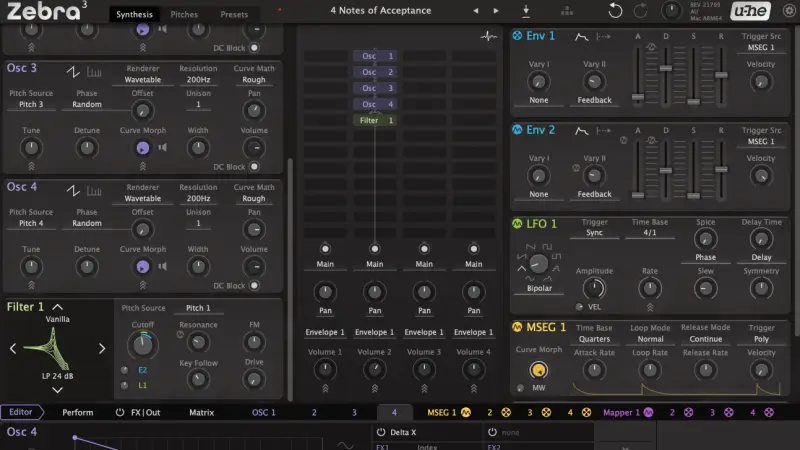
u-he Zebra 3 makes a strong case for patience. The synth arrived in April 2026 after 11 years of development and an extended public beta, and the result is a substantial instrument for producers who want to build sounds from the signal path up. Its breadth can slow down first contact, but the payoff is a wide range of tones and ways to shape them.
A long-running synth grows up
The Zebra line began in late 2003. Zebra 1 established the basic concept, while Zebra 2 brought a major interface redesign and a more modular approach. Zebra 3 keeps that modular foundation and reworks access to its parts, making the signal flow easier to follow while expanding the available synthesis and processing options.
The scope is considerable. Alongside subtractive waveforms, Zebra 3 offers wavetable, additive, FM and modal synthesis. The FM approach is described as Yamaha-style, or phase distortion synthesis. Modal resonators and comb filters sit alongside noise and exciter modules, giving sound designers tools for physical-modeling-style tones. Twenty oscillator effects include spectral decay, oscillator sync and phase remapping.
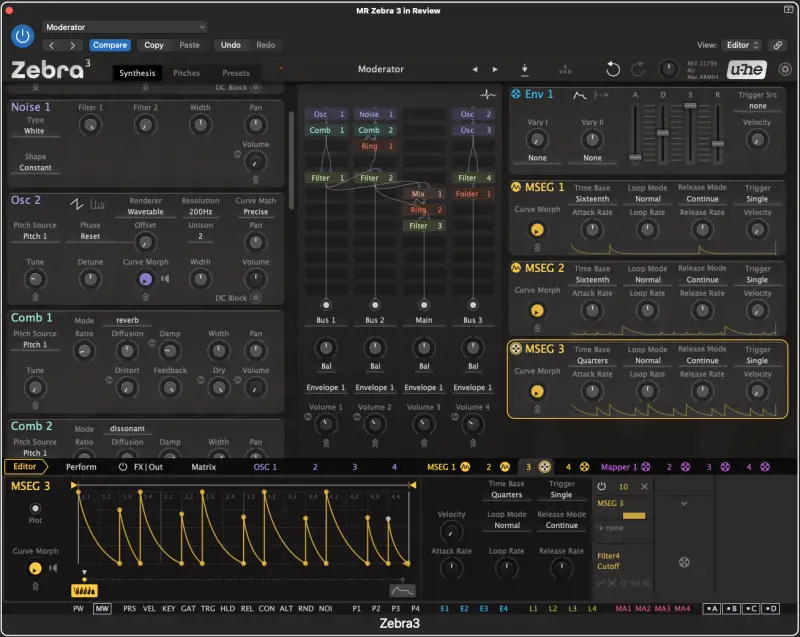
Modulation is central to the instrument. Standard LFOs are joined by Multi-Stage Envelope Generators (MSEGs), which can draw complex shapes, loop them and use them for triggering. Ring modulation, distortion and wave folding broaden the processing options, while an extensive effects section handles further shaping. Zebra 3 also supports MPE, microtuning, Linux and the CLAP plugin format.
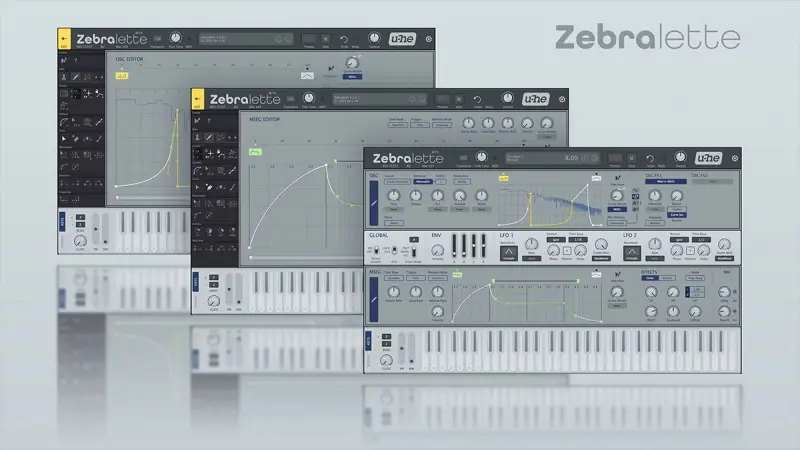
The package costs €249 and includes more than 1,200 presets. It runs on Mac, Windows and Linux, with CLAP, AUv2, VST3 and AAX plugin formats listed. u-he also offers ZebraCM, a free two-oscillator instrument, and Zebralette 3, a free, stripped-down version of Zebra 3.
Presets reveal the range
The preset library is a practical place to start. Its sounds are arranged by category, with a Showcase folder collecting u-he’s selected favourites. The range runs from atmospheres and drum loops to basses, leads, chordal patches and modeled acoustic-style sounds. That breadth makes the synth useful for finding a starting point quickly, even before its deeper programming becomes familiar.
Many patches combine synthesis methods and modulation in ways that take time to unpack. That complexity appears to be a strength of the library: presets provide both playable sounds and examples of how Zebra 3’s modules can work together. The sounds cover different musical settings, from spacious pads to more direct parts, and can help get a writing session moving.
There is one compatibility issue for existing users: patches made in Zebra 2 cannot be imported into Zebra 3. The change reflects the new instrument’s architecture, but it means an upgrade won’t provide a direct route for carrying an older preset collection forward.
Follow the signal path
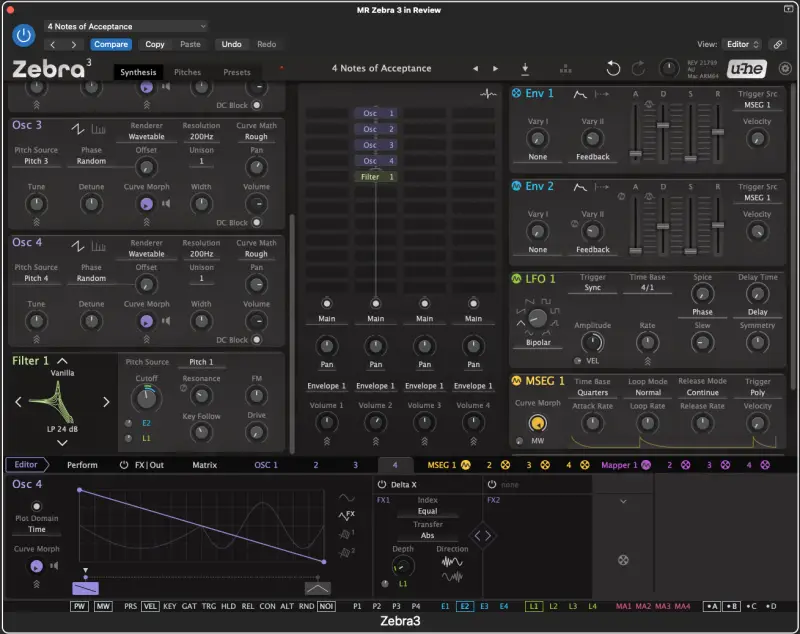
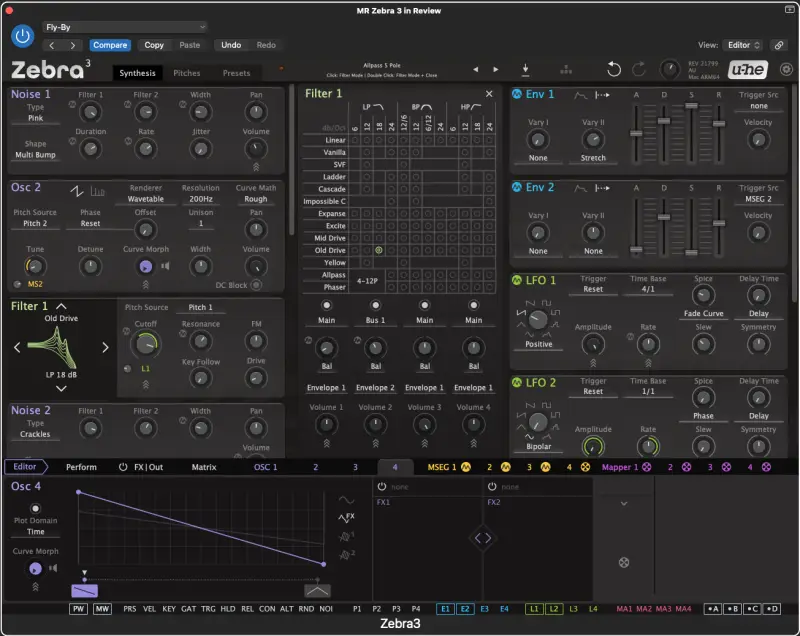
The main Synthesis page is the clearest way into programming. Its central grid presents the signal flow across four columns, which can operate separately or interact. It also makes it straightforward to solo parts and hear individual components while building or investigating a patch. Signal generators sit to the left of the plugin window, modulators to the right, and a lower panel provides quick access to the selected module’s controls.
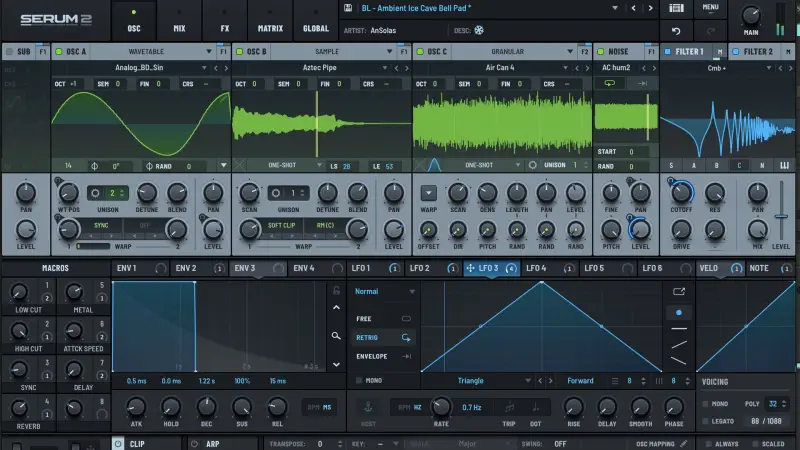
Starting with an oscillator and filter gives familiar subtractive synthesis users a foothold. But Zebra 3’s oscillators are involved, and moving into modal or FM techniques quickly opens up less familiar territory. A sound that appears simple at the output may depend on a more elaborate synthesis process underneath. That can produce clean, focused tones, or provide a foundation for additional processing and distortion.
Wavetable movement is easy to add with an LFO, while four-stage envelopes offer a more conventional way to shape a sound over time. MSEGs go much further: they can create looping modulation patterns and even trigger drum pitches. Following the grid and selecting a module takes you directly to its controls, which helps explain how a patch is assembled and makes adjustments quicker.
For users who find the full instrument overwhelming, u-he’s suggestion to try Zebralette 3 makes sense. Its simpler signal path provides room to learn the basic ideas before taking on Zebra 3’s larger set of modules and routing choices.
Filters and workflow
The filter section has 13 models, with low-pass, high-pass and band-pass options and slopes ranging from 6 to 24 dB. Those choices cover routine tone shaping as well as more detailed patch design. A double-click on the filter module opens a selection grid, so users can compare models without hunting through a long series of menus.
That attention to access extends across the interface. Colour schemes help distinguish sections, and the grid keeps the relationships between modules visible. The design supports hands-on exploration, though the number of choices still asks users to spend time learning where each part fits in the sound.
Who should consider Zebra 3?
For newcomers, the preset library offers an immediate way to use Zebra 3 without first mastering its architecture. Producers who enjoy programming will find a deep instrument whose modules can be combined in many ways. Those with some experience of modular synthesis may find the signal-flow approach especially intuitive, but understanding how the sections interact remains a meaningful learning commitment.
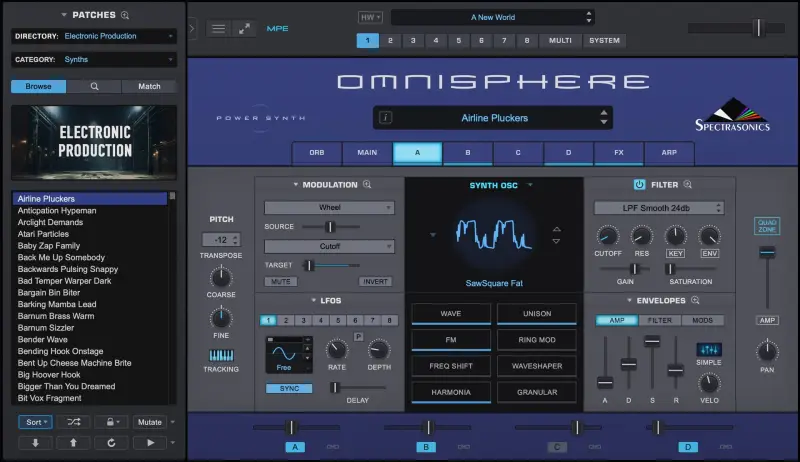
Omnisphere and Serum 2 are alternatives for producers comparing broad software synths. Omnisphere is presented with a library of close to 50,000 sounds, while Serum 2 offers several synthesis options and an established place in commercial music production. For a free introduction to u-he’s approach, Zebralette 3 is the lower-commitment option.
Zebra 3’s strongest argument is the depth behind its playable presets: it can serve as a ready-made sound source or as a modular design environment. Existing Zebra 2 users will need to account for the lack of preset import, while new users should expect a learning curve. For anyone willing to follow the signal path and experiment, the instrument offers room to keep finding new ways through a patch.
Specifications
Price | €249 |
Key features | Interface that adapts as you work; more than 1,200 presets; wavetable, additive, FM and modal synthesis; 20 oscillator effects; 13 filter models; extensive modulation routing; effects section. |
System requirements | Mac, Windows PC or Linux; CLAP, AUv2, VST3 and AAX plugin formats. |
Contact |


