Eric Persing’s Accidental Alpha Juno Preset Became the ‘Hoover’ Rave Synth Sound
Persing created the Alpha Juno patch years before learning European dance producers had made it a defining rave sound.

Eric Persing didn’t set out to create a defining rave synth sound. The patch that became known as the Hoover started as a joke preset for Roland’s Alpha Juno, then found a life of its own in European dance music. Persing only learned that he had made it when he was asked to recreate a Hoover for Roland’s JP-8000, more than a decade later.
The sound had become closely tied to early ’90s rave records, including Second Phase’s “Mentasm” and Human Resource’s “Dominator”. Yet Persing, who is now creative director at Spectrasonics, had no idea that the patch he’d designed for Roland was circulating under that name. Between 1984 and 2004, he worked at Roland as chief sound designer.
A request for a sound Persing had already made
The unexpected reunion came during work on the JP-8000, which Roland released in 1996. In an interview with Anthony Marinelli, Persing recalled that some European distributors felt the available sounds had become too American in character. They wanted Roland to deliver something that suited the tastes of European dance producers.
Persing asked what kind of sounds they were looking for. The answer was “Hoovers.” Nobody could explain what a Hoover was, he said; they only knew that people wanted one. Persing took the request as a practical design brief. He was used to working across different musical settings, so he figured he could research the sound and build something that fit.
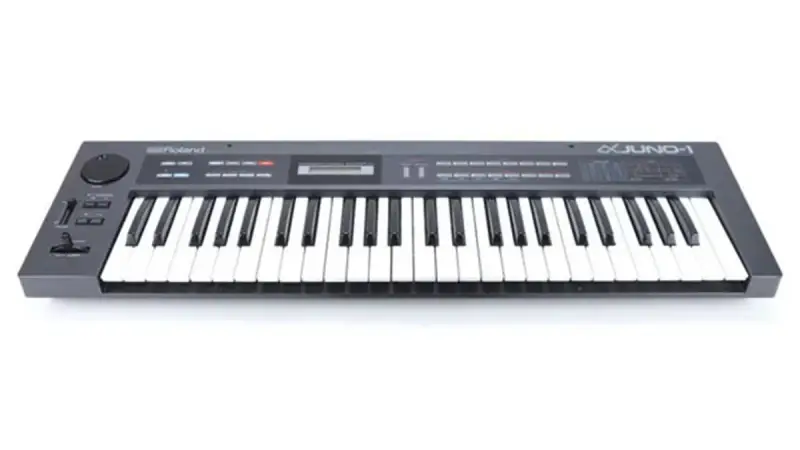
He went online to investigate. That search turned up a page documenting the Hoover and listing the records where it appeared. Persing followed the trail to its instrument: a Roland Alpha Juno. The connection changed the task from sound design to recognition. “I made the sounds for that!” he remembered thinking. “I was the guy who made the Hoover!”
From “What the” to the dance floor
The Alpha Juno arrived in 1985, around a decade before Persing was asked about the Hoover. The preset hadn’t been given that name in the factory, and it wasn’t conceived as a polished flagship sound. Persing said he made it as a joke for the engineers, near the end of the sound list. Unsure what to call it, he labeled the patch “What the.”
That throwaway label didn’t follow the sound into club music. British producers heard the patch, sampled it, and put it to work in dance tracks. Persing recalled that drum and bass producers also began using it. The name “Hoover” came from the sound’s resemblance to a vacuum cleaner switching on and off; in the UK, Hoover is a familiar name for vacuum cleaners.
That route from preset to sampled hook is part of what makes the story useful to sound designers. A patch’s role can change once it leaves the instrument and enters a track: sampling lets producers repeat, edit and place a sound in a new musical context. Here, the patch’s distinctive movement and rough-edged character made it recognizable enough to acquire a nickname and travel well beyond its original keyboard.
Recreating the Hoover today
The Hoover remains a fixture of synth history, and it can be approximated with modern software instruments as well as vintage hardware. AudioRealism’s ReDominator is one option: its design closely resembles the Alpha Juno. That family resemblance matters because the original sound depends on more than a generic saw wave. Its oscillator shape and envelope behavior contribute to the result.
In a 2019 discussion of the sound, ReDominator creator Mike Janney said that a synth with a multi-stage envelope should be capable of making a Hoover-style patch. He cited Native Instruments’ Massive as one possible tool, while cautioning that the Alpha Juno’s envelope has an unusual combination of linear and exponential sections. He also pointed to the instrument’s PWM Saw, a shape-modulatable sawtooth waveform, as a distinctive part of the sound.
Janney wasn’t sure that other off-the-shelf synths offered the same oscillator feature. For producers building the sound in software, that’s a useful distinction: a broadly similar patch may capture the Hoover’s energy, but reproducing the Alpha Juno’s particular waveform behavior can be a different challenge. Persing’s accidental classic shows how far a single preset can travel; the practical starting point for recreating it is to pay attention to both the oscillator and the envelope, not just the name on the patch.


