Martinic Prodigy Review: A Faithful Moog Classic With More Room to Play
Martinic’s Prodigy captures the Moog’s weighty ladder-filter sound and adds polyphony, a sequencer and expanded modulation for £58.
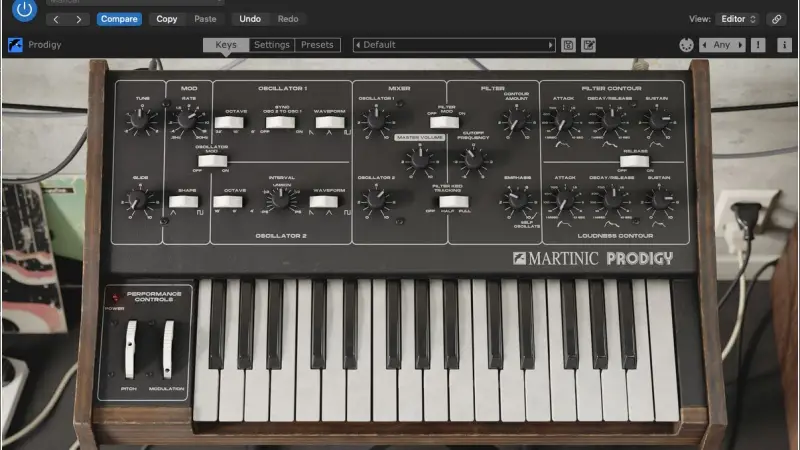
Martinic’s Prodigy makes a strong case for revisiting a deliberately limited monosynth: it keeps the original Moog’s weighty oscillator and ladder-filter character, then adds tools that make the instrument more flexible in a modern session. The result is both a convincing take on the Prodigy and a capable synth in its own right.
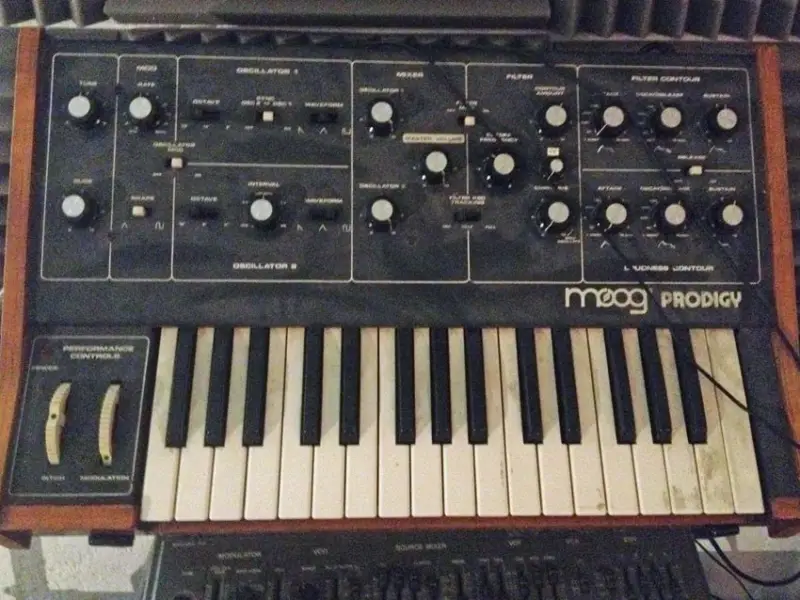
A compact Moog design
Moog introduced the hardware Prodigy in 1979, when monosynths were a familiar fixture onstage but often expensive and heavy. The company’s answer was a more affordable instrument with a wood-sided case, two oscillators and its 24dB ladder filter. Its original price was £295, a comparatively accessible figure at the time, though still a substantial purchase.
The cost-conscious design came with clear limits. Each oscillator offered three waveforms: saw, triangle and square on VCO 2, while VCO 1 substituted a fixed-width pulse for square. Users could sync the oscillators or shift VCO 2’s pitch to create basic intervals, reaching up to a fifth above or below VCO 1. The LFO provided triangle and square waves, routed to pitch or filter.
Two three-stage envelopes followed Moog’s familiar ADS contour, with a switch to add release. The controls also reflected the lower price: the pots were less sturdy than those on higher-end Moog instruments, and the panel switches could fail. Those restrictions are part of the Prodigy’s identity, but they also explain why a software version benefits from offering a deeper mode alongside the original layout.
Modelled sound, familiar controls
Martinic presents the plugin with the hardware’s keyboard and control panel in the foreground, set against softly blurred cabling. The interface has a lightly worn appearance, down to small-looking marks on the panel and woodwork. It gives the instrument a lived-in feel without making the controls difficult to read.
Start with the default saw wave and the sound is bright, but there’s weight behind it. Bringing in the second oscillator thickens the tone quickly, a useful reminder that the Prodigy’s straightforward architecture can deliver satisfying bass and lead sounds without much programming.
The filter is the centrepiece. Its cutoff responds quickly, taking the oscillator signal out early in the control’s travel. The resonance control, labelled “Emphasis,” produces the familiar loss of low end as it rises. Push it far enough and the filter self-oscillates; turn down the oscillators and that sine-like tone can stand on its own. The filter’s behaviour and character make a persuasive match for the instrument’s central sound.
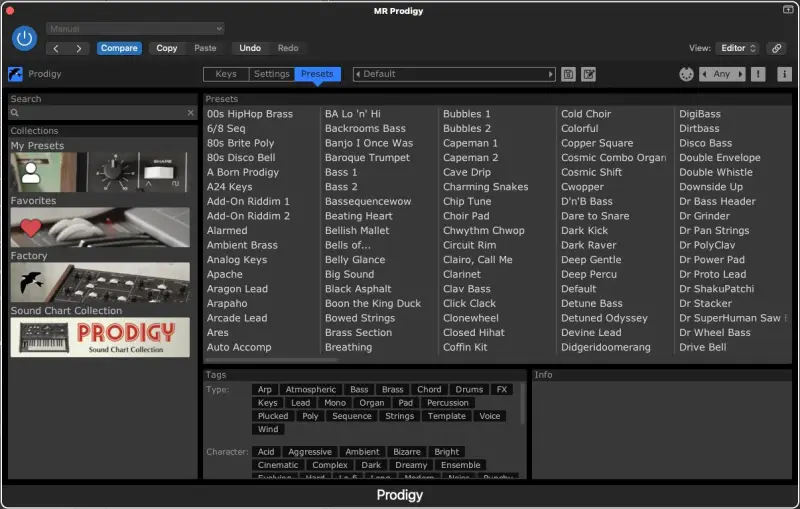
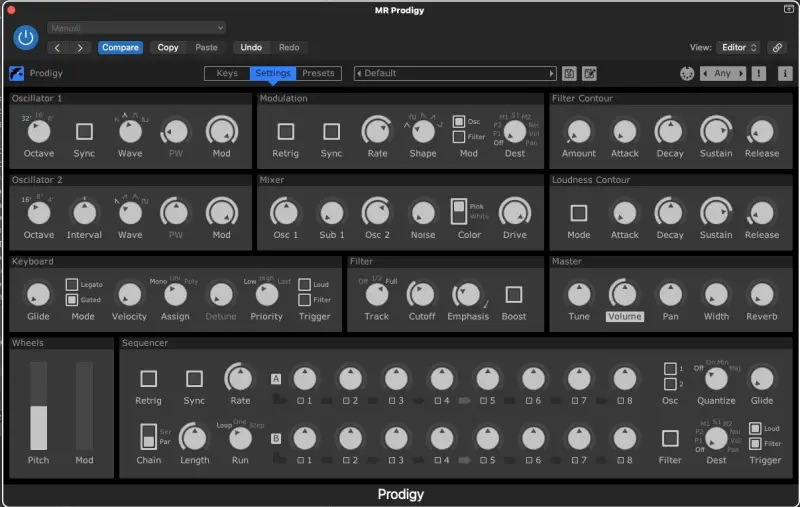
Here’s the practical wrinkle: Martinic has also built in an Advanced mode, accessed from the plugin’s Settings page. A boost option can compensate for the bass loss at high resonance, and the expanded controls give sound designers more room to shape patches than the original panel allows. The added features are useful, even if this page is less visually evocative than the main interface.
Advanced mode and performance options
Advanced mode expands the oscillator section to four waveforms and adds a basic sub oscillator and a choice of pink or white noise. An overdrive control adds grit and can reinforce the synth’s low end. The envelopes gain a fourth stage, while the LFO grows to five waveforms and offers a wider selection of modulation destinations.
The sequencer is a notable addition. It can run as one 16-step pattern or split into two eight-step lanes, with modulation destinations available for shaping movement across the sequence. It can sync to tempo, making it straightforward to fit into a DAW arrangement.
The plugin also extends the instrument’s performance range beyond the original monosynth setup. It supports six-note Unison mode and eight-note polyphony, plus MPE pitch bend. That gives players options for layered, multi-note parts while retaining a focused path back to the classic monophonic sound.
Formats, effects and alternatives
Martinic Prodigy is available for £58 for a full licence or £20 for a one-year licence. It runs on MacOSX and WindowsPC as an AU, VST2/3, AAX or CLAP plugin. There’s no standalone version, so it needs to run inside a compatible host. The included effects are focused: overdrive and a spring reverb modelled for the instrument.
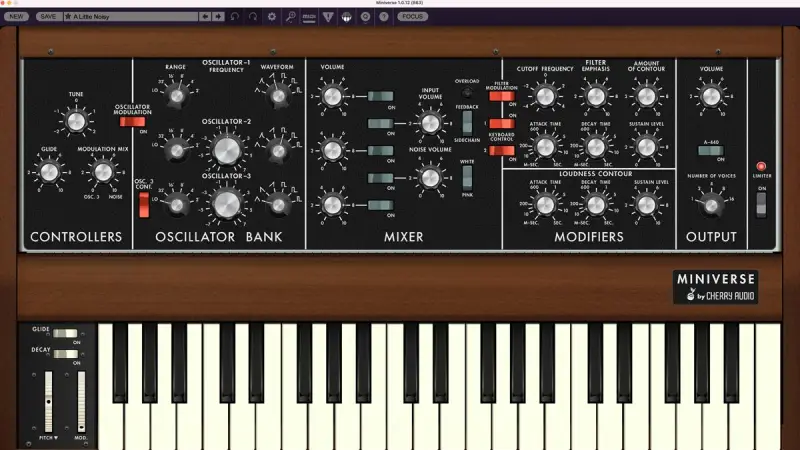
For buyers who want Prodigy sounds without the plugin’s modelling approach, Vintage Synth Sample offers a sample set made from the original hardware across two volumes. Cherry Audio’s Miniverse is another nearby option: it models a Minimoog rather than a Prodigy, with some related characteristics.
Verdict
Martinic has made the Prodigy’s defining strengths easy to reach: a bright, substantial oscillator sound and an expressive ladder filter, presented through an interface that clearly evokes the hardware. Advanced mode adds enough synthesis and sequencing options to keep the instrument useful when a patch calls for more than the original design could provide.
The split between the faithful main panel and the more practical Settings page lets users choose how closely they want to work to the original. With polyphony, MPE support and a syncable sequencer added to the mix, this is more than a static hardware portrait. Producers looking for a compact bass and lead instrument can start with the familiar controls, then turn to the extra modes when a track asks for broader parts or more motion.


