Cherry Audio Ensoniq ESQ-1 Review: A Distinctive Hybrid Synth for the Desktop
Cherry Audio’s ESQ-1 brings three digital oscillators, a modeled Curtis filter and expanded effects to a 32-voice software instrument.
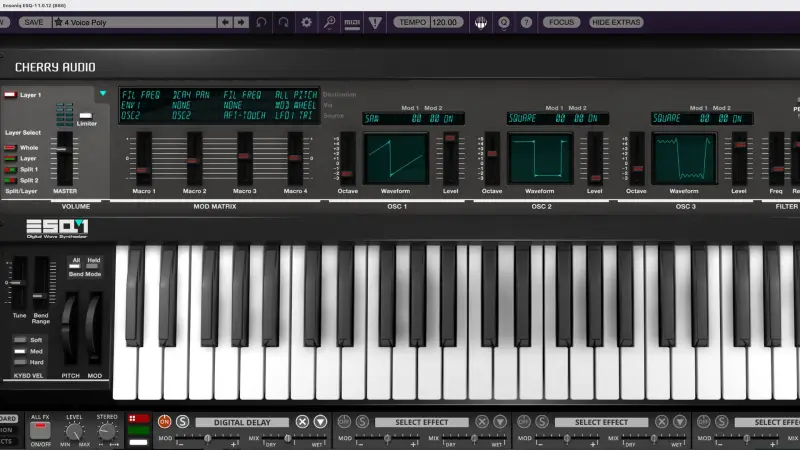
The Cherry Audio Ensoniq ESQ-1 makes a strong case for revisiting a hybrid synth that sat outside the mainstream of its era. Its mix of complex digital waveforms and an analogue-style Curtis filter gives it a different voice from familiar subtractive instruments, while modern effects and expanded polyphony make it easier to use in current productions.
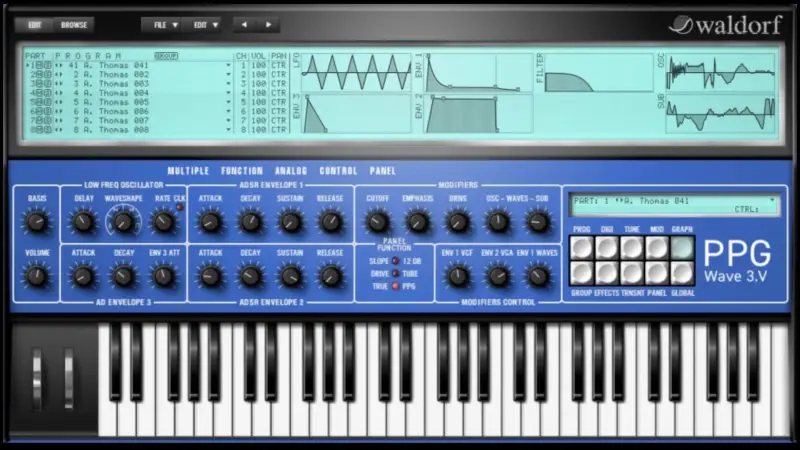
A hybrid design with room to move
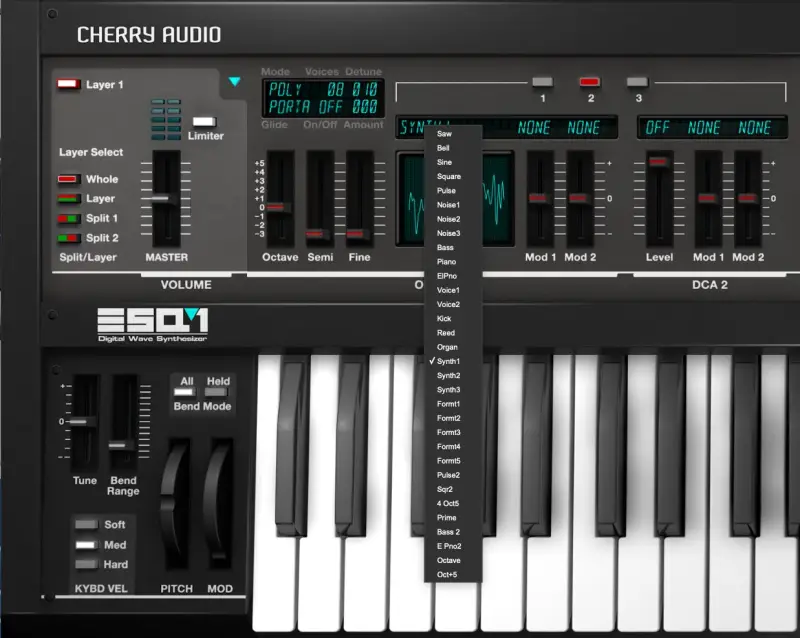
By the mid-1980s, Yamaha’s FM and DX instruments had put crisp digital sounds within reach of more musicians. Ensoniq took another route with the ESQ-1: three digital oscillators, each drawing on a library of 32 waveforms, feed a low-pass filter modeled on the Curtis CEM3379. Traditional saw and square waves are available, but the broader waveform selection opens up more complex tones than a conventional subtractive setup can produce.
The ESQ-1 followed Ensoniq’s 1985 Mirage sampler, a keyboard priced at around $1,500. The company had been founded in 1982, and the Mirage’s comparatively accessible price helped establish its place in the market. The ESQ-1 carried that practical approach into synthesis, combining digital sound generation with a familiar filter stage.
Cherry Audio’s instrument includes the original waveform content and factory patches. It’s also the first product in the company’s catalog to be developed collaboratively with, and receive full endorsement from, Creative Technology Ltd, which owns the rights to Ensoniq’s intellectual property.
Editing that suits a software instrument
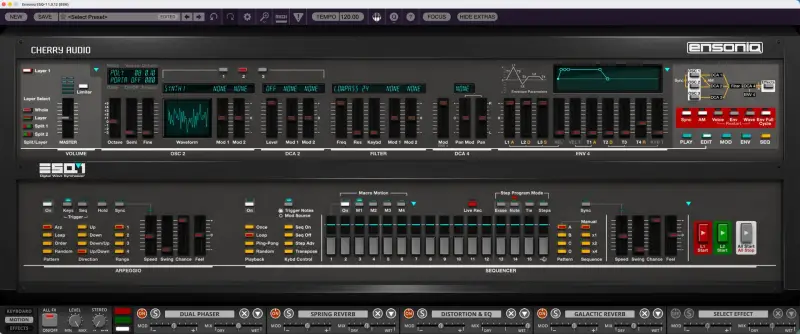
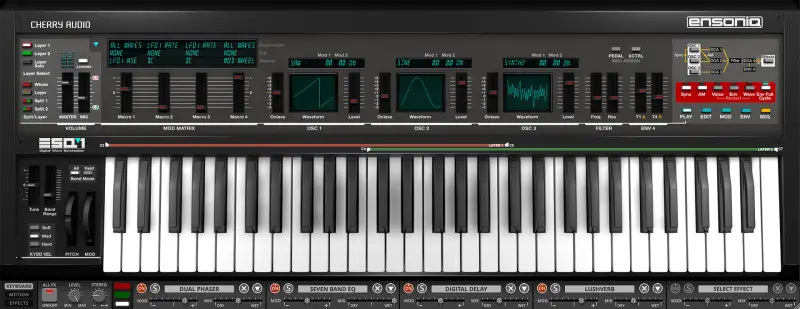
The interface translates the ESQ-1’s dense control layout into a clear, resizable panel. Its turquoise displays, buttons and faders give the instrument a period look, while the standalone version can fill a computer screen. Focus mode enlarges a selected area for detailed editing on smaller displays, with navigation available while zoomed in.
The main view presents the three oscillators and their waveforms. A play button returns to that overview, while dedicated controls on the right provide quick access to each oscillator’s editing layer. From there, waveform selection and modulation are close at hand. The signal path reads from left to right, with the shared filter and the fourth envelope, which controls amplitude, available in the same layer.
Envelope editing goes beyond basic ADSR shapes. The ESQ-1 has four multi-stage envelopes and three LFOs; graphical envelope displays make it possible to see and adjust the shape directly. The modulation matrix offers four slots, with 41 sources and 85 destinations. MIDI CC assignments are quick to make, and MPE support is available for compatible controllers.
Factory sounds and filter character
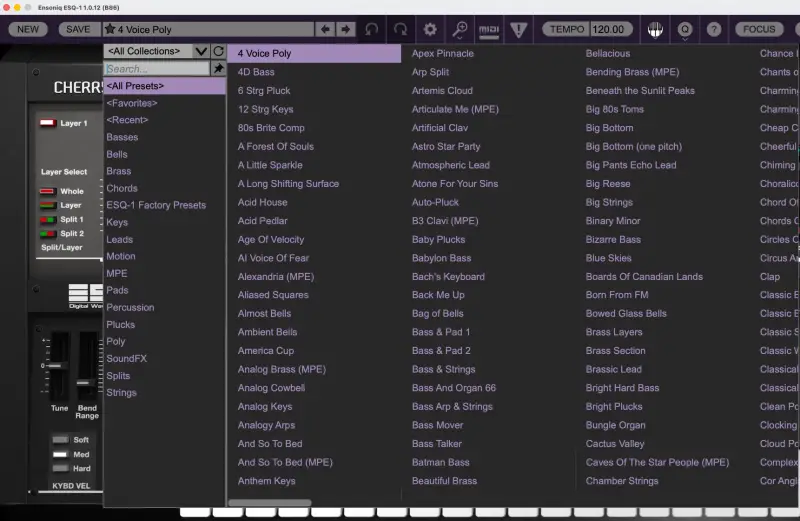
The original preset bank is a useful starting point for hearing the instrument’s range. Bright bells and digital choirs capture a familiar 1980s flavor, while the percussive sounds, pianos, pads and organs have more individual character. Cherry Audio has added its own patches, extending the palette with internal effects, an arpeggiator and a sequencer.
The filter is a particular strength. It switches between 12 dB and 24 dB low-pass modes, as well as high-pass and band-pass operation. The cutoff feels precise, and resonance can add emphasis without the harshness or loss of low end often associated with filters from this period. That response helps the filter shape the ESQ-1’s weightier oscillator sounds while keeping them controlled.
Cherry Audio’s software version also keeps the output clean and ready for production. The original hardware may have had some background noise, but the reviewer’s recollection of that detail is uncertain; the software instrument’s presentation is notably tidy. Its voice architecture adds stereo layering and up to 32-note polyphony, making dense patches more practical to arrange.
A useful alternative to familiar vintage colors
The hardware ESQ-1 had users including Jean-Michel Jarre, Prince, John Carpenter and Roxette, though it was less widely used than some vintage synths as sampling gained ground. That relative obscurity is part of the software instrument’s appeal: it offers a recognizable period sound without simply retracing the most familiar paths.
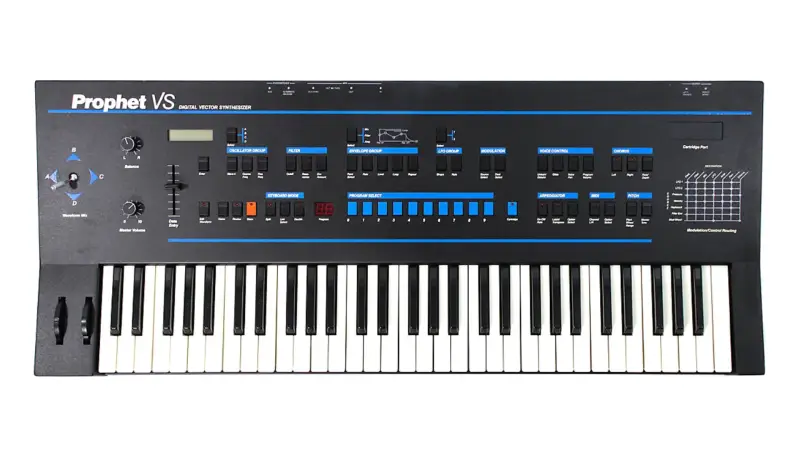
For producers comparing hybrid software instruments, Waldorf’s PPG Wave 3.V brings the PPG Wave to the desktop, while Arturia’s Prophet-VS V offers a related architecture and its own character. Cherry Audio’s ESQ-1 stands apart through its three-oscillator design, modeled Curtis filter and expanded voice options.
At $69, the ESQ-1 is available for macOS and Windows in AU, VST3, AAX and standalone formats. Its specification includes 20 studio-quality effects, three oscillators per voice, four multi-stage envelopes, three LFOs and 32-note polyphony. For a project that needs digital timbres with a more shaped, filter-led edge, it’s a distinctive instrument to have in the session.


