Memory Costs Pressure Camera Makers as Canon Signals Price Increases From 2027
Memory expenses are squeezing camera makers unevenly. Canon plans price increases from 2027, while component shortages are also limiting production.
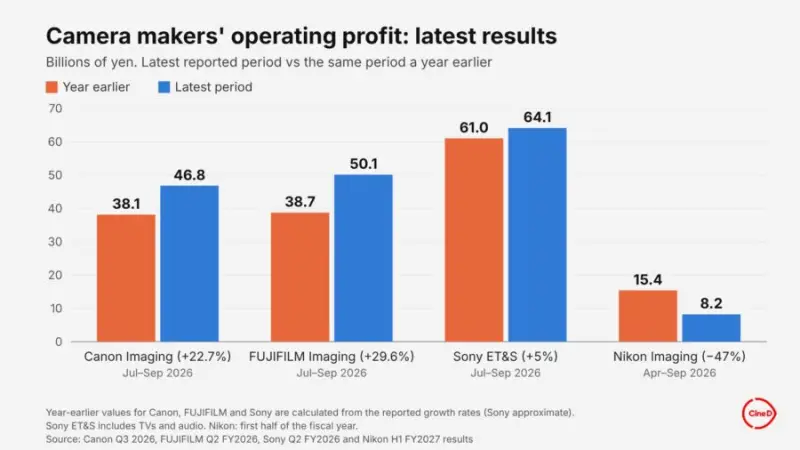
Camera makers are absorbing sharply higher memory costs, and Canon has now said it plans to offset rising procurement expenses with price increases from 2027. The pressure is uneven across the industry: Canon and FUJIFILM report strong Imaging profits, Nikon’s Imaging profit has nearly halved, and Sony’s camera business has held operating income slightly higher despite lower sales.
Memory prices have been climbing for a year, with little near term relief expected. TrendForce projects DRAM contract prices will rise 10 to 15% in the current quarter and NAND prices 15 to 20%, with DRAM increases expected to gather pace in early 2027. Recent company results put concrete figures on the cost, though they don’t establish what buyers will pay for specific cameras.
Canon flags costs and a second supply constraint
Canon’s July to September group sales rose 4.9% to ¥1,158.8 billion (about $7.3 billion), while operating profit increased 10.3% to ¥97.1 billion (about $615 million). Imaging sales grew 16.3% to ¥294.9 billion, and unit operating profit rose 22.7% to ¥46.8 billion. Network cameras supplied much of that growth. Camera sales increased 4% in yen but fell 3.6% in local currencies, and Canon sold 0.62 million interchangeable lens cameras, down 16% from a year earlier.
In the quarter, higher memory prices reduced Canon’s profit by ¥19.8 billion (about $125 million). The company says it secured the memory needed for this year at the expected price, but it does not expect memory or raw material prices to fall next year. Asked about supply and costs in 2027, Canon said its company wide policy is to offset higher procurement costs through price increases from next year onward.
Canon gave no affected camera models or increase percentages. For Imaging, it said memory and Middle East costs reduced the fourth quarter margin by about five percentage points. The company acknowledged that it has not fully passed those costs on through pricing and said persistent increases would be absorbed through price rises. Canon also says it weighs those increases against their possible effect on sales volume.
Printed circuit boards and related electronic parts are adding a separate production problem. Canon says shortages have emerged since August as AI related demand has grown, significantly affecting production operations. Compact camera revenue rose more than 50% in the quarter, but component constraints led Canon to lower its full year compact production forecast. Its interchangeable lens camera forecast also fell, from 2.80 million to 2.75 million units, a change Canon linked to conditions in the Middle East and China.

FUJIFILM quantifies the effect
FUJIFILM provided the clearest memory cost breakdown. Rising prices for semiconductor memory and IT related components affected its Imaging segment by ¥2.5 billion (about $16 million) in the second quarter. Its full year forecast puts the Imaging impact at ¥14 billion (about $89 million), out of ¥25 billion for the group. FUJIFILM plans to counter the expense through pricing measures and alternative materials and components. It has already announced price increases of up to 15% in Japan.

The Imaging segment can currently absorb pressure: revenue rose 11% to ¥162.3 billion (about $1.03 billion), and operating income climbed 29.6% to ¥50.1 billion, a 30.8% margin. But the business mix matters. Consumer Imaging, including instax, grew 22.5%, while Professional Imaging, which includes X and GFX cameras, declined 5.1% to ¥57.7 billion. Excluding currency effects, that segment fell 11.3%. FUJIFILM attributed the comparison in part to strong product launches in the same quarter a year earlier.
Nikon and Sony face different results
Nikon’s Imaging operating profit dropped to ¥8.2 billion in its half year, from ¥15.4 billion a year earlier. The company cited lower revenue and higher memory and other component costs, and reduced its camera sales plan. Nikon expects the full year memory impact to reach the high single digit billions of yen. It says it has secured almost all the volume it needs, including for the next fiscal year.
Sony’s camera business recorded sales of ¥567.8 billion, a small decline, while operating income rose 5% to ¥64.1 billion. CFO Lin Tao described imaging conditions as difficult, mainly because of China, and said new products helped limit the effect of memory costs and lower unit sales. Sony’s image sensor segment produced a different pattern: operating income increased 12% to ¥154.6 billion even as sales fell 6%. Management said the smartphone market was down about 20%, mainly because of memory costs.
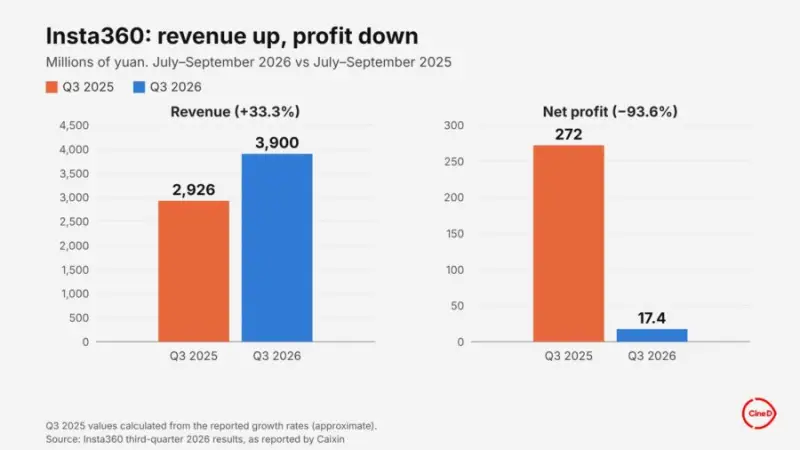
Insta360 offers another example of how cost and expansion can pull against sales growth. Caixin reported third quarter revenue up 33.3% to 3.9 billion yuan, while net profit fell 93.6% to 17.4 million yuan. Spending on new products and expansion weighed on earnings; Chinese reports also cited high memory chip costs and large component stockpiles.
What the reports mean for buyers
Canon has described a pricing policy, and FUJIFILM lists price measures among its responses. Blackmagic Design has already raised prices on 36 products, citing memory costs. None of these updates gives a broad camera price list or specifies which Canon models might change. Products with more memory per unit and tighter margins may face greater pressure, while currency rates will shape how increases translate across regions.
For buyers, the practical signal is the timing and direction of costs, not a confirmed price change on a particular camera. Canon’s 2027 plan remains broad, and component availability is already affecting production. Specific model pricing will become clearer only when manufacturers announce it.


