Steinberg Chromaspheres Turns Your Samples Into Playable Synths
Steinberg’s free Chromaspheres instrument offers four synthesis engines, 30 modes, MPE control and section by section randomisation for HALion Sonic.
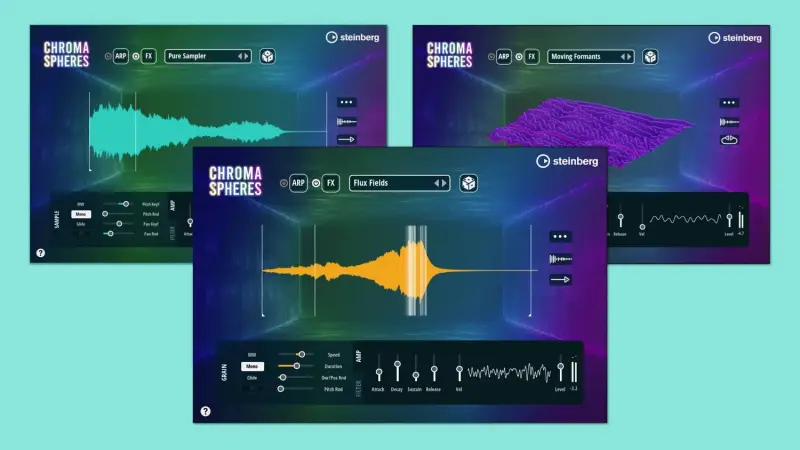
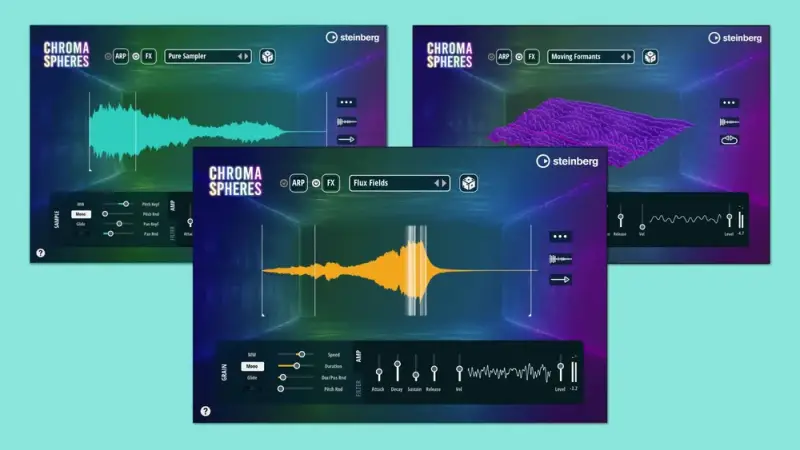
Chromaspheres gives producers a direct route from a recording to a playable instrument: drop in a sample, choose a synthesis approach and shape the result inside Steinberg’s HALion environment. The free instrument marks 25 years of HALion and brings wavetable, granular, spectral and sample playback engines together in one interface. For composers and sound designers, the useful idea is that a field recording, vocal fragment or familiar loop can become the raw material for a patch rather than just another clip in the timeline.
The four engines cover distinct ways of treating that material, with 30 sound-shaping modes distributed across them. Effects including a wavefolder, resonator, EQ, compressor, reverb and delay add further tone and space shaping. A built-in arpeggiator can turn held notes or chords into patterns, while whole-instrument and section-level randomisation make it easier to explore variations without rebuilding a patch from scratch.
Four engines, four ways into a sample
Wavetable mode scans through the loaded recording as a wavetable. Its options include moving formants and retro-style playback, giving the source a path toward shifting, pitched textures. Granular mode divides audio into small grains, a technique suited to stretching a source into pads or scattering it into glitches, noise and other less recognisable material.
The spectral engine works with the frequency content of a recording, with modes that stretch, blur or freeze parts of it into sustained tones. That makes it a practical choice when a brief sound needs to become a longer texture. The sample engine keeps more of the original character intact, then reshapes it with lo-fi colouration, filter modulation and rhythmic movement. Some of its modes add rhythm selection and stepped playback, which can give loops and chops a more structured pulse.
These approaches make the instrument useful at different points in a production. A sound designer can pull a sustained layer out of a short recording, while a composer can use a recognisable source as the basis for a playable part. The source does not have to be a polished sample: field recordings, vocal chops and loops from an existing library are all listed as suitable starting points. The result will depend on the material and chosen mode, so a recording’s character remains part of the sound-design decision.
Randomise a patch while keeping its useful parts
Chromaspheres includes a global randomise function that changes the instrument’s parameters in one step. Parameters can be locked before using it, preserving elements that are already working while other settings change. That gives producers a way to search for a new direction without losing a useful oscillator or effect setup every time they explore.
Randomisation can also target the oscillator, effects or arpeggiator individually. This narrower approach is handy when the basic tone is right but the movement needs work, or when a patch needs a new effects treatment while its source and note pattern stay put. Starting from one sample, users can make related variations by changing one section at a time, then decide which versions deserve more detailed editing.
The arpeggiator adds another source of movement by generating note patterns from held chords or notes. It can turn a sustained patch into a repeating figure and gives the instrument a performance-oriented element alongside its sample-processing tools. The source details do not specify pattern counts or timing ranges, so those capabilities are best assessed in the instrument itself.
MPE and host compatibility
Each of the 30 modes comes with MPE modulation assignments already in place. That means compatible controllers can provide per-note expression without requiring users to map those controls manually for every mode. Steinberg names the Roli Seaboard, Expressive E Osmose and Ableton Push 3 as examples of devices that can respond to those assignments.
Chromaspheres runs inside the free HALion Sonic Player, so a full HALion licence or Cubase is not required. It supports hosts that can load VST3, AU or AAX plug-ins, making it an option for users working in other DAWs as well. The reported system requirements are 64-bit Windows 10 or Windows 11 version 21H2 or later, and macOS 11 or later, with native Apple Silicon support.
The instrument requires 260 MB of disk space, in addition to the free HALion Sonic Player if it is not already installed. A Steinberg account and an internet connection are required to download, register and activate the licence. For existing HALion Sonic users, that makes trying the instrument a modest setup task; anyone new to the player will need to install it before loading Chromaspheres in a host.
A free tool for getting more from existing audio
Chromaspheres follows Steinberg’s X-Stream spectral instrument, which also worked from imported audio. Its appeal is the combination of several synthesis treatments with a playable instrument workflow: the sample becomes something to perform, modulate and sequence, rather than remaining a static source. The included effect section and arpeggiator let users develop a sound inside the same instrument, while selective randomisation supports quick exploration.
Steinberg has shared audio examples in its Chromaspheres sound collection. The instrument is available as a free download from Steinberg. For producers looking to turn recordings already on hand into playable parts, the best starting point is a source with some distinctive character; the engine and mode choices then determine how far that character travels.


