HONOR Magic9 Pro Max Brings ARRI LogC3, APV 4:2:2 and Dual 200MP Cameras to Global Markets
The Magic9 Pro Max starts its global rollout in Malaysia with 4K60 LogC3, APV 10-bit 4:2:2 and a new phone video accessory range.

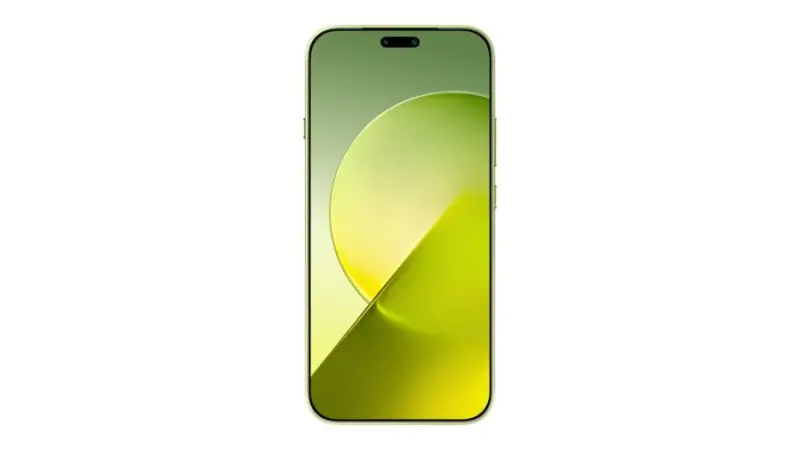
The HONOR Magic9 Pro Max pairs a phone camera system with a LogC3 workflow aimed at crews that want footage ready for a color-managed edit. Its international rollout begins in Malaysia, with other markets expected to follow in the coming weeks. The core draw for video makers is ARRI CINEMA Mode: up to 4K at 60fps, encoded in ARRI LogC3 and ARRI Wide Gamut 3, with 10-bit color and APV recording at 4:2:2.
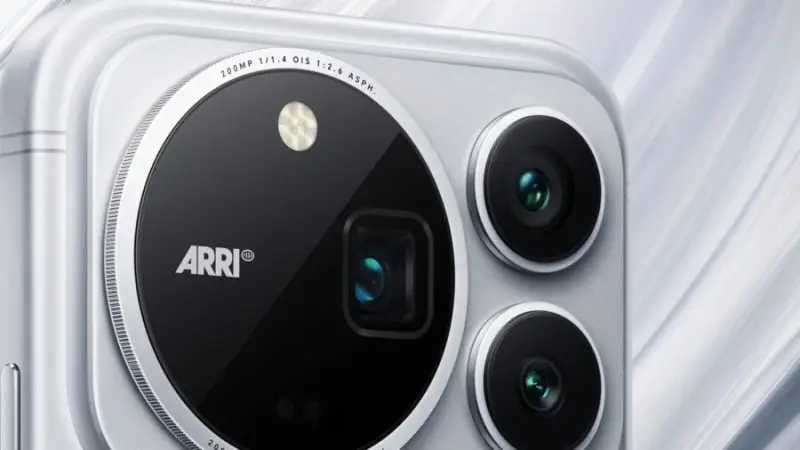
ARRI’s role is focused on color management. The collaboration covers sensor calibration, LogC3 encoding and ARRI Looks; HONOR supplies the optics, sensors and image processing. That distinction matters when weighing the phone’s cinema workflow: its color tools are designed to fit familiar LogC3 grading practices, while its imaging hardware remains HONOR’s.
LogC3 capture and APV editing
LogC3 connects the phone’s footage to conversion LUTs and color-managed timelines already used with the ALEXA Mini and AMIRA generation. ARRI CINEMA Mode gathers exposure, focus, frame rate, codec and monitoring controls in one interface. For compact B-roll, inserts or behind-the-scenes coverage, that should make it easier to keep phone footage in a post-production workflow built around LogC3.
HONOR records the mode’s footage in APV, a 10-bit 4:2:2 codec supported by the Snapdragon platform. HONOR says APV files can use about 20% less storage than ProRes at a similar image-quality target, though the result depends on settings and test conditions. LumaFusion for Android and DaVinci Resolve support APV decoding; Adobe Premiere does not currently support it, a practical compatibility gap for editors working across applications.
The phone offers 14 built-in ARRI Looks: two conversion Looks and 12 stylized options. They can appear as a live preview while recording LogC3 or be applied directly to the recorded image. The ARRI Look Library adds 87 predefined grades, and third-party LogC3 LUTs are supported. That gives users a choice between keeping footage flexible for grading and committing to a look during capture.
Three rear cameras, two with 200 megapixels
The main camera combines a 200MP 1/1.28-inch sensor with an f/1.57 lens, optical image stabilization and what HONOR describes as 3-degree gimbal-level stabilization. The 200MP telephoto camera has a 1/1.4-inch sensor, an f/2.6 lens and OIS. HONOR rates both at CIPA 8.0 for stabilization. A 50MP ultra-wide camera with an f/2.0 lens rounds out the rear array.
There are limits to which cameras work in the cinema workflow. The ultra-wide was unavailable in ARRI CINEMA Mode during the phone’s first look, and the mode tops out at 4K60. Other supported video modes reach 4K120. On the front, a 55MP f/2.0 camera uses a square sensor, allowing users to record with the phone upright and reframe for vertical or horizontal deliverables afterward.
Processing runs on HONOR’s Imaging Chip H1, built on a 6nm process and rated at 18.8 TOPS/W. HONOR says it performs real-time AI noise reduction in the RAW domain. Its own test data claims an 8dB signal-to-noise improvement and up to 14 stops of dynamic range; those figures have not been independently measured in a lab.
Short clips, color matching and onboard audio
Cinematic LiveVideo captures a three-second clip when the shutter is pressed and held. It records at up to 4K in either 16:9 or 2.39:1, with the selected ARRI Look applied and an optional ARRI watermark. Magic Color for Video takes a reference clip’s color treatment and applies a matching look to new footage, offering a way to keep shots visually consistent across a sequence.
For sound, HONOR combines one directional microphone with three omnidirectional microphones. The company says its Cinematic Directional Microphone can isolate a selected source from as far as 20m / 66ft and reduce sound outside a ±60° range. Four directional presets and a custom mode target uses such as interviews, performances and location recording. The tradeoff for field work is that manual audio-level control isn’t available in any video mode.
Accessories extend the phone rig
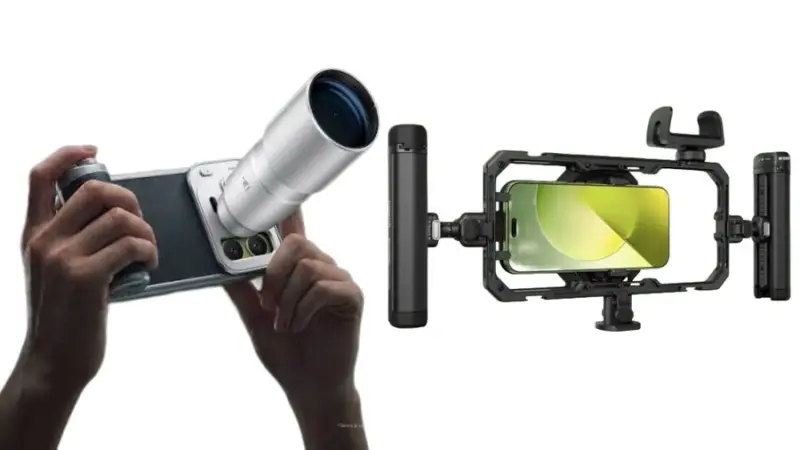
HONOR is launching several optional tools alongside the phone. The Teleconverter G200 is a 200mm add-on lens measuring about 81mm / 3.2in and weighing about 88g / 3.1oz. HONOR calls it the smallest and lightest 200mm smartphone teleconverter. The G500 offers a 500mm equivalent focal length, which HONOR describes as the longest available on a smartphone teleconverter, for subjects such as stage performances and wildlife.
The SmallRig Mobile Video Kit is a cage with mounting points for filming accessories and includes a cooling accessory for longer recordings. HONOR is also offering a handheld smart gimbal and an external mini-gimbal. Together, these options provide a path from a pocketable camera setup to a more supported rig, though the available details don’t specify accessory pricing.
Display, design and system details
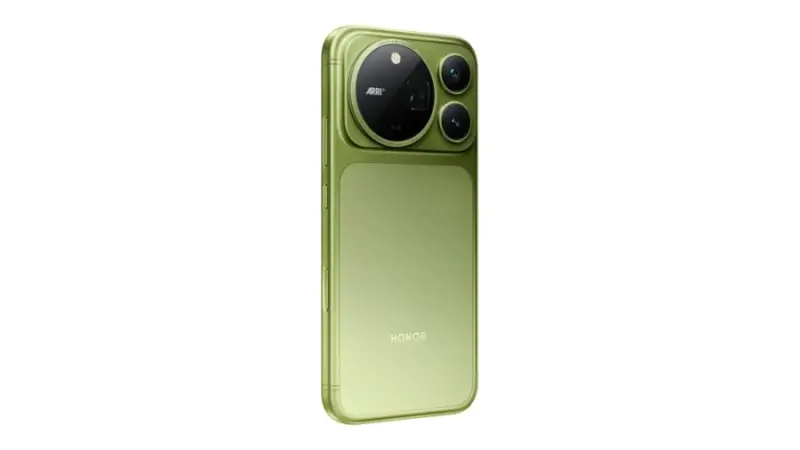
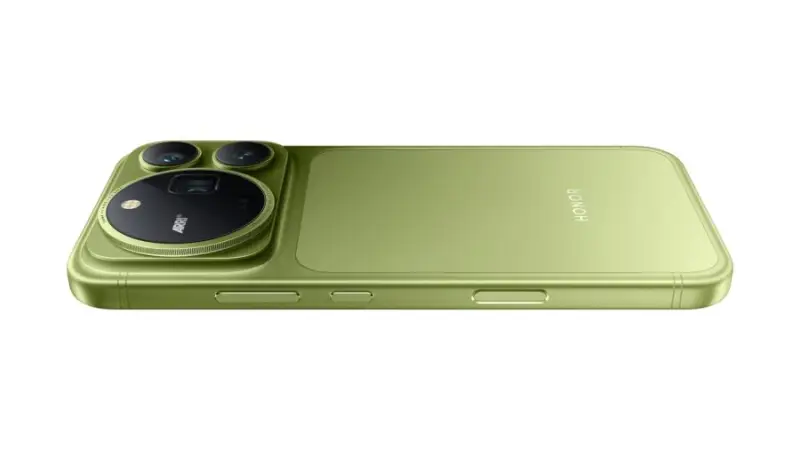
The 1+2 rear camera layout takes visual cues from the three-lens turret of ARRIFLEX cameras, which date to 1937. The all-metal body measures 161.64 x 76.98 x 8.59mm / 6.36 x 3.03 x 0.34in, weighs 233g / 8.2oz and carries IP68, IP69 and IP69K water and dust ratings.
Its 6.8-inch LTPO OLED screen has a 1320 x 2868 resolution, a 1 to 120Hz refresh rate and 100% DCI-P3 coverage. HONOR lists 4,320Hz PWM dimming, up to 10,000 nits peak brightness, 2,000 nits full-screen brightness and 1.5% reflectance. The anti-reflective coating and HONOR Anti-Scratch NanoCrystal Shield support its role as an on-camera monitor; for outdoor viewing, the stated reflectance is especially relevant.
The global specification lists a 2nm Snapdragon 8 Elite Extreme Gen 6 processor with a Qualcomm Oryon CPU running up to 5GHz. Its silicon-carbon battery is listed at 8,000mAh typical and 7,745mAh rated, with 100W wired and 80W wireless HONOR SuperCharge. MagicOS 11 is based on Android 17. A dedicated AI Button opens HONOR’s AI agents, Google Lens and Gemini, while HONOR Connect supports file sharing with Insta360 devices and the AirDrop framework.
Availability and workflow caveats
In Malaysia, the Magic9 Pro Max is priced at RM5,999 (about $1,460 / €1,330 at current exchange rates) for 24GB RAM and 512GB storage. HONOR includes 12GB of HONOR Turbo RAM in the 24GB figure, making this the global-spec 12GB+512GB configuration. Colors are Shadow Black, Glacier Silver and Moss Green. Pre-orders in selected regions run from November 24 to December 3, 2026.
HONOR has not announced prices for other markets. The phone won’t be available in the US, and European distribution is planned for 2027 without an exact date. Battery capacity also varies by region: the Chinese model has 8,800mAh, compared with 8,000mAh typical on the global specification. For video crews, the immediate decision is whether LogC3, onboard Looks and APV fit their post pipeline—and whether the current camera-mode and audio-control limits suit the shots they need to capture.


