Music First Audio LP103 LCR: Transformer MC Input and LCR RIAA
The £8,760 LP103 LCR pairs transformer MC gain with a discrete Class A stage; listening tests found strong detail, dynamics and cartridge flexibility.
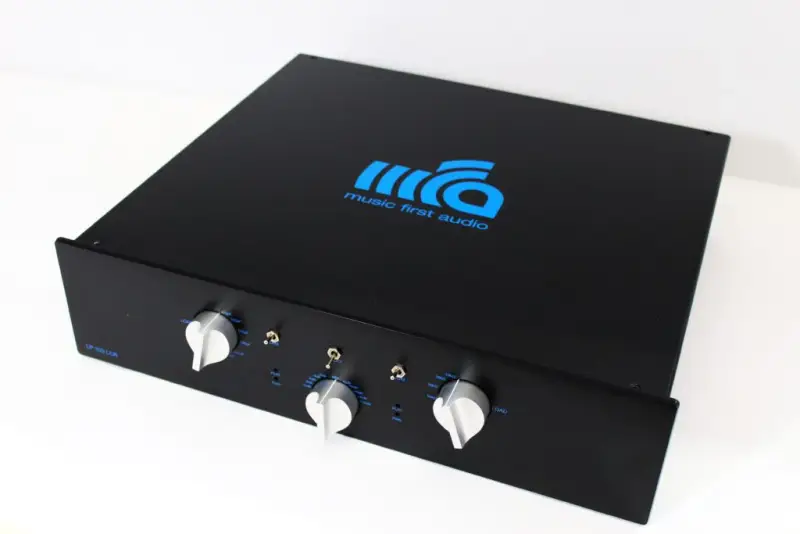
Music First Audio’s LP103 LCR combines a transformer-coupled moving-coil input with a discrete Class A phono stage. That arrangement gives cartridge matching a central role: three transformer gain options work alongside adjustable resistive and capacitive loading, while a front-panel control trims active gain. At £8,760, it’s a substantial investment, but the design and listening results make a clear case for auditioning it with both moving-coil and moving-magnet cartridges.
The UK company draws on its transformer-making background. Owner Jonathan Billington also runs Stevens & Billington, the transformer specialist founded by his father and C St John Stevens in 1963. The LP103 LCR’s transformer expertise is paired with active-stage design by Thorsten Loesch. Music First Audio also makes transformer-based preamps, and its Reference SUT MC step-up transformer provided a useful point of comparison for the LP103’s input design.
Transformer input, discrete Class A circuitry
The moving-coil input transformer feeds the active gain stage; moving-magnet signals go directly to that stage. The circuit is a fully discrete Class A design with a J-FET first gain stage and 600-ohm LCR RIAA equalisation. Separate dual-mono power supplies serve the dual-mono circuit. Component choices include Nichicon Muse KZ and ES capacitors, plus WIMA FKP and MKP film capacitors.
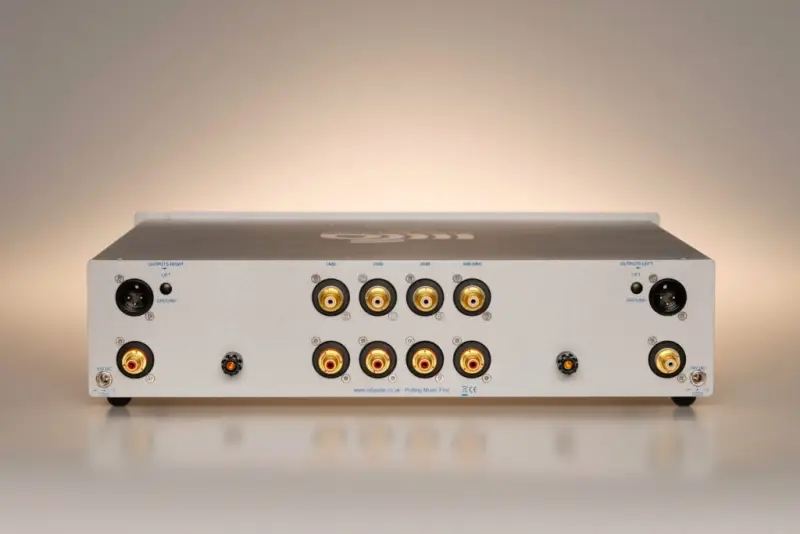
At the front, a central rotary control adjusts active gain by ±10dB in 2dB increments, covering 30dB to 50dB. The MC transformer adds a selectable 14dB, 20dB or 26dB. A mono button, 12dB setting and full mute round out the front-panel controls. Connections are non-balanced as standard, with balanced connections available to special order.
The MC transformer is close in design to the one in Music First Audio’s Reference SUT, though it has three secondary taps instead of four. It uses a large-bobbin EI core, with laminations made from 80% nickel and 20% iron. Billington says the reduced tap count allows more room between copper windings. Paper interleaving between the plates is intended to limit saturation and eddy currents, which can degrade performance.
Loesch’s choices in the active circuit reflect a focus on its first stage, where noise performance is set. He told the reviewer that J-FETs are “hard to outperform in the first stage” and described their electrical parameters as more tube-like than those of bipolar transistors. Their lower bias-current requirement also offers the option of removing the input coupling capacitor. Loesch kept one in this design, explaining that removing it usually requires a replacement elsewhere, and that the extra circuitry can add more distortion and noise than the capacitor. The J-FET stage allows a lower-value capacitor, making a higher-quality part practical; bipolar transistors handle the later gain stages.
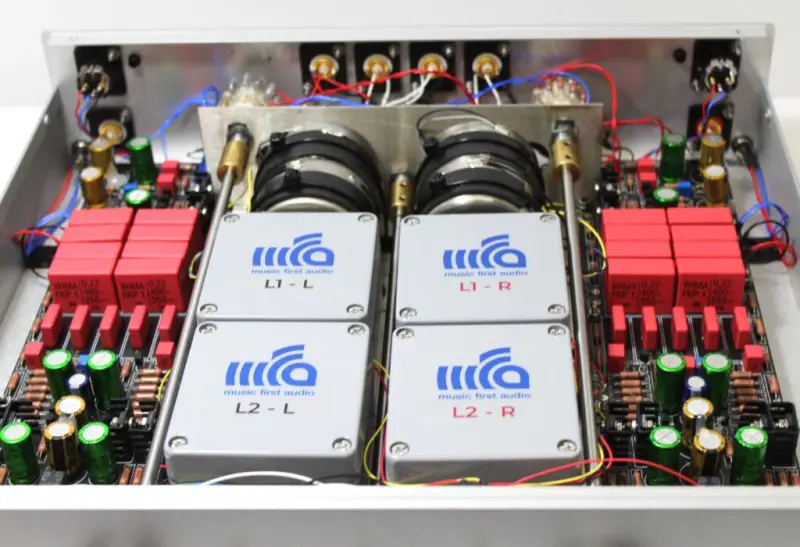
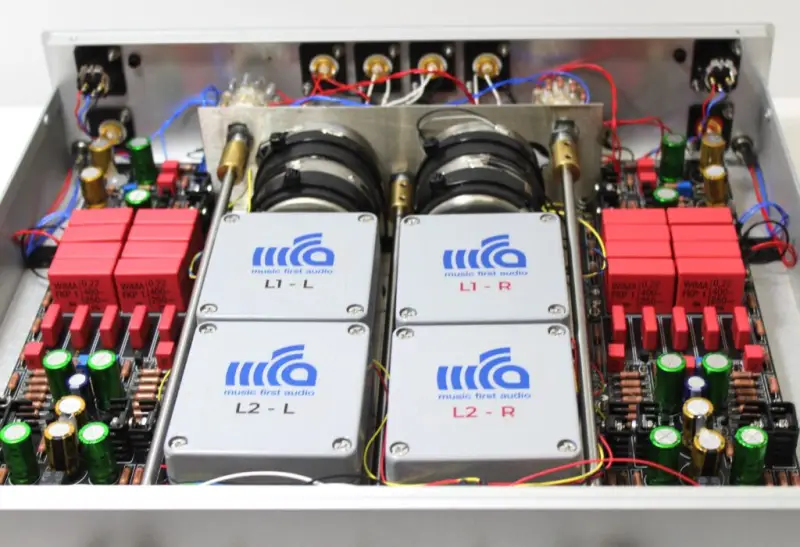
The RIAA network uses custom-wound inductors because the required 1.8 Henry and 45mH values weren’t available off the shelf. Music First Audio winds them in-house. They sit in four large cans visible inside the unit, ahead of the two transformers.
Loading and cartridge setup
Left and right front-panel rotary controls set capacitive loading. The available range is 1.175nF to 188nF for moving coils and 47pF to 470pF for moving magnets. The resistive control offers 10kΩ, 20kΩ, 30kΩ, 50kΩ, 70kΩ and 100kΩ settings. Those markings don’t correspond directly to the load seen by a cartridge on the MC input: the effective load changes with transformer gain. At the 10kΩ setting, for example, the 14dB, 20dB and 26dB inputs present 25Ω, 100Ω and 400Ω respectively. The manual includes a table to translate the settings.
That interaction means it’s worth setting gain and load together. Start with the cartridge maker’s recommended resistive load, then try values above and below it and listen. The reviewer found that changing the gain input could also change the preferred result, even with the same cartridge.
Listening with Hana and Audio Note cartridges
The listening setup used an Audio Note TT3/PSU3 turntable with an Arm Two tonearm. The main cartridge was a Hana Umami Black, rated at 0.3mV output and suited to a load around 200Ω. An Audio Note Io1, with roughly 0.04mV output and a preference for low load impedance, provided a second test. The system also included a Viva Solista single-ended integrated valve amplifier, Fyne Audio Vintage 10 speakers with SuperTrax super-tweeters, and MusicWorks mains equipment and cables.
A separate phono stage retailing for around £6,000 served as the reviewer’s reference. With the Hana connected to the LP103 LCR’s 20dB input and loaded at 200Ω, the reviewer heard Dee Dee Bridgewater’s vocals on “It’s Your Thing” from Christian McBride’s Conversations as more open and articulate than through the reference. McBride’s bass was described as tighter and more clearly shaped, with better definition in the lowest notes.
On “Omission”, from Julian Lage’s Speak To Me, the LP103 LCR brought out the attack and chord definition of Lage’s guitar. The reviewer also found the acoustic and electric guitar timbres easier to distinguish, with a tighter bass line and more audible detail in the drumming and cymbals. The reference phono stage sounded sweet, but the reviewer felt it softened the rhythm.
Larry Carlton’s version of “Minute By Minute” from Discovery showed a similar pattern. The LP103 LCR made the playing’s detail more apparent, gave the bass line greater authority, separated the backing vocals more clearly and lent Kirk Whalum’s sax more bite and body. On Billington’s suggestion, the reviewer then tried the Hana on the 26dB transformer input and reset the load for that setting. The higher-gain option brought a further improvement in the reviewer’s assessment, particularly in vocal openness, bass focus and rhythmic drive.
The Audio Note Io1 went through the 26dB input with a 75Ω load. Despite its very low output, the LP103 LCR produced no audible noise in the reviewer’s test. The result was described as detailed, dynamic and musical, and as the best performance that cartridge had delivered with a separate phono stage to date.
Specifications and price
The LP103 LCR is a moving-magnet and moving-coil phono amplifier. Its MM gain is 40dB ±10dB in 2dB steps, with MC transformer gain of 14dB, 20dB or 26dB. Maximum output is +26dBu (15.5V); output impedance is below 100 ohms. The published signal-to-noise figures are greater than 70dB unweighted at 1V output and 40dB gain, and greater than 78dB A-weighted. Total harmonic distortion is listed as greater than 0.003% at 1V output and 40dB gain, while RIAA accuracy is ±0.2dB.
Listed MC load impedance ranges from 25Ω to 4kΩ depending on the selected input gain. MM loading is specified as 15kΩ to 100kΩ and 10pF to 470pF. The chassis measures 41.2cm wide, 10.4cm high and 41.5cm deep, weighs 8kg, and comes in black or silver. The UK price is £8,760; international pricing is available on application. Further product information is available from Music First Audio.
My read is that the LP103 LCR’s appeal lies in how its transformer choices, loading controls and quiet active stage work together. Its flexibility rewards careful setup, and the reviewer’s results with both cartridges suggest it deserves to be heard with the cartridge you actually own.


