Panasonic LUMIX AU-SHX1: Blackmagic RAW, ND Choices and What Comes Next
Panasonic explains the SHX1’s cinema and live workflow, its external ND approach, and what it can share about future LUMIX cameras.

The LUMIX AU-SHX1 is designed to bridge camera work that often calls for separate tools: compact cinema shooting, mobile video production and multi-camera live setups. Panasonic’s imaging chief, Toshiyuki Tsumura, describes it as a new product concept built from the company’s LUMIX camera experience and professional AV know-how. The choices behind it help explain who Panasonic expects to use the camera—and why some familiar features, such as an internal ND filter, didn’t make the cut.
Tsumura is Managing Executive Officer in charge of AVC Business and Director of Panasonic’s Imaging Solution Business Division. He says the SHX1 took roughly two years to develop, following the integration of Panasonic’s professional AV and LUMIX businesses in 2024. That change gave the camera team more direct input from live production crews and film professionals, alongside consumer creators. Panasonic says it gathered feedback from more than 100 creators during development.

One body for cinema, mobile work and live production
Panasonic’s central idea is a box-style camera that can be configured for very different jobs. Add a grip and vari-angle monitor, and the SHX1 can be handled more like a mirrorless camera for lightweight cinema or creator work. In a fixed setup, its expandable body, professional connections and remote-control options are intended to fit production and broadcast workflows.
The camera brings together phase-detection autofocus and in-body image stabilization in a form Panasonic says is new to its lineup. For cinema work, it records ProRes RAW and Blackmagic RAW, and ARRI LogC3 is pre-installed following Panasonic’s first collaboration with ARRI. Tsumura says this lets the camera serve as a B-camera alongside ARRI systems, and in some situations shoot full scenes using the ARRI look. The camera also retains Open Gate capture, which can give productions more room to reframe footage for vertical delivery.
For live production, Panasonic points to the SHX1’s interfaces, multi-camera support and remote-camera capabilities. Low latency was a design priority for both live output and focus pulling. The camera can also be integrated with Panasonic’s KAIROS switcher systems, extending its role beyond a standalone cinema body.

Why Panasonic chose stabilization over internal ND
The SHX1’s lack of a built-in ND filter is one of its clearest trade-offs. Tsumura says Panasonic considered internal ND carefully, but fitting it alongside in-body image stabilization in the desired compact body proved difficult. Feedback from creators put stabilization high on the list, so the company gave it priority.
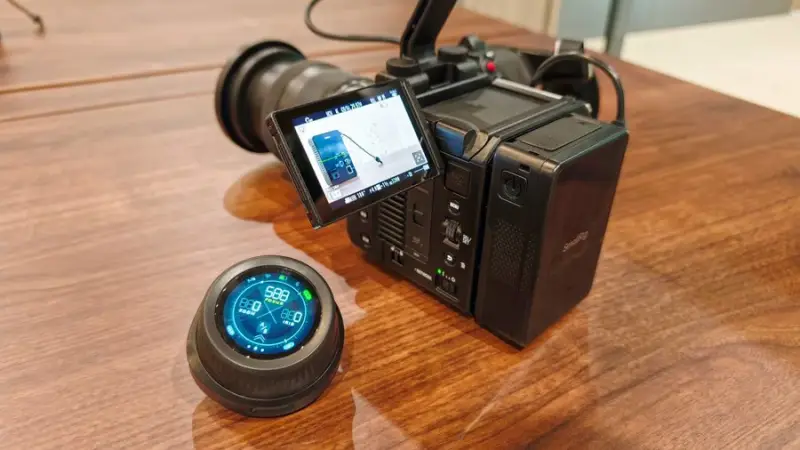
Panasonic’s answer is an external variable ND system developed with Tilta. The accessory was introduced alongside the camera and can be controlled from the SHX1’s body controls, according to Tsumura. The aim is to adjust ND in the same way an operator changes shutter speed or iris, while retaining the camera’s stabilization. That arrangement adds an accessory to the rig, so buyers weighing the setup will need to consider how often they use ND, how they build their camera package and whether an external filter suits their shooting style.
Blackmagic RAW goes to SSD
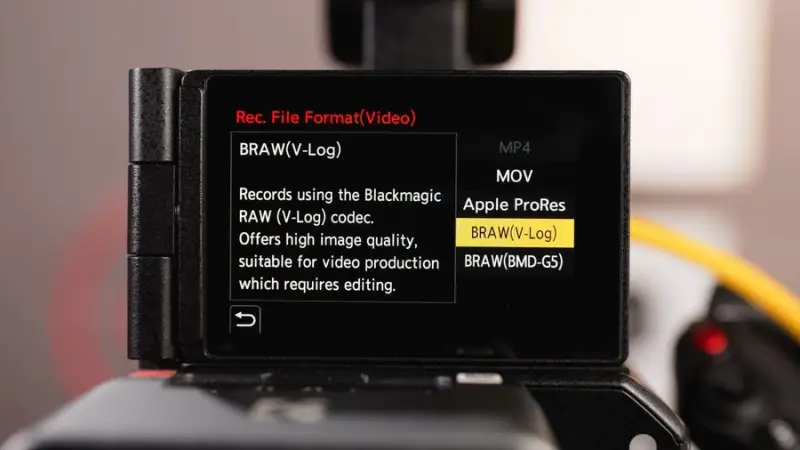
Blackmagic RAW recording on a camera outside Blackmagic’s own range is a first, Tsumura says, and Panasonic developed the feature in close cooperation with Blackmagic. On the SHX1, Blackmagic RAW records directly to an external SSD. Proxy files go to the internal CFexpress Type B card, giving editors a separate media path for lower-bandwidth files.
That division can help organize a post-production workflow, but it also means users planning to shoot Blackmagic RAW need to account for external storage and its connection to the camera. Panasonic has heard requests for internal Blackmagic RAW recording and says it is continuing to work on the possibility for future development. Tsumura did not commit to a release or timeline.
A new line, with a different brief from the S1II
Panasonic does not position the SHX1 as a replacement for VARICAM or EVA models. Tsumura calls it the first step in a new initiative, combining knowledge from those professional lines with LUMIX mobility and image quality.
Its recording specifications may look close to those of the LUMIX S1II, but Panasonic says the SHX1 is built around a different job: professional and semi-professional creators moving into more demanding production. Although both cameras have 24-megapixel resolution, the SHX1 uses a new sensor with an optical low-pass filter. Panasonic tuned noise reduction for V-Log and ARRI LogC3 to retain fine detail while reducing moiré, drawing on experience from both VARICAM and the LUMIX S1H.
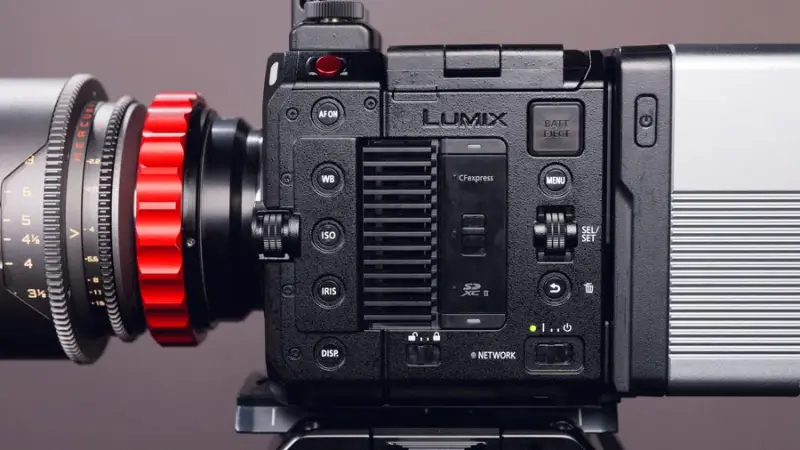
Other distinctions include Blackmagic RAW, an improved Open Gate mode, 12G-SDI output, timecode input and V-mount battery support. The body is designed for heat dissipation during extended operation. Tsumura says it has no recording time limit, including when recording at 4K 120p, whereas the S1II has a recording time limit. The SHX1 also supports 32-bit float recording through its microphone input, a first for Panasonic, which the company says prevents clipping in the camera’s audio recording.
Those features give the SHX1 a broader production role than a mirrorless camera in a box. Its connections and power options are aimed at professional sets, while stabilization, autofocus and the vari-angle monitor keep it usable for mobile work. Tsumura’s pitch rests on that range: different recording formats, an adaptable body and support for both film-style and live workflows.
Where Panasonic sees its advantage
Asked why a buyer might choose the SHX1 over cameras in a similar price bracket, Tsumura highlighted three areas. The first is format choice: V-Log, ARRI LogC3, ProRes RAW and Blackmagic RAW let teams match capture to their preferred workflow. The second is the combination of compact dimensions, stabilization, autofocus and vari-angle monitoring with recording that can continue without a time limit, including at 4K 120p.
The third is live production. Panasonic says the SHX1 can slot into KAIROS systems and offers 12G-SDI, multi-camera support and remote operation. For crews who need one camera for more than a conventional cinema rig, these connections may matter as much as the image formats. They also make the SHX1’s expandable body easier to understand: the box shape is meant to accommodate both mobile shooting and a built-out production setup.
Tsumura says Panasonic wants the camera to help creators take on work beyond the limits of their current equipment or shooting environment. He also describes ongoing services, support and third-party options as part of the company’s responsibility after purchase. That emphasis reflects the product’s wide brief: the camera is intended to grow into different rigs and jobs rather than serve one narrowly defined production style.
Future LUMIX cameras: S9 and Micro Four Thirds
On the possibility of a LUMIX S9 successor with an electronic viewfinder, Tsumura explained that Panasonic designed the S9 for people moving from smartphones and shooting with the rear monitor. The camera has found an audience, but Panasonic has also heard repeated requests for a viewfinder for more serious photography and video work. More than two years have passed since the S9’s release, and Tsumura said the company is working to meet customer expectations. He offered no firm details about a successor or its timing.
For Micro Four Thirds, Tsumura described the GH7 as a complete camera that continues to attract both existing fans and new buyers. He pointed to the system’s compact bodies and lenses, wide lens selection, unlimited recording and smaller telephoto options as reasons it remains distinct from Panasonic’s full-frame L-Mount cameras. He declined to discuss a potential GH7 successor, while reaffirming that Micro Four Thirds remains important to the company. Panasonic sees having distinctive products in both formats as a strength.
Firmware changes and Panasonic’s approach to AI
Independent programmers have begun modifying camera firmware with AI-assisted tools, opening up functions that manufacturers may not provide. Tsumura said Panasonic understands why users rewrite firmware to change how their cameras work, and recognizes that the practice may be difficult to stop. He cautioned that unofficial changes can affect reliability, safety and security, and said Panasonic cannot recommend them.
His preferred route is for Panasonic to develop AI in-house, with the goal of supporting customer workflows and improving image quality. He also asked users to share the features and improvements they want. In his view, Panasonic’s role is to respond through ongoing firmware updates, making customer feedback part of the camera’s development after release.
The SHX1’s defining choice is its attempt to carry cinema and live production features in a body that can still move between rigs. Buyers will need to decide whether the SSD-based Blackmagic RAW workflow and external ND setup fit their work. Panasonic’s answers on future models remain open, but the company’s direction is clear: build around specific creator needs, then keep refining the tools through feedback and firmware.


