Sound Radix POWAIR 2 Adds True-Peak Limiting and Delta Ducking
POWAIR 2 adds limiting, clipping and Delta Ducking to its loudness workflow. Early access costs $129, with a $29 upgrade for POWAIR 1 owners.
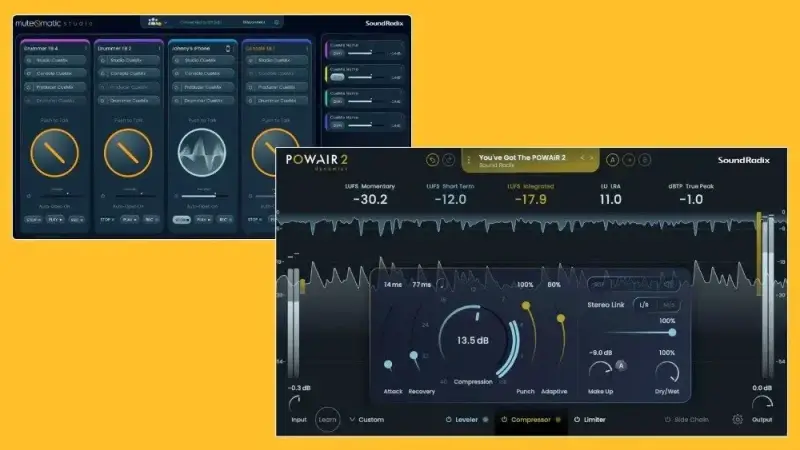
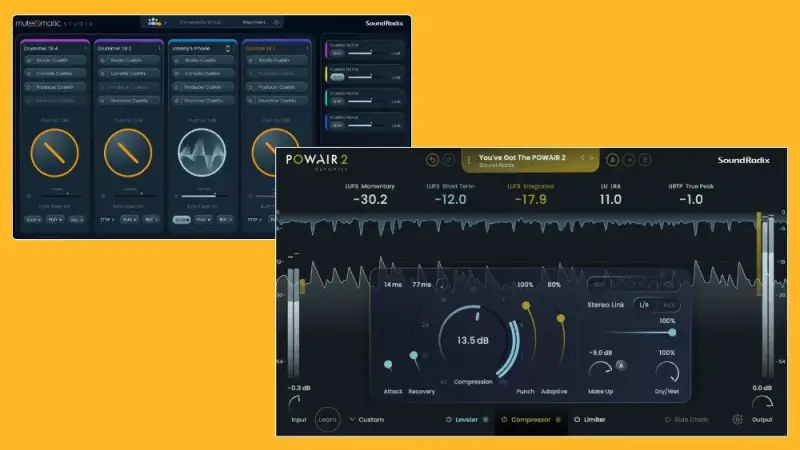
POWAIR 2 expands Sound Radix’s loudness and dynamics toolkit into a longer processing chain: automatic levelling, compression, clipping, saturation, true-peak limiting and metering all sit in one plugin. The additions that most change its use are the true-peak brick-wall limiter and Delta Duck, a side-chain mode that keeps the processed material at a set level below the key signal.
The new version is available for $129 during early access, compared with a regular price of $199. Owners of POWAIR 1 can upgrade for $29 during early access; that price rises to $49 afterward. Existing presets from POWAIR 1 load without conversion, which should make it easier to check the new processing against established sessions.
From loudness control to a fuller dynamics chain
The Leveler rides the signal toward a chosen LUFS target, handling longer-term changes in level while the compressor responds to faster dynamics. Separate Range and Integration Time controls set how far and how quickly it adjusts level, with a Link option for tying the settings together. Its noise-floor modes offer Soft with attenuation, Hold and Off. On Click Learn can set Input Trim, noise-floor threshold, Range and Integration Time from a representative passage.
Leveler Automation writes the level adjustments into the DAW as automation and can read that automation back. That gives engineers a way to inspect or edit the ride in the session, rather than treating level correction as an invisible process inside the plugin.
The compressor adds a Punch control for shaping transients independently of Attack time. Adaptive Compression is designed to maintain average compression across a performance, which may help when a source’s level changes over time. These controls sit alongside the Leveler, so the intended workflow can divide slower level movement from quicker dynamic shaping.
For peak control, the true-peak limiter has an adjustable ceiling in dBTP and offers Auto or Manual recovery. Its recovery behavior is divided into transient and sustain envelopes. A Maximizer can drive the signal into the Clipper, which now includes Knee and Saturation Drive controls. Those additions provide further ways to manage peaks and add saturation within the same processing path; the available details don’t specify a particular tonal result, so the useful test is how the controls behave on the material in a session.
Delta Duck and delivery targets
Delta Duck adds side-chain ducking with a defined level relationship: it holds the processed material a set target delta below the key signal. That makes it relevant to situations where one source needs to remain consistently beneath another. The target-based approach gives the engineer a level relationship to set, while the actual result will depend on the source, side-chain feed and chosen settings.
POWAIR 2 includes loudness target presets for 26 delivery standards. The list includes EBU R128, ATSC A/85, Netflix, Spotify, Apple Music, YouTube, AES TD1008 and podcast standards. Each preset sets a LUFS target and a true-peak ceiling. For reference, the plugin meters Momentary, Short-Term and Integrated loudness, LRA and True Peak to BS.1770 and EBU R128.
Latency options include Live at zero latency, plus 10, 25 and 50 ms modes. Processing runs at 2x oversampling and 64-bit double precision. These details matter when deciding where POWAIR 2 fits: a zero-latency mode is available for live use, while the longer lookahead choices offer different operating points for mix or mastering work. The source specifications don’t give performance figures for each mode, so engineers should check the plugin in their own sessions and system setup.
The preset compatibility and automation support give current POWAIR users practical reasons to evaluate the update in existing projects. The larger question is whether its expanded chain suits the way a studio already handles loudness. Some engineers may value keeping several stages and meters together; others may prefer separate processors they already know. POWAIR 2 places more of those jobs in one instance, but that alone won’t determine which approach is right for a particular mix.
MuteØmatic Studio and the bundle
Sound Radix has also released MuteØmatic Studio, a paid expansion of the original Muteomatic talkback-muting plugin. It adds flexible routing for talkback microphones and cue mixes, voice levelling, cue dimming and mobile connectivity through a companion app for phones and tablets. The system is designed to bring studio communication functions into the DAW workflow, extending the original plugin’s automatic talkback control.
Both new products are included in Radical Bundle 5, a seven-tool collection priced at $699. The current bundle price is $529, compared with $1,323 for the tools bought separately. The bundle includes Radical1, MuteØmatic Studio and POWAIR 2, alongside Auto-Align 2, Auto-Align Post 2, Drum Leveler, Muteomatic, Pi and SurferEQ 2.
For a POWAIR 1 owner, the early-access upgrade price makes the decision hinge mainly on whether the added limiter, clipper and Delta Duck fit the work at hand. For studios considering several tools, the bundle brings a wider set of alignment, level, EQ and communication functions under one purchase. The practical next step is to compare POWAIR 2 with the processors already trusted in a session and check how its latency modes and automation behave in the DAW.


